Not What It Seems: Going deeper into Ugandan Orphanages
In this short video, Amanda Thorsteinsson documents the proliferation of orphanages in Uganda and the role of well-intentioned Westerners in contributing to this problem.
In this short video, Amanda Thorsteinsson documents the proliferation of orphanages in Uganda and the role of well-intentioned Westerners in contributing to this problem.
The Child Welfare Policy Manual, issued by the U.S. Department of Health and Human Services, Children’s Bureau, contains policy questions and answers applicable to child welfare programs operated by the Children's Bureau.
This handbook authored by the World Health Organization Europe and Liverpool John Moores University – based on a series of interviews with the world's leading experts on preventing child maltreatment – provides practical information to policy-makers, practitioners and others on implementing prevention programmes. The handbook describes key principles for selecting and delivering programmes, and important practical considerations, including resources and technical support.
Retrak has released a literature review on independent living programmes in an effort to understand the needs of young people coming of age on the streets.
To better understand the impact of donor funding, Lumos is conducting a five-part research study to examine the role of donors across a variety of sectors in propagating, supporting or ending the institutionalization of children. This report on US government funding is the first in the series.

In this article, a Human Rights Watch researcher describes her personal experiences meeting adults and children in the Western Balkans who have spent their lives hidden away in institutions because they have a disability.
This country care review includes the care-related Concluding Observations adopted by the Committee on the Rights of Persons with Disabilities and the Committee on the Rights of the Child.
This country care review includes the care-related Concluding Observations adopted by the Committee on the Rights of the Child during the seventy-fifth session (15 May 2017 - 2 Jun 2017) of the Convention on the Rights of the Child.
This country care review includes the care-related Concluding Observations adopted by the Committee on the Rights of Persons with Disabilities.
This country care review includes the care-related Concluding Observations adopted by the Committee on the Rights of Persons with Disabilities and the Committee on the Rights of the Child.
This country care review includes the care-related Concluding Observations adopted by the Committee on the Rights of Persons with Disabilities.
This country care review includes the care-related Concluding Observations adopted by the Committee on the Rights of Persons with Disabilities.
On 10 December 2015, the Peruvian Congress approved by a near unanimous vote the Law prohibiting the use of physical and other humiliating punishment against children and adolescents (“Ley que prohibie el uso del castigo físico y humillante contra los niños, niñas y adolescents”).
In this short video, BBC News interviews Gramboute Ibrahima, a local social worker who helps child trafficking victims in Abengourou, Ivory Coast. His organisation, CREER, has opened the region's first centre to help rehabilitate trafficked children. Almost every country in the world is affected by human trafficking. Children are particularly at risk, often sold across borders to work in brothels or on farms.
This pamphlet and the accompanying video, a joint publication by Save the Children and the International Organization for Migration (IOM), share the experiences of "children on the move" in various countries, including Turkey, Italy, and Sweden.
This article explores how the demand for orphanage tourism, whether from volunteers or holidaymakers visiting or donating, can fuel child trafficking and abuse.
This report is a follow up to HRW/Asia's publication of "Death By Default" on January 7, 1996, which found that most orphaned or abandoned children in China die within one year of their admittance to state-run orphanages and that the government does little or nothing to prevent this loss of life—despite the modest economic cost of so doing.
This report is the product of a year-long investigation and collaboration between Disability Rights International (DRI) and the Comisión Mexicana de Defensa y Promoción de los Derechos Humanos (CMDPDH). From August 2009 through September 2010, DRI and the CMDPDH investigated psychiatric institutions, orphanages, shelters, and other public facilities that house children and adults with disabilities.
This petition was submitted to the Inter-American Commission of Human Rights (IACHR) by Disability Rights International and the Human Rights Office of the Arch-Bishop of Guatemala requesting precautionary measures, in accordance with article 25 of the IACHR rules of procedure, on behalf 334 children and adults with disabilities detained at the National Mental Health Hospital in Guatemala City (“Federico Mora” hospital). The petition documents the serious risks of physical and psychological harm of those detained at Federico Mora.
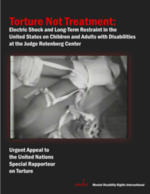
This report is the product of an investigation by Mental Disability Rights International (MDRI) into the human rights abuses of children and young adults with mental disabilities residing at the Judge Rotenberg Center (JRC) (formerly known as the Behavior Research Institute) in Canton, Massachusetts in the United States. This report is an urgent appeal to the United Nations Special Rapporteur on Torture or other Cruel, Inhuman or Degrading Treatment or Punishment, by MDRI. The report documents many human rights abuses at JRC, including the intentional infliction of severe pain on children by the use of electric shock and longterm restraint.
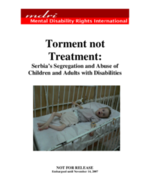
This report is the product of an investigation spanning four years by Mental Disability Rights International (MDRI) into the human rights abuses perpetrated against institutionalized children and adults in Serbia. From July 2003 to August 2007, MDRI documented a broad array of human rights violations against people with disabilities, segregated from society and forced to live out their lives in institutions.
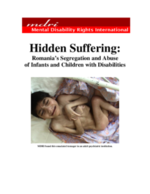
This report is the product of an 18-month investigation by Mental Disability Rights International (MDRI) into the human rights abuses of children with disabilities in Romania. This report documents a broad range of atrocious conditions for children with disabilities inside Romania’s institutions. While Romania has reduced its orphanage population and created foster care placements for many children, the reforms have left behind children with disabilities. This report documents serious human rights violations against children with disabilities in an institution for babies and in adult facilities.
This report describes the findings of a two-year investigation in Turkey by Mental Disability Rights International (MDRI) and exposes the human rights abuses perpetrated against children and adults with mental disabilities. Locked away and out of public view, people with psychiatric disorders as well as people with intellectual disabilities are subjected to treatment practices that are tantamount to torture. Inhuman and degrading conditions of confinement are widespread throughout the Turkish mental health system.
The South African Child Gauge is the only publication in the country that provides an annual snap-shot of the status of South Africa’s children.
Retrak has published new Standard Operating Procedures (SOPs) on street outreach, which is the beginning of its relationship building with children on the streets and the start of them finding a way back to family care.
ISS, with support from UNICEF Viet Nam and MOLISA, undertook research on child abandonment and relinquishment in 2011 and 2012, as part of its follow up technical support to Viet Nam in overhauling its adoption system.
This paper explores the effects of remittance receipt on child labour in an African context.
This document highlights some of the key learnings from the Ishema Mu Muryango program, a program designed to safely and sustainably reintegrate children living in institutions in two districts of Rwanda into their families or communities and prevent further institutionalization.
This study examines the consequences of the affective and educative nature of Romanian parents’ migration related to their children.
This article discusses the effect of international migration on the accumulation of human capital among Mexican youths aged 15–18 who are left behind.
This paper uses a large nationally representative survey data to examine the impact of China's rural–urban migration on high school attendance of left-behind children by disentangling the effect of remittances from that of migration.
This paper examines the relationship between migration and child growth in the rural highlands of Guatemala, a region with substantial international migration outflows, significant remittance inflows, and some of the highest rates of child undernutrition in the world.
This six-part study series from the Faith to Action Initiative, Caring for Orphans and Vulnerable Children: A Study Guide for Journeys of Faith, is designed to support small faith group study accompanying ‘Journeys of Faith: A Resource Guide for Orphan Care Ministries Helping Children in Africa & Beyond.’
This paper explores the effects of a mother’s migration on her children’s well-being.
This interpretive study examines the experiences of 54 Ethiopian emerging adults who had aged out of institutional care facilities. Findings are derived from interviews and focus groups in which questions and activities focused on the challenges faced by participants and the supports they relied on throughout the transition process.
This paper combines qualitative research with three micro data sets and finds that the presence of urban basic services is importantly linked to child residence of migrant parents.
This analysis of the impact of internal migration on the time allocation patterns of the left-behind elderly and children in rural China, 1997–2006, contributes to the literature on changes in the well-being of the left-behind population.
This paper uses data collected in 2008 and 2009 for a project on Child Health and Migrant Parents in South-East Asia (CHAMPSEA) to address a largely neglected research area by investigating the mental health of those who stay behind in Indonesia, Philippines and Vietnam to care for the children of overseas migrants.
This study aims to bridge gaps in areas of knowledge by quantitatively investigating the association between transnational families and children's psychological well-being. It analyzes a survey conducted in three African countries in 2010-11 (Ghana, Angola, and Nigeria) amongst pupils of secondary schools, comparing children in transnational families to those living with their parents in their country of origin.
Using data collected from a nationally-representative household survey conducted in Moldova between September 2011 and February 2012, this paper analyses the psychosocial health outcomes of children of migrant parents by comparing them with children without migrant parents (n = 1979).
This article provides an overview of the situation of children affected by international migration and the national and international policies in place to protect those children.
Through an examination of over 800 thematic drawings and stories, regarding ‘moving house’, produced by children aged 10–17 years in urban and rural communities of Lesotho and Malawi, this paper explores southern African children’s representations of migration.
This brief is part of a series of country briefs which aim to provide an analysis of children’s living and care arrangements according to the latest available data from Demographic and Heal
This study employed a cluster analysis to identify subpopulations in a large, national sample of 17-year-old youth in the USA based on the following indicators: educational attainment, connection to a supportive adult, adolescent parenthood, homelessness, substance abuse referral and incarceration.
This article talks about the application of the Hague Convention on Protection of Children and Co-Operation in Respect of Intercountry Adoption of 1993 in Brazil.
This issue brief from the UNHCR highlights key messages from UNHCR in regards to alternative care, including the importance of making alternative care arrangements based on the best interests of the child and using residential or institutional care only as a very last resort.
The Alternative Care in Emergencies Toolkit is designed to facilitate interagency planning and implementation of alternative care and related services for children separated from or unable to live with their families during and after an emergency.
This report from the Women’s Refugee Commission describes the recent increase in migration of unaccompanied children from Central America to the United States and provides an overview of the situation of these children, including the factors that motivate their migration - primarily the violence they experience in their home countries.
The Integrated Child Protection Scheme (ICPS) of India outlines, and contributes to the implementation of, the Government’s responsibility to establish an effective and efficient child protection system.
This webinar from Faith to Action Initiative presents key strategies for expanding the capacity of families to care for orphans and vulnerable children.
These Guidelines govern the adoption procedure of orphan, abandoned and surrendered children in India, replacing the Guidelines Governing the Adoption of Children, 2011.
This blank form from the Ministry of Women and Child Development of India is designed for use during an audit of a children’s home.
These Guidelines for Foster care aim to protect the well-being of children in India who are deprived of family care or who are at risk of being so.
This document is the first report from a study commissioned by Barnardo’s Scotland. The study explores experiences, needs and outcomes for children and young people in Scotland who are (or have been) looked after at home (ie subject to a home supervision requirement or order).
In this study 59 children between 10 and 18 years placed in long term foster care in the Netherlands completed standardized questionnaires on the relationship with their parents respectively foster parents and their wellbeing.
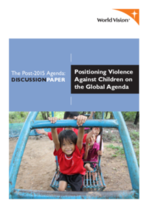
World Vision is publishing this paper to inform current strategic discussions which seek to ensure that ending violence against children (VAC) remains on the post 2015 global development agenda.
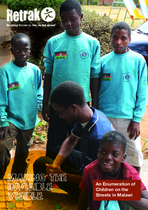
Through this enumeration study, Retrak, Chisomo Children’s Club, and the Malawi Ministry of Gender, Children, Disability, and Social Welfare sought to address the lack of information on the number of children living and working on the streets in Malawi.
This handbook provides links to tools and resources for engaging with and enlisting the support of religious communities and faith-based institutions towards the prohibition and elimination of corporal punishment of children.

This country care review includes the care-related Concluding Observations adopted by the Committee on the Rights of the Child.
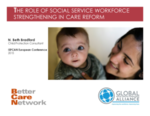
This presentation was given by Beth Bradford at the ISPCAN European Conference in September 2015.
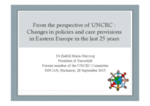
This presentation was given at the ISPCAN Conference in Bucharest, Romania in September 2015. The presentation reviews similarities and differences in national care reform efforts in the Eastern Europe region, highlights the main care-related issues in the region 25 years ago, describes the reforms and improvements made in the region as well as the challenges and responses to reforms, and provides recommendations for the way forward.
This paper explores how the UNCRC reporting process, and guidelines from the Committee outlining how States should promote the rights of young people making the transition from care to adulthood, can be used as an instrument to track global patterns of change in policy and practice.
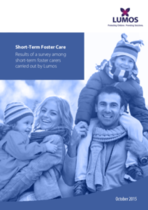
This study from Lumos provides an analysis of a survey administered to temporary foster carers in June 2015 in seven regions of the Czech Republic to address negative perceptions of foster carers and to determine whether public criticisms were founded.
The aim of this study is to identify the perceptions of potential short-term international tourists concerning children’s residential care in Cambodia.
This Compendium is a compilation of the most encouraging initiatives in the area of prevention of child abandonment and relinquishment that have been implemented and tested in the CEE/CIS region.
This report uses 80 surveys conducted by The Demographic and Health Surveys Program (DHS) and 55 Multiple Indicator Cluster Surveys (MICS), between 2000 and 2014 in 70 different countries, to estimate the prevalence of the components and combinations of vulnerability.
This report aims at giving an insight into the treatment of children in armed conflict, with a primary focus on children in detention.
The purpose of this qualitative research was twofold: the first was to explore the phenomenon of homebound girls in Jordan and to understand the reasons that led to their confinement. By shedding light on and investigating this phenomenon, the second purpose of this research, in turn, was to identify possible interventions to allow these girls access to education and strengthen their social development.
The overall objective of this research was to increase understanding of kinship care practices as experienced by Syrian refugee children and caregivers in Jordan, which can be used to inform programming and policy developments on children’s care and protection in a humanitarian context.
This paper discusses the probable impacts for children of different ages from the increasing risk of storms, flooding, landslides, heat waves, drought and water supply constraints that climate change is likely to bring to most urban centres in Africa, Asia and Latin America.
This report aims at describing and analysing existing protection mechanisms available for Palestinian refugee children with a focus on Lebanon and the occupied Palestinian territory (oPt).
On May 6th, 2015, industry leaders met for a stock-taking discussion on Economic Strengthening for Orphans and Vulnerable Children. View videos, presentations, and the agenda from the event.
This review focuses on the findings from high-quality published evaluation research into economic strengthening (ES) programs, implemented by NGOs, in resource-poor environments in the developing world, where external evaluators measured impacts on any of a wide variety of indicators of children’s or youth’s protection and wellbeing.
This review is a systematic research synthesis of randomized impact evaluations of NGO-implemented interventions in low-income countries that work to build income and/or economic assets either of the caregiver, the household, or the individual child, adolescent, or youth, where the evaluation looked at any child-level or youth-level outcomes.
This study was designed to evaluate the effectiveness of a family-level economic strengthening intervention with regard to school attendance, school grades, and self-esteem in AIDS-orphaned adolescents aged 12-16 years from 10 public rural primary schools in southern Uganda.
In this report, the US Government Accountability Office (GAO) examined (1) the reasons adoptive families consider unregulated child custody transfers, and services that exist to support these families before they take such an action; (2) what is known about the prevalence of these transfers; and (3) actions selected states and federal agencies have taken to address such transfers.
Ce document de contexte et les briefs nationaux individuels ont été commandés afin d'examiner le statut actuel des services de renforcement familial et de la prise en charge alternative dans dix-huit pays d'Afrique subsaharienne francophone ainsi que quatre pays anglophones et
In this position paper, the Muslim Women’s Shura Council considers whether adoption can be possible within an Islamic framework.
This report provides an overview of children's rights issues in the Middle East and North Africa.
This annual report of the World Family Map Project shares the latest data on 16 indicators of family structure, family socioeconomics, family processes, and family culture in multiple countries as well as an original essay focusing on one important aspect of contemporary family life.
This video by Save the Children highlights key research findings from an assessment on the quality of care in children's homes in Indonesia (2007), jointly published with the Indonesian Ministry of Social Affairs and UNICEF.
This paper presents a study on the children who were sent to orphanages or Islamic boarding schools (Dayahs) in Indonesia in the aftermath of the 2004 Boxing Day Tsunami.
This video showcases the Family-based care program of Save the Children and its partners in Indonesia.
Este evento paralelo del Consejo de Derechos Humanos incluyó presentaciones en separación familiar en los contextos africanos, asiáticos, europeos, y latinoamericanos.
This Human Rights Council Side event included presentations on family separation in the African, Asian, European, and Latin American contexts.
This Human Rights Council Side event included presentations on family separation in the African, Asian, European, and Latin American contexts.
This video, from Forget Me Not, features the story of Alisha, a young girl in Nepal who was separated from her family and taken to a children’s home in Kathmandu.
As part of a wider qualitative study of the volunteering experience, this paper seeks to critique the problematic relationship between a touristic experience and the needs of Cambodia’s poor children.
Taking a Polanyian political economy approach, this article illustrates how the emergence of and response to the orphanage tourism industry represent, in Karl Polanyi’s words, a ‘double movement’ between the neoliberalization of orphanages and the corollary protective countermovement by antiorphanage tourism campaigns that challenge the industry’s morality and legitimacy.
Pursuant to the decision of the Ninth Summit, the SAARC Convention on Regional Arrangements on the Promotion of Child Welfare in South Asia was signed in January 2002 during the Eleventh Summit in Kathmandu.
The African Charter on the Rights and Welfare of the Child (ACRWC) is an important tool for advancing children’s rights.
This video gives an inside look at an assisted family setting in Ghana where children with disabilities live with their foster mothers. It highlights the increased risk of family separation faced by children with special needs and advocates for the provision of quality family-based care to children who cannot be with their parents or extended families.
This video is presented by Better Care Network and UNICEF. It tells the story of Maureen, a young girl in Kenya who was separated from her family and sent to live in a children's home. The video also features interviews with experts, including those who have lived in children's homes, explaining some of the negative impacts of institutionalization and highlights the efforts of care reform initiatives to deinstitutionalize children in Kenya.
This video is presented by Better Care Network and UNICEF. It tells the story of Maureen, a young girl in Kenya who was separated from her family and sent to live in a children's home. It also features interviews with experts, including those who have lived in children's homes, explaining some of the negative impacts of institutionalization and highlights the efforts of Care Reform Initiatives to deinstitutionalize children in Kenya and Ghana.
This report presents an overview of the Millennium Development Goals and ‘A World Fit for Children’ commitments, the situation of children in the Islamic world, and the constraints and challenges facing children in the region in regards to health, education, poverty, child protection, and HIV/AIDS. The report asks “are we fulfilling our commitment to children?”
This webinar looks at the range of alternative care for children who have been separated from parental care and emphasizes family care.
A Continuum of Care provides an overview of a range of alternative care options for children who have been separated from parental care.
This series of podcasts from Faith to Action Initiative features the audio from past Faith to Action webinars, including a webinar on The Continuum of Care.
Este taller está diseñado para entrenar los expertos técnicos en los valores y principios básicos involucrados en la labor del trabajo de Protección de Niñez y Adolescencia.