Code of Ethics for Child and Youth Care Workers in South Africa - Video
This video provides instruction on the code of ethics and other standards of care for those who work in the field of Child and Youth Care.
This video examines Standard 13, “Unaccompanied and Separated Children,” of the Minimum Standards for Child Protection in Humanitarian Action, developed by the Global Child Protection Working Group and collaborators.
This country care review includes the care related Concluding Observations adopted by the Committee on the Rights of the Child and the Committee on the Rights of Persons with Disabilities.
This policy brief provides an overview of research from 2002-2006 on whether children in Zimbabwe who recently migrated were at increased risk of dropping out of school, including research questions, findings, and conclusions.
Assessment of the current status of Alternative Care Legislation, Standards and Practices and identified Gaps in six countries: Kenya, Malawi, Swaziland, Tanzania, Zambia and Zimbabwe.
This study sought to assess, analyse and inform the different forms of vulnerabilities affecting children and youth, and their effects and existing strategies and programmes addressing the challenges and vulnerabilities facing orphans, vulnerable children and youth (OVCY) in the Southern Africa Development Community (SADC) region. The study also sought to propose recommendations for improvement, and development of minimum standards for OVCY and the finalisation of the SADC OVCY Strategic Framework.
The Minimum Package is a guide to encourage the harmonizing of service delivery for Orphans and Other Vulnerable Children and Youth (OVCY) across the Southern African Development Community (SADC) region.
This Situation Analysis Report is one of a series of three documents: (1) Report on the Situation of Orphans and Vulnerable and Children and Youth in the SADC Region; (2) Conceptual Framework for Psychosocial Support for Orphans and Vulnerable Children and Youth in the SADC Region; and (3) Minimum Package of Services for Orphans and Vulnerable Children and Youth in the SADC Region. The Situation Analysis Report has informed the development of the PSS Framework and the Minimum Package of Services.
In this post from Community Child Protection Exchange, Sarah Lilley - Deputy Head of Child Protection, Save the Children UK and Coordinator for the Inter-Agency Learning Initiative on Community-Based Child Protection Mechanisms and Child Protection Systems - reflects on the last five years of building an evidence base on community-based child protection mechanisms.
The objective of this Law shall be to facilitate the respect, protection, promotion, and provision of the realization of child rights in order to make maximum contribution to the survival, development, participation, and protection of every child in Liberia.
This guide is designed for all staff working on child protection programmes who need quantitative data on knowledge, attitudes and practices related to child protection.
The purpose of this qualitative study was to understand the experiences of grandparents in the US and the challenges they face raising their grandchildren.
This video documents Save the Children's work in Armenia to reform the child protection system, including its use of the Guidelines for Alternative Care as a roadmap to focus on supporting a range of appropriate family environments for children without appropriate care.
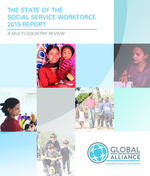
This working paper, produced by the Better Care Network and the Global Social Service Workforce Alliance, explores the topic of social service workforce strengthening as it relates to child care reform.
The Uruguayan Network for the Right to Live in a Family and a Community (Red por el Derecho a la Convivencia Familiar y Comunitaria) was launched in April 2012 with support from RELAF and UNICEF.
BCN Netherlands (BCNN) was formed by international nongovernmental organizations and donors in the Netherlands with the aim of raising awareness about appropriate forms of alternative care among the Dutch groups and organizations.
The Taskforce is a body promoting non-institutional forms of child care system in the State of Orissa.
Alternative Care Initiatives is a small NGO established to respond to the growing need in Uganda to support government and civil society organisations to develop and implement Alternative Care solutions.
The Government of Ghana's Care Reform Initiative and ongoing efforts to move away from resdidential care for children.
RELAF is the Latin American Foster Care Network, for the right to community and family- based care for children and adolescents.
The Opening Doors campaign operates at EU level and in 12 countries across Europe, calling on the EU and national governments to prioritize the transition from institutional to family-based care.
The Transformative Monitoring for Enhanced Equity (TransMonEE) Database captures a vast range of data relevant to social and economic issues relevant to the situation and wellbeing of children, young people and women in countries of Central Eastern Europe and Commonwealth of independent States (CEE/CIS).
UNICEF's Regional Office for Central, Eastern Europe and the Commonwealth of Independent States (RO CEE/CIS) coordinates and supervises UNICEF’s work in 22 countries and entities to ensure that no child is left out in our efforts to realize their rights.
The Faith to Action Initiative began as the BCN Faith-Based Organization (FBO) Committee. The overarching aim of the BCN FBO Committee was to dialogue with churches, organizations, and leaders in the faith community for the purpose of promoting better practices in regards to orphans and vulnerable children (OVC).
The Geneva Working Group on Children Without Parental Care is now a thematic Working Group under Child Rights Connect.
The main objective of the Working Group is to disseminate and promote the implementation of the Guidelines on Alternative Care of Children.
A description of BCN's role in implementing the Guidelines for the Alternative Care of Children.
An overview of the history and development of the Guidelines for the Alternative Care of Children.
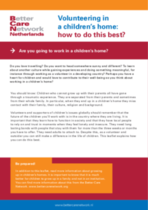
This leaflet was developed by the Working Group ‘Quality of Care’ of Better Care Network. It is published by Better Care Network Netherlands. The leaflet provides useful information on child development and children’s care for those planning to volunteer at orphanages in developing countries.
This report provides an overview of a two-day regional consultancy on strengthening child care systems in Eastern and Southern Africa.
This paper provides an overview of the violence perpetrated by gangs and other criminal organizations in Mexico and Central America which compels many children to flee their communities. The paper also describes the US government’s obligations to protect unaccompanied children upon arrival, and good practices of other governments relating to the protection of child migrants and refugees.
This draft from the Liberian government outlines the protocol and guidelines for responding to children's care issues in the context of Ebola, specifically for the Interim Care Centers (ICC) for children who have come into contact with Ebola.
This article explores how established faith-based organizations that work with children affected by HIV/AIDS address the Convention on the Rights of the Child and the Millennium Development Goals in their service practices and what challenges they face.
This article introduces the series of articles in this issue of the Child Abuse and Neglect Journal which focus on the role of religion and religious communities on children’s care and protection.
This article explores what Judaism’s communal orientation means for the protection of children.
This article outlines a few of the common values and principles that provide the foundation for Muslim understandings of child–adult relationships and approaches to child protection and nurture.
This article is primarily aimed at providing a foundation for analyzing both the challenges and opportunities of partnering with religious communities and organizations in addressing child abuse and neglect.
This article highlights the historical role churches have played in child protection stemming from biblical teachings and mandates as well as a current example of church involvement in child protection.
This article provides examples from the Christian Bible to suggest that Christianity offers many principles and mandates that promote Christians to protect and nurture children.
This article explores some of the ways that Buddhism expresses care for its children.
The Committee considered the combined third to fifth periodic reports of Venezuela (CRC/C/VEN/3-5) at its 1903rd and 1904th meetings (see CRC/C/SR.
This country care review includes the care-related Concluding Observations adopted by the Committee on the Rights of the Child and the Committee on the Rights of Persons with Disabilities.
This country care review includes the care-related Concluding Observations adopted by the Committee on the Rights of Persons with Disabilities and the Committee on the Rights of the Child.
The Committee considered the combined second to fourth periodic reports of Fiji (CRC/C/FJI/2-4) at its 1909th and 1910th meetings (see CRC/C/SR.1909 and 1910), held on 4 and 5 September 2014, and adopted, at its 1929th meeting, held on 19 September 2014, the following concluding observations.
This country care review includes the care related Concluding Observations adopted by the Committee on the Rights of the Child and the Committee on the Rights of Persons with Disabilities.
This animated video, produced by Save the Children, tells the story of Suman, a boy whose mother sends him to a care center as she is having difficulty caring for him.
This document is intended as a guide, primarily for UNICEF staff and partners, to building effective partnerships with larger religious, and local faith, communities and networks, especially religious leaders.
This report, informed by a field study conducted by the International Rescue Committee, provides a summary of findings and presents recommendations aimed at helping policy makers to improve the current and future response to the arrival of unaccompanied children from Central America to the United States.
Through a desk review of peer reviewed journal and “grey” literature published in English and Russian languages, this paper provides a review of current deinstitutionalization efforts in the region, identifies potential challenges, describes the need for economic empowerment interventions, and outlines directions for future research.
This Review, commissioned by UNICEF Bulgaria, is aimed at informing the recommendations for the Bulgarian Government’s Action Plan for the implementation of the National Strategy ‘Vision for Deinstitutionalisation of Children in Bulgaria.’