
Psychosocial support for children and families during COVID-19
This How We Care series explores how Family for Every Child's Members are providing essential psychosocial support to vulnerable children and families within the context of the pandemic.
This How We Care series explores how Family for Every Child's Members are providing essential psychosocial support to vulnerable children and families within the context of the pandemic.
In this comment piece, the The WHO–UNICEF–Lancet Commissioners argue that "recovery and adaptation to COVID-19 can be used to build a better world for children and future generations."
This study aimed to explore the experiences and perceptions of health among young people (YP) who have previously lived in care.
In this article, the authors outline some of the issues in the implementation and understanding of the Convention and highlight three major international developments over the last decade: the adoption of General Comment No 13, the work of the Special Representative of the Secretary General on Violence Against Children, and the adoption of the 2030 Agenda for Sustainable Development by the UN General Assembly in 2005.
This article examines rates of disparity using secondary longitudinal clinical-administrative data provided by a child protection agency in Quebec for a subsample of Black, White, and other visible minority children over a ten-year span.
In this study the authors examined the relative contributions of maternal versus paternal criminal offending or mental health problems in relation to the time to the offspring’s first report to child protection services, or first placement in out of home care (OOHC), using administrative records for a population sample of 71,661 children.
Using a phenomenological research design, this study delves into the motivations and challenging experience of foster carers in South-Kivu.
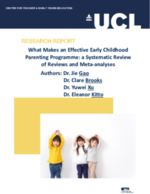
By synthesising the research evidence, this study seeks to address the questions of whether early childhood parenting programmes are effective in improving parenting and enhancing children's development; and which factors of the programme design and implementation contribute to the successful outcomes of parenting programmes.
In this article, the authors propose a definition of child well-being that draws on the economic literature pertaining to skill formation and human capital.