
Displaying 211 - 220 of 377
The purpose of this review was to identify evidence-based early response strategies and interventions for improving the outcomes of children outside of family care, including children of and on the street, institutionalized children, trafficked children, and children affected by conflict and disaster, and who are exploited for their labor. A conclusion was drawn that there is a strong need for strengthening the evidence base regarding the effectiveness or early assessments and responses to children living outside family care and for using evidence to guide operational policy and practice.
Recognizing the need for evidence to inform policies, strategies, and programs to care for vulnerable children, the U.S. Government convened an Evidence Summit on Protecting Children Outside of Family Care on December 12–13, 2011, in Washington, D.C., USA. This paper summarizes the background and methods for the acquisition and evaluation of the evidence used to achieve the goals of the Summit.
This paper reviews the various methodologies applied to identify and enumerate these often hidden and/or mobile populations. Methodologies that identify and enumerate children outside of family strive to meet two objectives: (1) to estimate the number and characteristics of a specific vulnerability category and (2) to determine eligibility to receive services. Conclusions from these reviews advocate for tailoring a methodology to the specific circumstances under which it is meant to identify or enumerate children outside of family care.
The objective of this review was to strengthen the evidence-base for policy and practice for support of children outside of family care through effective, efficient and sustainable mechanisms for monitoring and evaluation. Findings show that fostering a stronger evidence-base to improve protection for vulnerable children requires evaluations that are integrated into program development, use context-appropriate methodologies able to assess intervention scalability and employ more longitudinal designs to explore children’s trajectories.
Care related sections of the Government of the Russian Federation's fourth and fifth combined report on the implementation of the Convention on the Rights of the Child (dated 3rd June 2011).
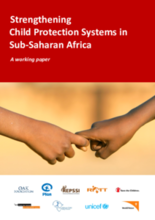
This paper is a response to the increasing need for agreement on approaches and documented evidence of good practices consistent with system strengthening work. The purpose of the Inter-Agency Working Paper is to consolidate current thinking, examples and lessons learned about child protection system strengthening in sub-Saharan Africa and suggest a way forward.
This article describes the Blueprints database of evidence-based programmes (EBPs) and its potential application in children's services in European countries.
The People’s Republic of China issued its third and fourth combined report on the implementation of the Convention on the Rights of the Child in June 2012. This extract of the report focuses on sections relevant to children's care and in particular those addressing Family Environment and Alternative Care
This International Labour Organization (ILO) brief introduces a new international standard adopted in June 2012, the Social Protection Floors Recommendation, 2012 (No. 202), that provides guidance to member States in building comprehensive social security systems and extending social security coverage by prioritizing the establishment of national floors of social protection accessible to all in need.

This International Labour Organization (ILO) document introduces a new international standard adopted in June 2012, the Social Protection Floors Recommendation, 2012 (No. 202), that provides guidance to member States in building comprehensive social security systems and extending social security coverage by prioritizing the establishment of national floors of social protection accessible to all in need.
