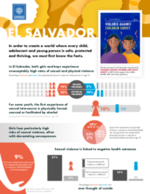
El Salvador: Violence Against Children Survey Fact Sheet
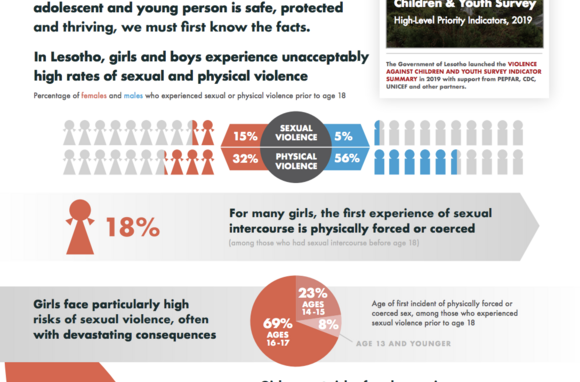
This fact sheet presents an overview of the data found in El Salvador’s Violence Against Children Survey.
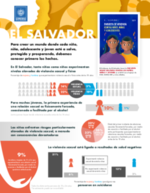
Esta página de datos presente un resumen de los datos encontrados en la Encuesta de Violencia Contra los Niños, Niñas y Adolescentes de El Salvador
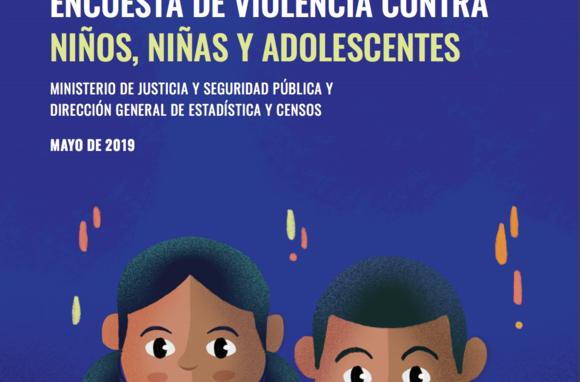
El siguiente resumen resalta los hallazgos principales de la Encuesta de Violencia contra Niños, Niñas y Adolescentes (EVCNNA), El Salvador 2017.
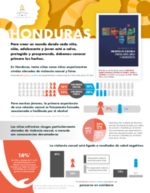
El siguiente resumen resalta los hallazgos principales de la Encuesta de Violencia contra Niños, Niñas y Adolescentes (EVCNNA) Honduras 2017.
Esta página de datos presente un resumen de los datos encontrados en la Encuesta de Violencia Contra los Niños, Niñas y Adolscentes de Honduras.
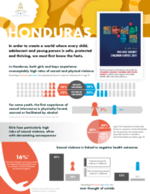
This fact sheet presents an overview of the data found in Honduras’s Violence Against Children Survey.
This briefing paper reports on the lessons learnt from a process evaluation of the child protection component of the Global Fund’s Young Women and Girls (YWG) programme, a multi-pronged HIV prevention programme targeting young women and girls implemented in 10 districts in South Africa.
This scoping review was undertaken to map survey methodologies for violence against children (VAC) measurement in Indonesia and other Southeast Asian countries and to identify key considerations for developing both methodologically sound and culturally appropriate VAC surveys in Indonesia and similar contexts.
By age 16 the attainment of most children in or on the edge of out of home care has fallen well behind the average for their age. This paper uses the English National Pupil Database to examine how much of this falling behind occurs before the age 7, and how any subsequent decline relates to time in care as against time outside it.
This three-paper dissertation examines the overrepresentation of Black children reported to child protection services in Canada.
Despite the importance of training residential youth care professionals to increase their professional competences, little attention has been paid so far to the influence of training on the behaviour and skills of residential professionals. This study aims to gain greater insight into the effects of training on the skills of these professionals.
The article examines from a comparative perspective how Sweden and Germany reacted to the unprecedented increase in unaccompanied asylum-seeking children (UASC) in 2015. By illustrating the reactions of two countries, the study shows that an unprecedented wave of refugees/asylum seekers can trigger both more incremental, adaptive and drastic transformative policy changes.
Using a phenomenological approach, this qualitative study explores the contexts of institutional placement of children in Azerbaijan from their caregivers' perspectives.
This report from Comhlámh and the Volunteering and Orphanages Working Group (OWG) explores the negative impacts of institutionalization on children and the negative impacts of volunteering in orphanages, including the proliferation of orphanages and perpetuation of family separation to satisfy volunteer demands, highlighting recommendations for addressing this issue.
This presentation provides an overview of care-leaving research in South Africa.
This report presents the findings of a global survey designed to map current implementation of Inclusive Early Childhood Development (IECD) and Early Childhood Intervention (ECI) programs, among other objectives, and outlines recommendations based on those findings.
This paper considers the importance of material objects for looked after and adopted children integrated as part of life story work practices.
The aim of the article was the analysis of the problem of speech development in care and educational institutions and family-run children’s houses in Poland.
In this study, the authors analyzed the literature on foster care in Poland and conducted a narrative questionnaire with an educator who simultaneously holds the responsibility for teaching youth in foster care autonomy in order to identify factors that affect educational and vocational plans that foster care charges have.
Drawing on the extant literature, this chapter will present a multileveled discussion of the experiences of prejudice and bias foster youth face, with a focus on the systemic inequities among diverse youth in foster care, the individual challenges youth with different social identities face, socialization processes that can support these youth, and challenges foster parents face in supporting foster youths’ healthy identity development.
The aim of this study was to ask youth themselves how they experience the impact of traumas prior to living in a foster family.
This study estimated the impact of state and individual-level risk and protective factors on adverse 19-year-old outcomes among a cohort of U.S. transition age youth.
This study tests whether an expansion of the Danish aftercare scheme in 2001 affects later outcomes of foster care alumni.
As part of a broader action research project aiming to prevent both harmful sexual behaviour carried out by children and young people and child sexual exploitation (CSE) in out‐of‐home care, four focus groups were undertaken with 17 workers at three Victorian residential houses in 2017.
This study explores understandings of children and childhood among 21 social workers from five child protection services in Chile.
This chapter aims to review how the CRC has been integrated into Taiwan’s laws and social practices since its promulgation in 1989.
This chapter will help the reader to understand the design and outcomes of the foster care system in the USA.
This chapter from Former Foster Youth in Postsecondary Education focuses on the transition point when youth begin to age out of care and may move into postsecondary education.
Este llamado pide a los gobiernos nacionales y locales, en coordinación con socios nacionales y globales, fortalecer la fuerza laboral del servicio social para mejorar los resultados de protección, salud y bienestar para niños, niñas, jóvenes, familias y comunidades como se describe en los Objetivos de Desarrollo Sostenible.
The purpose of this toolkit is to guide participatory, national level analyses of the social service workforce.
Virtual Philanthropy is a guided tour for nonprofits looking to understand the steps they should take in order to get in front of, and eventually get funding from, foundations and donors.
This research study was commissioned to generate a better understanding of three school communities in Cambodia: Islamic schools, Buddhist monastic schools, and floating schools with a focus on identifying challenges in delivering quality and inclusive education.
This study examines child protection risks faced by preschool age children (3-5 years old) and adolescents (10-14 years old) in Phnom Penh, Cambodia and determines the interconnectivity between such risks and education.
This study investigated what factors are associated with an improvement in quality of life (QoL) during residential stay for children and adolescents living in youth welfare institutions in Switzerland.
The present study uses the US National Youth in Transition Database (NYTD) to examine educational attainment, employment, homelessness, and incarceration for white, African-American, Hispanic, and American Indian/Alaska Native emancipated youth.
The aim of this study was to assess and compare emotional and behavioral problems between left-behind children (LBC) and non-LBC in Indonesia.
This review aimed to identify, appraise and synthesise published literature concerned with the reunification of looked after children with their birth parents in the UK.
This article aims to unpack the reasons that Sweden's incorporation of legal measures to secure the rights recognised in the Convention on the Rights of the Child has been the subject of a lengthy and contentious debate.
This module is the third part of the Parenting without Violence Bronze Course. The module identifies concrete ways to integrate Parenting without Violence into your work.
This module is the second part of the Parenting without Violence Bronze Course. It focuses on the course's second learning outcome by sharing more about HOW Parenting without Violence works.
This course is designed for participants to gain a basic understanding of the Parenting without Violence common approach in order to be able to promote its use.
In this cross-sectional study, the authors assessed the mental health of children held at a US immigration detention center over two months in mid-2018.
The aim of this study is to discover how the different factors documented at the time of the custody decision or the placement in out-of-home care are associated with the coping abilities of young adults once aftercare services come to an end.
Written from a multidisciplinary and international perspective, this article outlines the place of adoption in the child protection system, as well as its core elements of permanence and stability.
This chapter identifies the structural components of the transnational illegal adoption market by applying the basic logic of the routine activity theory that has been developed by Cohen and Felson.
The goal of this study was to assess the child maltreatment (CM) prevention readiness (CMPR) of the Kingdom of Saudi Arabia (KSA) in regard to implementing large-scale, evidence-based CM-prevention programs.
In this study, the authors surveyed one hundred 4- to 11-year-olds removed from home because of maltreatment about their placement preferences. These results suggest that young children may express more mature preferences than recognized by the law, and that there may be value in asking even relatively young children about with whom they would like to live following removal from home as a result of maltreatment.
The present study examined the association between family resources and mental health as mediated by personal psychological resources (PPRs) for left‐behind children (LBC).
The present open access study examines how deprivation (including institutionalization) and threat are associated with cognitive and emotional outcomes in early childhood.
This book largely focuses on unaccompanied minors who arrived in a European country in 2015, with special attention paid to the top-three nationalities of unaccompanied minors, namely Syrian, Afghan and Eritrean minors.
This study investigates the nature of newly formed relationships between children and their foster carers.
This paper used the latest judgment documents from the court as a new data source, and identified the key nodes and trafficking paths by using a series of network indicators to enhance the public’s understanding of the crime mechanism of child trafficking.
Concerned by the protection risks faced by women and girls, the United Nations Refugee Agency (UNHCR), the United Nations Population Fund (UNFPA) and the Women’s Refugee Commission (WRC) undertook a joint seven-day assessment mission to Greece and the former Yugoslav Republic of Macedonia in November 2015. This report describes the assessment’s findings and key recommendations for the European Union (EU), transit and destination country governments, humanitarian actors and civil society organizations (CSOs).
This study seeks to improve understanding of the risks and types of sexual and gender-based violence faced by children who migrate on their own, as well as the unfortunate and widespread gaps in protection and assistance for these children.
This resource aims to set standards for quality, compassionate care for GBV survivors in humanitarian settings, with particular focus on the provision of case management services.
This module is designed to increase field staff awareness, knowledge, and understanding on gender-based violence (GBV) and aims ultimately to contribute to the effective protection of refugees and internally displaced persons (IDPs).
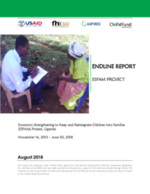
This report describes the FARE project - a subproject of ASPIRES that sought to develop evidence and programming guidance for matching contextually appropriate economic interventions with specifically targeted households to reintegrate separated children into families and prevent unnecessary separation of children from their families - and summarizes achievements, challenges, and learning.
This plan builds a solid and sustainable foundation for a modern juvenile justice system in Cambodia and provides effective and positive impact to current and future children, who are in conflict with law.
This Action Plan to prevent and respond to violence against children in Cambodia identifies five key areas of intervention: 1) coordination and cooperation, 2) primary prevention, 3) multi-sectoral child protection response services, 4) law and policy formulation and amendment, 5) monitoring and evaluation.
This study describes access, utilization and ongoing social support needs among adolescents living with HIV aged 15–17 in transition from pediatric to adult HIV care in Cambodia.
This report from Save the Children outlines recommendations to governments and donors in order to ensure that positive childcare and protection practices are pursued at every level.
The purpose of this research was to capture more accurate and detailed information regarding children in various forms of alternative care in Thailand.
The purpose of this study was to establish the relationship between technology as a capacity building strategy and performance of the orphans and vulnerable children cash transfer program in Nairobi County, Kenya.
This study examined associations between perceived support from adults in three developmental contexts (home, school and neighbourhood) and mental well-being (life satisfaction, self-concept, optimism) among grade four children living with foster parents in British Columbia (B.C.), Canada.
The objective of this study was to determine the minimum set of cross-agency indicators that could accurately classify placement in out-of-home-care (OOHC) in Australia before age 13–14 years.
This Learning Brief draws on project documents,focus group discussions and individual interviews to document ChildFund International’s experience with Children and Youth Savings Groups for highly vulnerable children in Uganda’s Kamuli, Luwero and Gulu Districts through the Economic Strengthening for Families (ESFAM) Project.
This Learning Brief draws on information collected via focus group discussions, individual interviews, and project data to describe ESFAM’s experience with and learning from its MSA intervention, which aimed to encourage families to save for educational expenses, so that they would not have to send their children to residential care institutions for school.
This document was commissioned by the Regional Office for Europe of the Office of the United Nations High Commissioner for Human Rights (ROE OHCHR). One of its aims was to stimulate discussion at the Sub-Regional Workshop on the Rights of Vulnerable Children Aged 0 to 3 Years in Prague on 22 November 2011.
The objectives of this open access study were to investigate the association between parental visitation and depressive symptoms among institutionalized children in Japan, and to explore whether the established security of attachment interacts with that association.
In this study, working memory (WM) was examined during late childhood/adolescence as an intra-individual factor to mitigate the risk for separation anxiety, which is particularly susceptible to caregiving adversities, such as previous institutionalization (PI).
This study assesses the feasibility of hiring coders to abstract the required information from administrative records and case narratives, to inform programs that aim to eradicate child maltreatment (CM) and to provide services to children and families in Canada.
The goal of this study was to examine whether and how alternative kinship structures were reproduced in Charitable Children’s Institutions (CCIs) in Kenya.
This theoretical-empirical study is based on two particular case studies of families bringing up children from institutional care in Slovakia.
This study focused on health promotion for children and young adults who live in residential care institutions in Portugal.
This document provides a guide to looked after children statistics published by the UK Department for Education.
This open access review presents evidence for family- and parent-focused interventions on mental health outcomes for children and youth in LMIC and identifies treatment components present in promising interventions.
Given the impact that institutional care has been found to have on psychological and cognitive outcomes, the authors make the case for the adaptation of Early Childhood Child Care HOME (EC-CC-HOME), a world-renowned instrument that assesses children’s child-care environment, to the Greek context.
In Wales, a significant body of work has been produced on and with care-experienced children and young people. This edited collection attempts to highlight these valuable insights in a single volume.
The objective of this research project was to profile the experiences of survivors abused in long-term child care in Scotland, and to develop a model which linked maltreatment, risk and protective factors, and outcomes.
The objectives of this study were: (a) to measure the time-to-initial placement change in different types of settings, including non-relative foster homes, kinship care, residential treatment centers (RTC), group homes and other types of settings; and (b) to identify predictors of the initial placement change.
Data and Trend Analysis (DATA) Refugees and Migrants at the Western Balkans Route Regional Overview, covering period October - December 2018, describes key trends in migrations in the region, detailing information about the number of people on the move, demography (age, sex, country of origin, etc), behavioral patterns, and routes in use - with a focus on children, particularly unaccompanied children. Data in this report includes key trends in Bulgaria, North Macedonia, Serbia, Albania, Montenegro, Bosnia and Herzegovina, and Croatia.
This talk, given by Dr Charles Nelson, focuses on two strands of work that reflect very different types of adversity: (1) the effects of early, profound psychosocial deprivation (including a review of the most recent findings from the Bucharest Early Intervention Project, a randomized controlled trial of foster care as an intervention for early institutionalization in Romania) and (2) the effects of growing up in a low resource urban center where children are exposed to a large number of both biological (e.g., malnutrition) and psychosocial (maltreatment) stressors (including a review of recent findings from a large study taking place in Dhaka, Bangladesh).
This article focuses on the relationship between economic inequality and out-of-home care and child protection interventions in England.
While previous studies have focused on the effects of parental deportation on young children, this study uniquely contributes to the literature by exploring how adolescents experience and cope with a forced family separation.
The study's objective was to determine what successful caregivers of orphaned and vulnerable children (OVC) in diverse countries do to sustain their positive mental health.
This webinar includes presentations from the Democratic Republic of Congo and the Philippines, sharing experiences designing, managing and evaluating parenting interventions to reduce violence against children and adolescents by parents and caregivers.
In this study, the effects of the International Child Development Programme (ICDP) and the specific addition of a violence prevention module were observed in a preidentified population in Colombia where children are experiencing high levels of violence.
This evidence brief from the Evaluation Fund presents an evaluation of the International Child Development Programme (ICDP) in Colombia, a national ICDP branch that provides community-based caregiver training through locally trained ICDP facilitators.
A pre-post design with 6–13-month follow-up assessed the feasibility and acceptability of a home-visiting intervention to promote early childhood development, improve parenting and shared decision-making, and reduce violence in impoverished Rwandan households.
World Vision commissioned the research, 'No Choice', to better understand children associated with armed groups.
The objective of the review was to answer the question: “How can we ensure that the CPIMS+ and associated tools that support information management for case management are effective in supporting child protection case management in humanitarian contexts?” Following a detailed assessment of the findings, the consultant has included a series of recommendations to the CPIMS+ SC for consideration.
The Community-based Child Protection Task Force held a webinar on Thursday, 4 Apr 2019, 13:00 - 14:00 (UTC+01:00) London, to discuss a “Community-Led Child Protection” toolkit developed by Professor Mike Wessells of Child Resilience Alliance and Patrick Onyango Mangen of TPO Uganda.
The first aim of this study was to find subgroups of adult international adoptees based on common risk and protective factors using a latent class analysis. The second aim was to examine whether the identified subgroups differed in outcome variables such as life satisfaction and psychological adjustment.
The aim of this study was to investigate the role of self-esteem as a mediator in the association between different types of child maltreatment (i.e., physical abuse, physical neglect, emotional abuse) and depressive symptomatology among a sample of adolescents in out-of-home care.
Drawing on the baseline data, this paper profiles >200 multistressed families (MF) who entered into a specific enhancement programme in Singapore and compares the sociodemographies, family functioning and resilience of the children between transnational and non-transnational families.
This article initiates the conversation on the conceptualisation of child neglect in Namibia, reporting findings from a small study undertaken in 2017.
This volume provides readers around the globe with a focused and comprehensive examination of how to prevent and respond to child maltreatment using evidence-informed public health approaches and programs that meet the needs of vulnerable children, and struggling families and communities. Detailed guidance is provided about how to re-think earlier intervention strategies, and establish stronger and more effective programs and services that prevent maltreatment at the population level.