Health prevention training for foster child care facility personnel
In this article, the experience, difficulties and perspectives of the first health training program for foster child care facilities personnel in Argentina are presented.
File
In this article, the experience, difficulties and perspectives of the first health training program for foster child care facilities personnel in Argentina are presented.
The objective of this study was to evaluate the health status and anthropometrical development of adopted children from Ethiopia living in southern Spain.
This qualitative research study explored the psycho-educational and social factors that contribute to anxiety in orphaned adolescent students in a secondary school in Welkom, Free State, South Africa.
This study analyzes the influence of children’s preadoptive history and adoptive parents’ characteristics on the psychosocial adjustment of nationally and internationally adopted children in Germany.
To help increase the college preparation of local foster youth in a Midwestern city in the US, the authors developed a working group comprised of foster youth nominated by agency staff, staff from a university research center that sponsored and coordinated the program, local community leaders who work with foster youth, and city government representatives.
The Bounce Project is a pilot youth-leadership mental health training programme co-designed with young people who have experienced out-of-home-care (OoHC). In this study, the authors evaluated the Bounce Project from the young people’s perspectives to explore the acceptability, successes and limitations of the training to promote the participant’s mental health and their contribution to system level change.
This chapter charts the application and impact of "crimmigration control" measures on unaccompanied minors, a particularly vulnerable category of migrants.
The authors of this study use life course theory to explore the role of agency in shaping the educational pathways of 18 Irish adults (aged 24–36 years) with care experience.
The Partner Due Diligence Assessment Tool was developed specifically for charities seeking to partner with overseas organisations who provide residential care services for children. It is designed to help you determine whether your partner or prospective partner is operating in accordance with standard notions of good practice and international norms.
This study sought to analyze the executive functions of a sample of 43 Spanish foster children aged between five and nine years (M = 7.51, SD = 1.29), using a caregiver-reported questionnaire.
This study aimed to identify the factors that affect the incidence rate of neglected children in Indonesia by considering the household effect.
This article draws on national data and quantitative data from a study of ‘City’, a local authority in the north of England with a large Family Group Conference service.
This resource guide aims to assist program designers, funders, and implementers to select and incorporate appropriate and effective household economic strengthening (HES) measures into programs to preserve or reestablish family care for children.
The purpose of this presentation is to summarize findings from the Bucharest Early Intervention Project (BEIP) - the only randomized, controlled trial of foster care (FC) as an alternative to institutional care ever conducted - regarding psychopathology and competence through age 12 years.
This paper explores the usefulness of undertaking a longitudinal analysis of these data at local authority level to determine the care pathways for children entering care, differentiating by age at entry.
This report from the Office of the Special Representative of the Secretary-General on Violence against Children outlines the impacts of violence against children and proposes recommendations for safeguarding the right of every child to protection from all forms of violence.
This country care review highlights the care-related Concluding Observations from the Committee on the Rights of Persons with Disabilities.

This general comment from the UN Committee on the Rights of the Child addresses children's rights in the child justice system. The general comment notes several concerns and recommendations regarding the deprivation of liberty of children, including the consideration of the child's best interests, the need to promote successful reintegration of children, and the recognition of the harm caused by deprivation of liberty.
Based on semi-structured interviews with parents involved with child protective services (CPS), this study explored these parents’ self-identified parenting strengths in light of their family-of-origin experiences.
This study addressed foundling and abandoned children in the Palestinian society as a multi-dimensional phenomenon.
In this article, the authors analyse how interventions of the State may undermine, rather than activate, the caring capabilities of vulnerable families across the life course, drawing on examples from Australia, England and the USA.
This article considers the application of Communities of Practice theory to understand transition into, through and out of care, arguing that a sense of belonging and identity emerges from participation in supportive communities. The authors consider the influence of community on looked after children and care leavers’ sense of identity, engagement and well-being in transition.
Part of the 'Permanently Progressing? Building secure futures for children in Scotland' study, this briefing draws upon the voices of children, carers and adoptive parents in Scotland, offering perspectives on kinship care, foster care and adoption.
The current study employed thematic analysis to explore Massachusetts foster youth’s academic challenges and supports through interviews with teachers, foster parents, former foster youth, and three individuals who were both teachers and foster parents.
This report compiles presentations and notes from the Accelerating Strategies for Practical Innovation & Research in Economic Strengthening (ASPIRES) Family Care Uganda Learning Event, Economic Strengthening and Keeping Children in Family Care, held May 29-30, 2018.
The present report summarizes the detailed findings of the global study on children deprived of liberty, the first scientific attempt, on the basis of global data, to comprehend the magnitude of the situation of children deprived of liberty, its possible justifications and root causes, as well as conditions of detention and their harmful impact on the health and development of children.
This report of the Special Representative of the Secretary-General on Violence against Children highlights action taken at national and regional levels towards realizing the right of every child to protection from violence.
In this webinar, 4Children shared an overview of the development and content of the case management package.
This paper examines whether children and main caregivers of overseas migrant fathers have fewer or more mental health symptoms compared to those of non-migrant fathers.
This thesis is concerned with the overrepresentation of black and minority ethnic (BME) children and looked after children, in the youth justice system in general and the secure state in particular, in England and Wales.
This article examines place and privacy as two key resources for producing kinship through an analysis of exceptional legal practices in Spain that overdetermine international adoptees’ Spanishness.
This qualitative study explored perspectives from young people with experience of OoHC in Melbourne, Australia regarding the promotion of mental health in OoHC. The study informed the subsequent development of a system-level intervention to support workers and carers in OoHC and evaluation of its implementation, the Ripple study.
The present study analyzes the process of deinstitutionalization in Romania, as a transition stage in the life of youngsters who leave care system after turning eighteen.
This chapter from 'Addressing Multicultural Needs in School Guidance and Counseling' focuses on the psychological and social issues that orphans and other vulnerable children experience when their parents are no longer alive.
The present study examines the influences of migration on the health of left-behind children in China and the mediating channels, using data from a new nationally representative survey.
This study examined the mediating effects of loneliness in the relationship between social anxiety and life satisfaction. Four hundred and forty two left‐behind children in rural China, who completed the Social Anxiety Subscale, UCLA Loneliness Scale, and Satisfaction with Life Scale, participated in the study.
This article presents a case study of a 15-year-old boy whose severe difficulties were understood and formulated in terms of ‘attachment problems’ for many years.
The current study compares risk factors and sleep in a sample of foster care alumni and low-income young adults aged 18–24.
This webinar offers foundational information related to the intersection of culture, the migration journey, trauma and assessment.
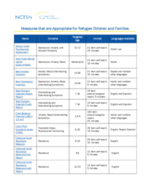
The National Child Traumatic Network (NCTN) has published a list of measures that front line professionals can use to assess the exposure to trauma among migrant and refugee families and children.
The webinar recording provides a basic overview of the intersection of early childhood development (0-5), attachment and trauma in young migrant children.
This documentary from CBS News takes viewers inside the real-life challenges facing migrant families split apart by the Trump administration's "Zero Tolerance" policy.
This report examines home visiting models and curricula, state- and federal-level policies related to early care and education and home visiting, funding streams to support early care and education and home visiting, and the perspectives of home-based child care (HBCC) providers and parents in order to explore the potential for scaling up this model of professional development for HBCC providers in the United States.
In this article, the stories of children left-behind by parental migration in Central America and Mexico are conveyed in their own words detailing how vulnerable they felt when abandoned, confused, and at times, rejected after finally connecting with their long-lost families.
The aim of this article is to develop proposals for the organization of a legal and regulatory framework in Russia, in accordance with the social and psychological needs of guardianship families and to identify the possibilities of the Ombudsman for the Rights of the Child to protect the rights of minors raised in guardianship families.
This study aimed to assess differences in the level of post-traumatic symptoms reported by those who experienced commercial sexual exploitation of children (CSEC) during adolescence and those who did not.
This book outlines narrative and dramatic approaches to improve vulnerable family relationships. It provides a model which offers new ways for parents to practise communicating with their children and develop positive relationships.
This report draws on interviews the authors conducted with 19 child welfare leaders in eight jurisdictions to highlight how jurisdictions are using existing funding sources to serve this population and examine the funding challenges they continue to face.
The objective of this study was to determine if Spanish foster care children and Spanish non-foster children differ on sluggish cognitive tempo (SCT), ADHD-inattention (IN), ADHD-hyperactivity/impulsivity (HI), oppositional defiant disorder (ODD), limited prosocial emotions (LPE), anxiety, depression, social and academic impairment measures and if the duration of foster care predicts a reduction in symptom and impairment differences between foster and non-foster care children.
This presentation was given at the National Conference on Child Abuse and Neglect in Washington, DC in April 2019. The presentation outlines data on the prevalence of parental substance abuse as a contributing factor for child removal in the US and highlights practices that work for families with substance abuse disorders.