Global Report on Food Crises: Joint Analysis for Better Decisions
The 2020 edition of The Global Report on Food Crises describes the scale of acute hunger in the world, including for vulnerable children.
File
The 2020 edition of The Global Report on Food Crises describes the scale of acute hunger in the world, including for vulnerable children.
This study is based on a review of the documented history of Tennessee’s child welfare reform and informed by the reflections and perspectives of many who played key roles in the litigation and related system improvement efforts.
Para ayudarle a los sistemas de primera infancia en los E.E.U.U. a aprender a trabajar con padres de maneras que promuevan resultados equitativos y maximicen las oportunidades para todos los niños 40 padres líderes y personal de agencias de nueve comunidades de Early Childhood Learning and Innovation Network for Communities (EC-LINC) se reunieron en enero de 2018 para crear un manifiesto para el cambio.
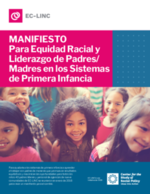
To help early childhood systems in the U.S. learn to work with parents in ways that promote equitable outcomes and maximize opportunities for all children, 40 parent leaders and agency staff from nine Early Childhood Learning and Innovation Network for Communities (EC-LINC) communities came together in January 2018 to create a manifesto for change.
This project, designed to explore parenting practices across various regions within Zambia, aims to further advance ongoing efforts to support early childhood development (ECD) by informing parenting programmes intended to promote optimal child development.
This report provides a brief analysis of social sector spending in Zambia.
The purpose of this assessment is (a) to review existing case management systems within and in relation to the Ministry of Community Development and Social Services (MCDSS) in Zambia and (b) make recommendations on how case management can be enhanced to ensure more efficient and effective service delivery to vulnerable children and adolescents.
This report details the end of programme evaluation Government of the Republic of Zambia-United Nations Joint Programme on Social Protection as a way of understanding and assessing its operational context and the effect the technical assistance had on the implementation of National Social Protection Policy (NSPP) during the programme’s lifetime.
Cracks in the System is a new report from Lumos that is the first of its kind to systematically explore the links between institutional care and child trafficking in Europe.
In partnership with the University of Houston Graduate College of Social Work, the upEND movement works to create a society in which the forcible separation of children from their families is no longer an acceptable solution for families in need.
This report from Child's i Foundation provides an overview of the organisation's response to the COVID-19 pandemic in Uganda.
The current study employed Interpretative Phenomenological Analysis (IPA) to guide the analysis of semi-structured interviews with eight young people with a range of care experiences, looking at the topic of confiding in others.
In this article, two case studies chart show that if foster carers are able to reflect upon the painful and unwanted feelings evoked in them, and acknowledge and take responsibility for what has become enacted in the placement, there may be an opportunity for harmful dynamics to be processed and repaired.
This paper explores within group differences for Mexican and Puerto Rican mothers vulnerable to child welfare involvement.
This study aimed to systematically review motivational interviewing (MI) with child welfare (CW) families as well as MI training with CW workers and social work students training to become CW workers.
This article explores in-home video chat between children and their incarcerated parents as a potentially viable option for building relationships during incarceration, especially when opportunities for positive physical contact are limited or non-existent.
This article charts the UK history of contact in fostering and adoption as it relates to children in care and their birth relatives.
This chapter provides an overview of one of the key factors implicated in young people’s contact with the criminal justice system: the criminalisation of children with care experience.
Using data from the Incarcerated Serious and Violent Young Offender Study, the criminal offending trajectories of 678 incarcerated youth were examined. A history of foster care predicted membership in a high rate chronic offending trajectory.
This article describes what type of families make up the Family Foster Care resource of the Province of Alicante and their parenting styles.
This study aims to answer two research questions: a) How do youth and staff/professionals define/conceptualize authentic youth engagement (AYE)? and b) What are youths’ and staff/professionals’ recommended strategies for authentically engaging youth?
The goals of this article were to (a) examine the changes in educational achievements of children in care from preschool through the end of primary school; (b) identify subgroups exhibiting distinct educational trajectories; and (c) explore key predictive individual, care, and school characteristics.
This research brief summarizes the findings of a rapid review that collates and synthesizes evidence on the child protection impacts of COVID-19 and previous pandemics, epidemics and infectious disease outbreaks.
This paper argues that whilst statutory services have expanded then contracted, children’s charities have remerged as the most influential voices that have shaped twenty-first century child protection policy and practice in the UK.
Theoretically-informed focused commentary on the literature in this paper considers the position of children and young people as embedded within socio-ecological systems. The specific focus is on the educational disadvantage of children and young people susceptible to involvement from child protection and welfare services in the Republic of Ireland.
this study examines the relationship between needs, matched services, and child protective services (CPS) re-report.
This qualitative study sought to understand the causes of separation among Syrian families in Jordan and the obstacles to family reunification.
The authors of this article sought to better understand the relationship between homelessness and child welfare services (CWS) involvement and examine whether homeless shelter data could combine with CWS data to enhance intervention targeting.
The authors of this article conducted a systematic review of the impact of parent-training interventions on children’s and caregivers’ cortisol levels, and meta-analyzed the results.
This brief article from Student Affairs Today highlights some of the lessons learned by student affairs professionals regarding foster care support programs at higher education institutions in the United States in light of the COVID-19 crisis.
This study assesses the magnitude of, and factors associated with undisclosed HIV status to a community-based HIV prevention program among caregivers of orphans and vulnerable children (OVC) in Tanzania.
This short report calls attention to heightened risks, and raises awareness, for practitioners in the fields of intercountry adoption and international surrogacy in light of the COVID-19 pandemic and asserts the need for caution.
This article reports on initial research from a survey study to describe the current state of play from practitioners into their perceptions and practices of children's participation in family support contexts.
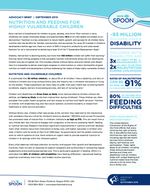
This advocacy brief from SPOON Foundation notes that successful nutrition interventions are not reaching the children who are at highest risk, including children without family care and children with disabilities, and outlines four key actions that can help to ensure that children without family care and children with disabilities have opportunities to grow and thrive.
This review from PeerJ aimed to evaluate currently available data on the nutrition status of children living within institutionalized care.
The purpose of this longitudinal study from BMC Public Health is to develop, implement and to test the efficacy of an evidence-based nutrition education programme (NEP) for orphans and vulnerable children (OVC) in South Africa that will integrate their families/caregivers, schools and communities.
This paper explores malnutrition among children in foster care in the U.S. and programs and interventions that help to improve the nutritional health of children in foster care.
This two-page brief outlines the UNICEF-WFP partnership's two-pronged strategy to respond to the immediate and medium-term needs to prevent and treat child wasting during and after COVID-19.
This resource document collates available guidance and tools on the Novel Coronavirus Disease (COVID-19) to assist Nutrition in Emergencies (NiE) practitioners in integrating COVID-19 preparedness and response into humanitarian nutrition responses.
This joint note aims to consolidate the current recommendations on Infant and Young Child Feeding in the context of the COVID-19 pandemic in Eastern, Central and Southern Africa.
This editorial from The Lancet Global Health discusses the effect of COVID-19 on food insecurity, particularly for women and children.
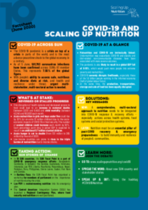
This one-page factsheet from Scaling Up Nutrition (SUN) provides facts and information about COVID-19 and malnutrition.
This information note provides initial considerations and actions for Scaling Up Nutrition (SUN) Government Focal Points and country multi-stakeholder platforms (MSPs) to help them engage in national COVID-19 response efforts to protect and promote good nutrition.
This document aims to guide the revision of existing Standard Operating Procedures (SOPs) for Food Distribution in the COVID-19 context at the country level to minimize the risk of exposure of personnel, partners and beneficiaries.
This guide is designed to assist Concern's health and nutrition staff responsible for the management and coordination of Community-based Management of Acute Malnutrition (CMAM) operations to adapt and modify programme modalities in the context of COVID-19.
In this webinar, hosted by Better Care Network and SOS Children's Villages International, panelists - including careleavers who served as co-trainers in the Leaving Care project - discussed the training, building a supportive network for care leavers, and the support needed to ensure that the rights of young people in alternative care are respected and that they are prepared for an independent life.
This report is based on findings the Nationwide Assessment of all Child Care Facilities (CCFs) in Zambia, which aimed to gather evidence for the purpose of updating baseline information pertaining to the condition of all Child Care Facilities (CCFs) in Zambia; in line with the Minimum Standards of Care for Child Care Facilities (MSC), United Nations Convention on the Rights of the Child (UNCRC) as well as the UN Guidelines for the Alternative Care of Children.
In this video, Grace Mwangi takes a critical look at the social work approach to the prevention of child abandonment, and the impact different approaches can have on outcomes for women and their children.
In this video, Ruth Wacuka and Samora Korea, two key leaders of the Kenya Society of Care Leavers, discuss the importance of care leaver networks, to enable care leavers to have a collective voice and to build a peer-to-peer supportive platform that aids in the transition of young people into independent living.
In this video, Peter Kamau from Child in Family Focus discusses his organisation’s approach to engaging with the directors of privately-run charitable children’s institutions (CCI’s) to secure their buy-in for transition and the reintegration of children into families, in line with government policy.