Alternative Care of Children in the Republic of Azerbaijan
This report is prepared within the MONEE project of UNICEF Regional Office for CEE/CIS. It provides an overview of alternative care in Azerbaijan.
File
This report is prepared within the MONEE project of UNICEF Regional Office for CEE/CIS. It provides an overview of alternative care in Azerbaijan.
This report is prepared within the MONEE project of UNICEF Regional Office for CEE/CIS. It provides an overview of alternative care in Armenia.
The current study uses a culturally and contextually modified early adolescent version of the Home Observation for Measurement of the Environment Inventory (EA-HOME-JP) in Japanese child welfare institutions (CWIs) to provide preliminary data on relevant variables in the caregiving environment that associate with domains of perceived self-competency.
The aim of this study was to explore factors affecting the wellbeing of institutionalized orphaned children in Dar es Salaam, Tanzania.
The purpose of this study was to investigate how orphans in secondary schools, especially those in the low-income class in society, manage to continue their education.
This study and documentation of existing reintegration and alternative family care services in Cambodia was designed to build the capacity of existing service providers to take emerging good practice to scale as an increased number of residential care institutions transition.
Family Care First (FCF) supported the study and documentation of existing reintegration and alternative family care services provided by seven implementing partners in Cambodia. This brief includes an outline of key findings of the study and concludes with recommendations based on those findings.
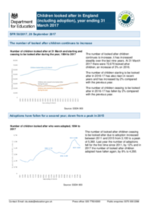
This Statistical First Release (SFR) provides information about looked after children in England for the year ending 31 March 2017, including where they are placed, their legal status, the numbers starting and ceasing to be looked after, and the numbers who go missing or are away from their placement without authorisation.
This study aims to facilitate further identification of the consequences of parental burnout for the parents themselves, their spouses and their child(ren).
This report is based on in-depth interviews with migrant children and parents, real estate and construction companies, government Ministries, and NGOs. It explores the challenges faced by children living in construction site camps, and suggests solutions that can be scaled to foster social responsibility within Thailand’s construction sector.