
Displaying 121 - 130 of 214
On Tuesday, October 22rd, the NGO Committee on UNICEF’s Working Group on Children without Parental Care in collaboration with the Office of the Special Representative to the Secretary-General on Violence against Children and the Permanent UN Missions of Austria and Brazil hosted an event at the UN, which drew representatives from Member States, the UN and civil society, to review progress on the implementation of the guidelines and share experiences from various regional perspectives.
This policy brief by Save the Children introduces the background, goals, and guiding principles of the Guidelines for the Alternative Care of Children endorsed by the UN General Assembly on the 20th of November 2009 while also explaining why family-based care is a preferred care arrangement over institutions. Furthermore, it suggests policy and practice recommendations to further protect children without appropriate care and strengthen families and communities.
This report from the UN High Commissioner for Refugees details the experiences of Syrian refugee children and youth.

This online resource, complete with videos and infographics, accompanies a report from the UN High Commissioner for Refugees which details the experiences of Syrian refugee children and youth.
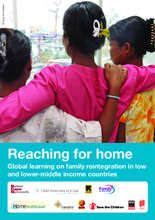
This inter-agency, desk-based research aims to arrive at a clearer understanding of reintegration practices for separated children in low and lower-middle income countries. The research pulls together learning from practitioners and academics working with a range of separated children, such as those torn from their families by emergencies, children who have been trafficked or migrated for work, and children living in institutions or on the streets.
This report just issued by the Child Protection Working Group presents the main findings of an interagency child protection assessment for Syria, covering the period February- May 2013. The report provides findings on key thematic areas: psychosocial wellbeing, physical violence, children associated with armed forces and armed groups, child marriage, sexual violence, child labour, separation from caregivers and access to basic services and information.
A coalition of over 40 international, regional and national NGOs and networks have issued a joint call to member States of the United Nations General Assembly (UN GA) to focus the 2014 Resolution on the Rights of the Child on strengthening family care and providing appropriate alternative care for children.
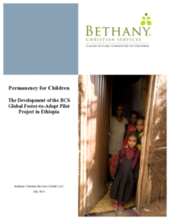
This report provides initial documentation of a pilot program launched by Bethany Christian Services in 2009 in Ethiopia. The pilot aims at moving children from institutional care to family-based care by developing alternative family care for non-relative children using a foster-to-adopt approach, working through a partnership between faith communities in Ethiopia and American faith congregations in the US.
In this article, Kathryn Joyce the author of the book 'The Child Catchers: Rescue, Trafficking, and the New Gospel of Adoption' chronicles the rapidly growing evangelical movement for international adoption in the United States, and its impact on children and their families, with a particular focus on Liberia.
Charts that accompany the article Orphan Fever: The Evangelical Movement’s Adoption Obsession, illustrating the trends in international adoptions from Liberia, Kyrgyzstan, Ethiopia, Uganda, and Haiti to families in the United States.