Displaying 141 - 150 of 214
This manual is the main outcome of the European Commission Daphne III programme, Prevent and Combat Child Abuse: What works? Involving regional exchanges and research from five countries (Germany, Hungary, Portugal, Sweden and the Netherlands), this manual brings together knowledge on what works in tackling child abuse. The manual suggests evidence and practice-based prevention and response strategies against child abuse and neglect, including programs and services that have been shown to be successful in strengthening family care.
The Minimum Standards for Child Protection in Humanitarian Action were formulated in 2011-2012 by the Child Protection Working Group (CPWG), an inter-agency working group composed of child protection practitioners, academics, and policy makers working to support child protection work in humanitarian settings.
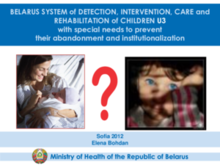
This presentation to the 2012 Sofia Conference introduces social services available in Belarus for the identification, intervention, care, and rehabilitation of children under the age of 3 with disabilities, in order to prevent their abandonment and placement in institutions.
This presentation to the 2012 Sofia Conference by the Kuan Sabi Program, in Kazakhstan suggests ways to improve the knowledge and skills of Primary Health Care workers that care for children under the age of 3.
This research paper provides a brief overview of the Vietnam Babylift and of a more recent child abduction attempt in Chad. Then, turning to the history of child abduction and adoption history in Latin America, the paper presents the conflicts of El Salvador and Argentina and discusses ‘living disappeared’ children – those who disappear into adoption networks during war. The research explores the post-conflict social realities in both nations. The role of the social worker and specific practices are identified and discussed in context of generalist social work practice.
This inter-agency paper was written by Family for Every Child, Better Care Network, Consortium for Street Children, Save the Children, SOS Children’s Villages, and World Vision, for submission to the United Nations consultation: ‘Health in the Post-2015 Development Agenda.’ It examines the links between child protection and health and argues for a continuing focus on health and child survival that encompasses particular goals and indicators on children’s protection.
The purpose of this review was to identify evidence-based early response strategies and interventions for improving the outcomes of children outside of family care, including children of and on the street, institutionalized children, trafficked children, and children affected by conflict and disaster, and who are exploited for their labor. A conclusion was drawn that there is a strong need for strengthening the evidence base regarding the effectiveness or early assessments and responses to children living outside family care and for using evidence to guide operational policy and practice.
Research was conducted in five Rift Valley towns in Kenya in 2011 to understand the link between emergencies and the perceived increase of children joining the streets. Findings show that emergencies such as Post Election Violence and drought have caused children to join the streets. By far the biggest reason for children joining the streets was food insecurity. The authors advocate for an urgent, large-scale response to place children currently connected to the streets in durable situations in tandem with a multi-sectorial development approach to tackle and address the root of the crisis.

Promotes and provides inter-agency information management tools for a coordinated approach to child protection particularly in regards to separated children, children associated with armed groups and forces and other especially vulnerable children.
The Ministry of Gender Equality and Child Welfare (MGECW) of Namibia released the 2012 Foster Care Standards and Guidelines which are aimed to guide social workers and other service providers in recruiting, assessing, training, matching, supporting, supervising and monitoring foster care services. The Foster Care Guidelines assist in translating the Standards into day-to-day practices. These Standards and Guidelines with accompanying training manuals were prepared to strengthen supported family-based care for vulnerable and marginalized children.