Displaying 411 - 420 of 786
The Committee's recommendations on the issues relevant to children's care are highlighted, as well as other care-related concluding observations, ratification dates, and links to the Universal Periodic Review and Hague Intercountry Adoption Country Profile.

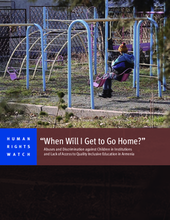
This report is based on Human Rights Watch visits to five state-run orphanages and ten state-run schools, including six special schools and four mainstream schools, and interviews with 173 people, in eight cities in Armenia.
Three semi-structured focus group interviews were conducted with twelve schoolchildren, aged 13–15 years for the purpose of exploring the knowledge and attitudes towards disability of young people within Moldova.
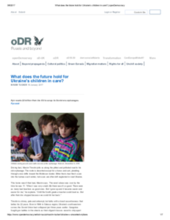
In this issue of ODR, Maxim Tucker details the deinstitutionalization challenges facing Ukraine
The attached study compared the care environments of family-based care and institutional care to determine if care environment contributed to differences in sexual behavior and/or sexual exploitation of orphaned and separated adolescents.
This study examined the psychological wellbeing of children in institutions and their various coping mechanisms.
This paper, produced for the Know Violence global learning initiative, looks at the violence children experience in closed institutions in the Central Asian countries, specifically the former Soviet republics: Kazakhstan, Kyrgyzstan, Tajikistan and Uzbekistan.
Using national and international law, court observations, and field experiences, this paper argues a case for deinstitutionalization of children in India, by empowering the families, thereby protecting children's right to a family and preventing abuse and exploitation.

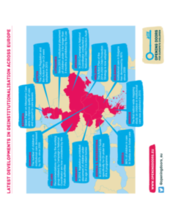
This infographic provides quick status reports on deinstitionalisation in the following countries: Estonia, Latvia, Lithuania, Ukraine, Moldova, Bulgaria, Greece, Serbia, Bosnia & Herzegovina, Hungary, Poland and Romania.
This report from Opening Doors discusses the Opening Doors II pan-European campaign launched in Chisinau.