
Displaying 461 - 470 of 786
This short video by ChildSafe in Cambodia explains how donations to orphanages, rather than helping the situation, often cause the creation of more orphans. It is estimated that about 80% of the 8 million children living in institutions around the world are not actually orphans. Donations to orphanages only fuel the orphanage industry further, so the focus should instead be on supporting families.
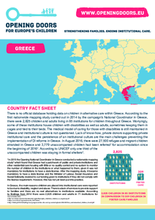
According to this Country Fact Sheet focusing Greece, there is no database holding data on children in alternative care in Greece.
The purpose of this chapter of The United Nations Convention on the Rights of the Child: Taking Stock after 25 Years and Looking Ahead, is to outline the importance of children’s rights monitoring of (international) institutions such as the ICC and to introduce a measurement matrix for undertaking such monitoring.
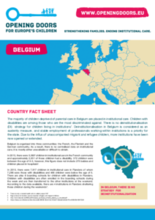
This Country Fact Sheet from Belgium contains short facts on care and institutionalization in Belgium.
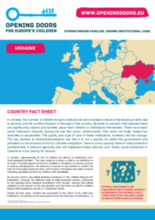
Due to poverty and military conflicts in the east, the number of children in institutional care in Ukraine has increased.
Décadas de investigaciones comprueban que el crecimiento de un niño en una institución posee un impacto nocivo en cuanto a lo psicológico, lo emocional y lo físico, incluyendo trastornos de vinculación, retrasos cognitivos y en el desarrollo, y una falta de capacidades sociales y para la vida que luego concluyen en múltiples desventajas durante la adultez.
Este documento pretende impulsar un cambio en el paradigma de la institucionalización como respuesta a la situación de los niños, niñas y adolescentes privados de cuidados familiares.

This fact sheet highlights Austria’s process in transforming institutional care towards community-based and family-based systems.
This publication includes common questions and answers on the implications of institutional care and why it should be ended.
In this short video, Amanda Thorsteinsson documents the proliferation of orphanages in Uganda and the role of well-intentioned Westerners in contributing to this problem.