
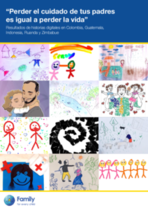
“Losing the care of your parents is equal to losing your life” Findings from digital stories in Colombia, Guatemala, Indonesia, Rwanda and Zimbabwe
This report explores what family means to children and adults in five countries using the digital storytelling technique.
File
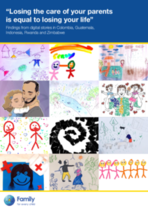
¿A quién le importa? Perspectivas del niño y la familia sobre el cuidado efectivo, quién lo brinda y por qué es importante
Pese a que hay un consenso sobre la importancia del cuidado efectivo en las familias para los niños, existe una falta de discusión y acuerdo sobre los componentes precisos de este cuidado. Este informe contribuye a debatir sobre este importante tema al proporcionar perspectivas de los grupos focales con 198 niños y 81 adultos de Brasil, Colombia, Egipto, México, Rusia, Ruanda y Zimbabue.
File

Who Cares? Child and family perspectives on effective care, who provides it and why it matters
There is extensive research demonstrating clearly the importance of a safe and caring family for child wellbeing and development. While there is consensus on the importance of effective care in families for children, there is a lack of discussion and agreement about the precise components of this care. This report contributes to debates on the components of family care by providing perspectives from nearly 200 children and over 80 adults from Brazil, Colombia, Egypt, Mexico, Russia, Rwanda and Zimbabwe. The report demonstrates that there are many commonalities in perspectives on and experiences of care across contexts.
File

The needs of carers: applying a hierarchy of needs to a foster and kinship care context
As foster and kinship carers are central to the lives of looked after children, it is important to recognise their unmet needs and the impact of these on the caring task. This article explores these issues by applying a hierarchy of needs to the foster and kinship care context, drawing on the perspectives of those involved, a group of Australian foster and kinship carers.
‘My children are my world’: Raising the voices of birth mothers with substantial experience of counselling following the loss of their children to adoption or foster care
The aim of this article is to raise the voices of a group of birth mothers, a historically stigmatised, powerless and neglected group, with substantial experience of counselling following the loss of a child.
‘They don’t meet the stereotypes in the boxes…’: Foster carers’ and clinicians’ views on the utility of psychometric tools in the mental health assessment of looked after children
The current study is the first to explore the perspectives of foster carers and clinicians working in Child and Adolescent Mental Health Services (CAMHS) in relation to the use of two brief screening tools: the Strengths and Difficulties Questionnaire (SDQ) and the Brief Assessment Checklists (BACs).
Baby drop-off box: Comparative Case Studies of The United States of America (สถานบริการตู้รับเด็กทารก: กรณีศึกษาเปรียบเทียบสหรัฐอเมริกา)
This article aims to study the legal measures that Thailand should take to solve the problem of abandoned children in unsafe places.
File
Early Deprivation and Children’s Emotional Development: A Developmental Perspective
In this chapter of the Handbook of Emotional Development, the authors discuss animal models that support developmental theories underscoring the importance of the caregiver–infant relationship for emotional development, explore how varying degrees of neglect may be differentially associated with subsequent emotional outcome, and review empirical work in this area from a developmental perspective by addressing how early neglect may impact the development of biological and behavioral mechanisms that underlie emotional functioning across multiple developmental periods.
School satisfaction among youth in residential care: A multi-source analysis
The aim of this article is to analyse the evaluations made by the main stakeholders involved in the school situation of young people in residential care and propose an explanatory model of their level of school satisfaction (SS) based on variables related to the youngsters' subjective well-being. The sample was composed of 219 subjects from five European countries (Germany, Austria, Croatia, Spain and France), including 75 young people, 75 caregivers, and 69 teachers.