Declaration on Protecting Children in Ukraine and in the European Union: EU Support for Reforming the Child Protection System in Ukraine

Swedish Presidency of the Council of the European Union

The Swedish Presidency has initiated a declaration to support the protection of Ukrainian children. The declaration will mobilise support among EU Member States for continued engagement in protecting the children who have been affected by Russia’s full-scale invasion of Ukraine.

File

Families Find a Way: Children with Disabilities in War-Torn Ukraine

Disability Rights International, Disability Rights Ukraine

DRI asked more than 500 families living in Ukraine what they are now experiencing during the war and what they need. In interviews with DRI staff, parents lay out all the difficult challenges and barriers they face. These interviews provide a blueprint of the change that must occur – by governments, donors, policymakers, caregivers, and communities during the war and recovery process.

File
Guía Para Facilitadores de “Educando en Familia”

Changing the Way We Care

La Guía para facilitadores de “Educando en Familia” es una guía realizada por “Cambiando La Forma en que Cuidamos Guatemala” y está basada en la metodología de Educando en Familia de la Secretaría de Bienestar Social de la Presidencia de la Republica de Guatemala, la guía proporciona herramientas, dinámicas y técnicas para trabajar el programa con grupos de padres, madres y cuidadores; la guía está dirigida a las personas que facilitan el programa o que están certificados para replicarlo por SBS.

File
Основні рекомендації щодо реформування системи захисту і догляду дітей

Interagency Statement

Шістнадцять неурядових організацій, які мають досвід захисту дітей, інклюзії з обмеженими можливостями та прав людини, закликають Уряд України та його міжнародних партнерів виконати ці ключові рекомендації щодо розвитку інклюзивної системи захисту дітей та піклування.

File
Disability Measurement in Residential Care Facilities in Kenya and its Role within Case Management

Changing the Way We Care (CTWWC)

Though research has been conducted on children with disabilities and on children in residential care settings, the intersections of these two topics has yet to be explored in depth. Notably, there is a lack of information surrounding disability measurement within residential care settings, highlighting a gap in the literature. It is estimated that a child with a disability is 17 times more likely to be placed in an institutionalized care setting than a child without a disability, and girls are more likely to be placed in an institution than boys. This report details research conducted in Kenya.

File
Separating Families Causes Trauma

BBC News

In the BBC interview below, parent activist Taliah Drayak presents key findings from the report: Children’s Social Care: The Way Forward. She describes her family’s own nightmare when social workers removed her two-year-old from her custody. 

Scaling Up Family Care Through Care Reform: A Conceptual Framework

Changing the Way We Care (CTWWC)

Changing the Way We Care prioritizes scaling family care as part of care reform. To support global efforts, CTWWC developed a conceptual framework to scaling within the countries where it works. The country-level conceptual framework presents scaling as a seven-step process. Scaling approaches vary across contexts and countries with there being no one-sized fits all approach.

File
Reunification and Reintegration of Children with Disabilities into Family Care: Guidance for Residential Care Facilities & Case Management Teams

Changing the Way We Care (CTWWC)

This guidance aims to provide case workers and others at residential care facilities with the considerations they need to look at for the successful reunification and placement of children with disabilities into family care, including understanding disability and how it impacts children’s care, disability-inclusive case management, and preparing children with disabilities for reunification/placement.

File
Learnings: Positive Parenting and Care Reform in Kenya
Changing the Way We Care (CTWWC)

Positive parenting programs are an important part of this package and are provided together with training in household finance, access to household economic strengthening opportunities, and referrals to other critical services such as child protection and disability support and helping families under stress feel supported and part of their local community. This brief describes the program and interventions.

File

Strengthening Families: How Family Strengthening Can Help Prevent the Unnecessary Separation of Children from their Families

SOS Children's Villages

This document makes the case for the importance of investing in family strengthening in countries across Central and Eastern Europe and Central Asia. It has a particular focus on support for families so that any unnecessary separation of children from their families and placement in alternative care can be prevented.

File

Combination of “Parenting with Tenderness” and “Parenting on the Move” in Migratory Contexts: Successes, challenges, and recommendations

Save the Children Spain

The objective of this Save the Children Spain document is to gather the key findings of the combination of “Parenting with tenderness” and “Parenting on the move” in migratory contexts. It also seeks to improve the quality of its implementation in the context of Mexican migration, based on good practices and lessons learned. 

File

Webinar Recording: Launch of the Transition Cost Estimation Tool

Transforming Children's Care Collaborative

The purpose of this webinar was to launch the tool, provide background information on its development, the analysis that underpins it, and conduct a virtual walk through of the tool.

El propósito de este seminario web fue lanzar la herramienta, proporcionar información de antecedentes sobre su desarrollo, el análisis que la sustenta y realizar un recorrido virtual por la herramienta.

Mutual Benefits: The Lessons Learned from a Community-Based Participatory Research Project with Unaccompanied Asylum-Seeking Children and Foster Carers

Justin Rogers, Sam Carr, Caroline Hickman - Children and Youth Services Review

This paper presents a community based participatory research project, which adopted a photovoice approach with seven unaccompanied asylum-seeking children (UASC) living in foster care in the United Kingdom.

File

Beyond a Dreamcatcher - Improving Services for Indigenous Justice Involved Youth with Substance Use Challenges: A Youth-led Study

McCreary Centre Society’s Youth Research Academy (YRA)

This youth-led study sought to capture the perspectives of Indigenous youth who had been involved in the criminal justice system (or who were at high risk of such involvement), and who had accessed substance use treatment and/or had experienced barriers to accessing substance use services.

File

Learning from Lived Experience in Government Care: Sharing Gains in Knowledge and Practice in Youth Participation with Key Care Stakeholders

Jade Purtell, Luke Westwick, Brittany Witnish, Jarrad Butcher, Annie [Withheld], Ralph Salera, Jenna Bollinger

This paper presents three care experienced perspectives on the benefits and challenges of capturing the voices of young people to inform policy and organisational decision-making in youth services.

File

Examining the Role of Lived Experience Consultants in an Australian Research Study on the Educational Experiences of Children and Young People in Out-of-Home Care

Philip Mendes, Jade Purtell, Sarah Morris, Emily Berger, Susan Baidawi, Levita D’Souza, Jenna Bollinger, Natasha Anderson, Geordie Armstrong

This paper presents the findings of a study in the Australian state of Victoria where a group of lived experience consultants (LECs) were employed to consult on the results of a broader survey of the attitudes of professionals, carers and care leavers regarding the educational experiences of children in out-of-home care.

Image
Qualitative Social Work

Transforming Children's Care Webinar #13: Learning from Participatory Research with Careleavers: Experiences from Latin America and Australia

Transforming Children's Care Collaborative

Drawing from the learning from participatory research in Latin America and the Caribbean as well as Australia, this webinar introduced different approaches used to engage individuals with lived experience of alternative care in research efforts.

United States Catholic Support for Overseas Residential Care: A Survey and Research Investigation of Catholic Organizations in the United States

Changing the Way We Care

Changing the Way We Care (CTWWC) conducted a study on the support by U.S. Catholic organizations for overseas residential care of children in 2018. This report provides insights from the study on U.S. Catholic Church support for children’s residential care facilities outside of the U.S. Its data provides a foundation for building effective engagement and messaging strategies, as well as helps inform advocacy and influence work concerning support for family strengthening and care for vulnerable children by the U.S. Catholic community.

File

Building Climate Change Into Care Reform in Eastern and Southern Africa

UNICEF ESARO, Changing the Way We Care (CTWWC)

This UNICEF/CTWWC paper argues that climate change is the greatest current and future threat to children’s care in the Eastern and Southern Africa region. Responding to this threat requires urgent coordinated action related to care reform policies and interventions and climate change responses.

Reconocidos, Contabilizados, Incluidos: Utilizar los Datos para Arrojar Luz Sobre el Bienestar de los Niños y Las Niñas Con Discapacidad - Resumen

UNICEF

El informe tiene como objetivo promover el uso de estos datos con el propósito de dar más protagonismo a los niños y niñas con discapacidad y de ese modo lograr una conciencia más plena de sus vivencias.

File

االهتامم، والرعاية، واإلدماج : استخدام البيانات لتسليط الضوء عىل عافية األطفال ذوي اإلعاقة - ملخص

UNICEF

تخل  جهود نمضالإعاقة  يللأطفال ذو جالإدما دصرعملية  تلَّطعتلطالما  شاملة. غير أنّ السنوات الأخيرةو ٍةقالتنمية بسبب الافتقار إلى بياناتٍ موثو  الأدواتوشهدت جهوداً مُجدَّدة كانت ترمي إلى سدّ الثغرات في البيانات.  أدَّت إلى زيادةٍ كبيرة في توافر دقلجمع البيانات  تَث ِدحُالجديدة التي است  رُوْلبت زّالإعاقة، الأمر الذي عز يجودة البيانات المتعلقة بالأطفال ذوو ج المعرفة.اتنالتحليلات الجديدة وساهم في زيادة إ

File

Seen, Counted, Included: Using Data to Shed Light on the Well-Being of Children with Disabilities

UNICEF

Millions of children with disabilities around the globe continue to be left behind, despite the near-universal ratification of the Convention on the Rights of the Child, the call for action embedded in the Convention on the Rights of Persons with Disabilities and the clear mandate set by the

File

Included, Every Step of the Way: Upholding the Rights of Migrant and Displaced Children with Disabilities

UNICEF

Children with disabilities and children on the move represent highly diverse populations living in a broad range of circumstances. But as two of the most marginalized groups of children in the world, there is much they have in common, often-times neglected in data collection, policies and programming. This report examines children’s lives when these two identities intersect.

File

Heartline Case Study: Transitioning from Residential Care to Family Care in Haiti

Faith to Action

The story of Heartline’s transition from residential care to family care is told in this recently released Faith to Action case study. The case study details their experience through three stages of transition—learning, preparation and planning, and full transition—with transparency. It addresses common challenges for transitioning organizations, as well as the strategies Heartline took to overcome them.

File

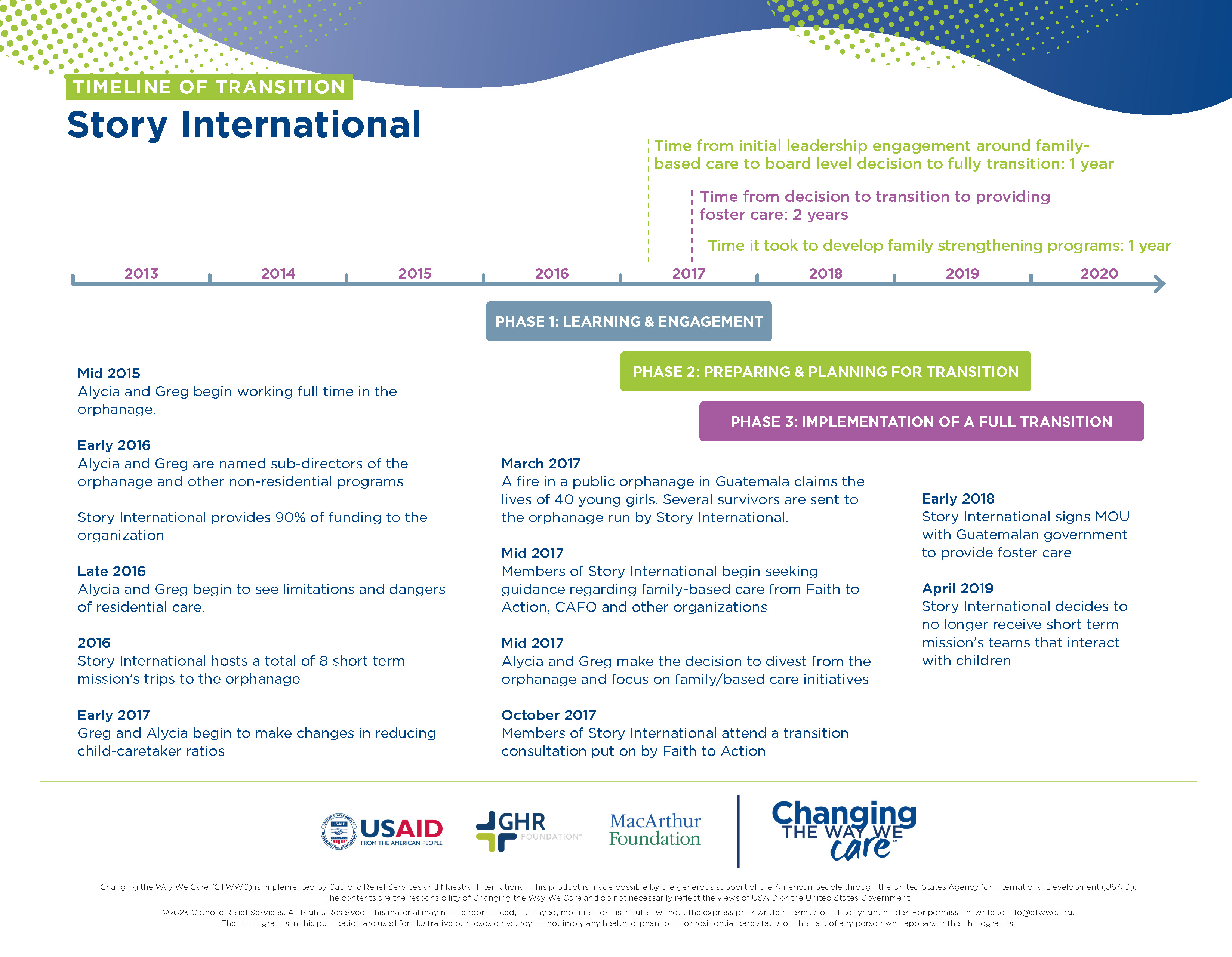
Buckner Case Study: Transitioning from Residential Care to Family Care in Guatemala

Faith to Action

The story of Buckner Guatemala’s transition from residential care to family care is told in this recently released Faith to Action case study. The case study details their experience through three stages of transition—learning, preparation and planning, and full transition—with transparency. It addresses common challenges for transitioning organizations, as well as the strategies Buckner took to overcome them.

File

UNICEF MICS7 Launch Meeting

UNICEF MICS

During the 54th session of the UN Statistical Commission, the Global MICS team launched MICS 7 with several new initiatives such as MICS Plus, geocoding, and integration with administrative data sources.

Insights from Moldova: Closing of a Residential Institution

Changing the Way We Care

After 60 years of serving as a residential institution for children with disabilities, the Hîncești Auxiliary Boarding school (SIA Hîncești) in Moldova closed its doors to children in May 2022. The closing of Hîncești SIA serves as a harbinger for what is possible for other institutions for children with disabilities in Moldova and around the world.

File

L'efficacité du Telephone Portable Comme Outil de Signalement et de Rétroaction pour les Enfant dans les Familles d'acceuil en Gambia: Succés, Enjeaux et Recommandations

Save the Children Spain

Save the Children a développé ce programme d'apprentissage afin d'évaluer l'utilisation des téléphones portables comme mécanismes d'information et de rétroaction pour les enfants placés en Gambie et de déterminer s'il est efficace et sécurisé.

File

The Inshuti z’Umuryango: The Volunteers Helping Keep Children Safe in Rwanda (Results Brief)

UNICEF, Rwanda National Child Development Agency

This brief presents the results of several assessments of the ‘Friends of the Family’ or ‘Inshuti z’Umuryango’ (IZU) initiative  in Rwanda. IZU is a frontline volunteer cadre introduced in 2016 as part of Rwanda's national child protection system strengthening and care reform efforts. 

File

Foster Families in Moldova Provide Safety and Protection for Children Fleeing Conflict from Ukraine

UNICEF

Alexander is one of many Ukrainian teenagers who fled to Moldova unaccompanied. Thanks to the partnership between border police, child protection specialists working with UNICEF and local authorities, he was identified and integrated into a foster family from Causeni. Since the onset of the conflict, one of UNICEF's biggest priorities has been to protect children from abuse or trafficking. 

The Bridge to Belonging: The Integration Journey for Unaccompanied Children from the Middle East to Europe

Family for Every Child

This report examines what happens after unaccompanied children have arrived at their European destinations and is based on interviews with key informants, a literature review, and research in three sites (Lebanon, Greece and Germany). What does it mean to integrate into a new society when you are a child on your own? How do they face the challenges of building an identity without their families, process the violence and dangers of their journeys, and face a new situation that may not be as welcoming or straightforward as they had expected?

File

Exploring Education, Health, and Child Protection Support Penetration

Jonathan Friedman, Camelia Gheorghe, Isaac Kamber

This web application was developed to allow for the exploration of various scenarios in the field of education, health, and child protection. The application offers a platform for the analysis of historical trends and patterns using a combination of open data and proprietary data shared by the Government of Moldova.

The Effectiveness of Providing Foster Care in Gambia with Cell Phones as a Reporting and Feedback Mechanism: Successes, Challenges and Recommendations

Save the Children Spain

Save the Children has developed this learning agenda in order to assess the use of cell phones as information and feedback mechanisms for foster children in Gambia and to determine whether it is effective and secure. 

File

التصدي لالنتحار يف األوضاع اإلنسانية

Inter-Agency Standing Committee Reference Group on Mental Health and Psychosocial Support (IASC MHPSS RG)

تهدف هذه المذكرة التوجيهية إلى دعم منفذي البرنامج والمنسقين والجهات الفاعلة الإنسانية الأخرى في معالجة الانتحار وإيذاء النفس في الأوضاع الإنسانية. إنه يجمع مجموعة واسعة من الأساليب والأدوات والمواد المرجعية وأمثلة الحالة.

File

人道主义背景下自杀问题应对指南

Inter-Agency Standing Committee Reference Group on Mental Health and Psychosocial Support (IASC MHPSS RG)

本指导说明旨在支持项目实施者、协调员和其他人道主义行为者解决人道主义环境中的自杀和自残问题。 它汇集了范围广泛的方法、工具、参考资料和案例示例。 它是一种实用而简洁的资源,适用于所有类型的紧急情况、组织和部门。

该文件包括三个主要部分:(i) 机构间协调和评估; (ii) 所有方案的基本组成部分; (iii) 关键有效的自杀预防和干预计划活动,读者可以根据优先事项和需要从中选择。 色彩丰富的说明旨在有效帮助人道主义行为者将技术内容应用到现实生活中。 它还展示了跨紧急情况的众多多部门自杀预防举措的例子,从国际组织的无线电广播活动到国家当局实施的数据收集方法。

File

Abordagem ao Suicídio em Contextos Humanitários

Inter-Agency Standing Committee Reference Group on Mental Health and Psychosocial Support (IASC MHPSS RG)

Esta nota de orientação visa apoiar os implementadores de programas, coordenadores e outros atores humanitários na abordagem do suicídio e da automutilação em contextos humanitários. Ele reúne uma ampla gama de abordagens, ferramentas, materiais de referência e exemplos de casos.

File

Решение проблемы самоубийств в контексте гуманитарной деятельности

Inter-Agency Standing Committee Reference Group on Mental Health and Psychosocial Support

Это руководство направлено на оказание поддержки исполнителям программ, координаторам и другим гуманитарным организациям в борьбе с самоубийствами и членовредительством в гуманитарных условиях. Он объединяет широкий спектр подходов, инструментов, справочных материалов и примеров из практики.

File

Time to Act – Toolkit for Practitioners: Gender-Transformative Programme Strategies for Addressing Child, Early and Forced Marriage and Unions in Asia-Pacific

Plan International Asia-Pacific Regional Hub

This toolkit developed by Plan International Asia-Pacific Regional Hub serves as a practical compendium of programming guidance for practitioners, and contributes to accelerating efforts to end child, early and forced marriage and unions (CEFMU) by 2030, in line with the Sustainable Development Goals (SDGs).

File

ការអនុវត្តក្របខណ្ឌចបាប់ ចំពោះអំពើជួញដូរកុមារ ក្នុងមណ្ឌលកុមារកំព: ករណីសិកសានៅកម្ពុជ

Rebecca Nhep និង Dr Kate van Doore

ការសិកសាស្រវជ្រវនះត្រូវធ្វើឡើងជាផ្នកមួយនគម្រងស្រវជ្រវពហុប្រទស ដលមានច្រើន ដំណាក់កាល ដលត្រូវបានរចនាឡើង ដើមបីពង្រឹងការកំណត់អត្តសញ្ញណ ការផ្ដន្ទទោស និងការទប់ស្កត់ បទល្មើសជួញដូរកុមារក្នុងមណ្ឌលកុមារកំព្រ។ការសិកសាស្រវជ្រវនះគឺជាដំណាក់កាលទីពីរនដំណាក់កាល ទាំងបួន ដលត្រូវធ្វើនៅកម្ពុជា ក្នុងនាមជាប្រទសមួយក្នុងច

File

Implementing the Legal Framework for Orphanage Trafficking: A Cambodia Case Study (A Summary of Findings)

Rebecca Nhep, Dr Kate van Doore

This study was conducted as a part of a multi-stage, multi-country project designed to enhance the identification, prosecution, and prevention of orphanage trafficking crimes. It was the second of four stages to be conducted in Cambodia as one of three jurisdictions included in the study. This report contains a summary of findings from this stage two case data and case study analysis.

File

Implementing the Legal Framework for the Prosecution of Orphanage Trafficking: A Cambodia Case Study

Rebecca Nhep, Dr Kate van Doore

This study was conducted as a part of a multi-stage, multi-country project designed to enhance the identification, prosecution, and prevention of orphanage trafficking crimes. It was the second of four stages to be conducted in Cambodia as one of three jurisdictions included in the study.

File

Designing Research to Study the Effects of Institutionalization on Brain and Behavioral Development: The Bucharest Early Intervention Project

Charles H. Zeanah, Charles A. Nelson, Nathan A. Fox, Anna T. Smyke, Peter Marshall, Susan W. Parker, Sebastian Koga

This paper provides an overview of the largest longitudinal investigation of institutionalized children less than 2 years old ever conducted. The Bucharest Early Intervention Project is an ongoing randomized controlled trial of foster placement as an alternative to institutionalization in abandoned infants and toddlers being conducted in Bucharest, Romania.

File

The Bucharest Early Intervention Project: Adolescent Mental Health and Adaptation Following Early Deprivation

Mark Wade, Jill Parsons, Kathryn L. Humphreys, Katie A. McLaughlin, Margaret A. Sheridan, Charles H. Zeanah, Charles A. Nelson, Nathan A. Fox

In this review, the authors detail the extent to which early deprivation affects mental health during vulnerable developmental periods, the capacity of family-based care to facilitate recovery from early deprivation, and the mechanisms underpinning these effects spanning social–emotional, cognitive, stress, and neurobiological domains.

Foster Care Leads to Sustained Cognitive Gains Following Severe Early Deprivation

Kathryn L. Humphreys, Lucy S. King, Katherine L. Guyon-Harris, Charles H. Zeanah

This study examined longitudinal data from the Bucharest Early Intervention Project, a randomized controlled trial of foster care as an alternative to institutional care following exposure to severe psychosocial deprivation. The findings indicate that early investment in family care as an alternative to institutional care leads to sustained gains in cognitive ability.

File

Rights of Persons With Disabilities During the War in Ukraine: Summary of Monitoring Report

Kharkiv Institute of Social Research (KhISR), League of the Strong (LS), European Disability Forum (EDF), National Assembly of People with Disabilities (NAPD)

Brief overview of the situation regarding the rights of people with disabilities in Ukraine one year after the beginning of the invasion of Ukraine by Russia.

File

Analytic Report: Based on the Survey of Legal Representatives of Children With Disabilities Concerning Access in Ukraine After 24 February 2022 to Benefits and Services Established by Legislation for Children with Disabilities and their Family Members

Larysa Bayda, Olha Mordan, Alla Sotska

This survey was carried out from December 19, 2022, to January 17, 2023. Its purpose was to determine the situation regarding potential opportunities for the implementation of legally guaranteed rights for children with disabilities and members of their families and the relevant practices and to study the urgent problems in the wartime.

File