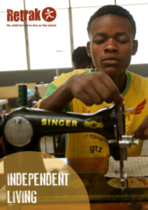
Independent Living

Retrak

This literature review explores current international and selected national policy on independent living arrangements and examines the evidence of good practice from existing independent living programmes for care leavers in order to assess how both of the above can be applied to street-connected children.

File

National Child Protection Working Group Formative Assessment Towards Strengthening the Child Protection System in Uganda

Richard Wamimbi Wotti - Royal Roads University Canada/Centres for Child Protection and Learning (CPL)

The Child Protection Working Group (CPWG) commissioned this assessment to assess the effectiveness of the CPWG, structural setup and work methods from 2012 to date in contributing to child protection systems strengthening in Uganda.

File

National Child-Focused Policy Research Agenda: 2016-2020

Sophie Busi, in close collaboration with the National Council for Children (NCC), the AfriChild centre, the Uganda Bureau of Statistics (UBoS), and UNICEF

Although not conclusive or exhaustive, this agenda represents a bold attempt to identify and prioritise key areas/research themes stemming from the Situation Analysis (2015) and other available evidence on the status of children in Uganda.

File

USAID/Uganda OVC Portfolio Review

4Children

This portfolio review of OVC programming in Uganda focuses on several priority issues, including: (1) targeting case management and referral mechanisms; (2) graduation; (3) links with HIV/AIDS care and treatment partners; and (4) overall coordination amongst implementing partners.

File
Technical Advisory Paper: Towards the National Children Policy Uganda

Ministry of Gender Labour and Social Development, Uganda

This technical advisory paper is prepared for the Ministry of Gender, Labour and Social Development to guide the scope of the National Children Policy expected to replace the existing National Policy on Orphans and Other Vulnerable Children in Uganda which has been in existence for past 12 years.

File

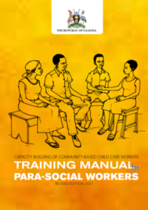
Capacity building of community based child care workers: A National Training Manual for Para Social Workers (2nd Edition)

Ministry of Gender, Labour and Social Development - Uganda

This manual is intended to train Para-social workers who are a non-formal “workforce” that constitute the largest but yet undefined group of caregivers who provide support and services to vulnerable children and families, particularly in low and middle income countries (GSSA, 2016).

File

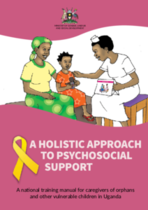
A Holistic Approach to Psychosocial Support: A national training manual for caregivers of orphans and other vulnerable children in Uganda

Ministry of Gender, Labor and Social Development, Uganda

The focus of this manual is on translating theoretical knowledge about policies into practical actions to provide psychosocial support to orphans and vulnerable children.

File

Interventions to Reduce Violence Against Children in Low- and Middle-income Countries: Evidence and Gap Map Research Brief 1 Overview of findings

Ashrita Saran; Ramya Subrahmanian; Howard White - UNICEF

This brief summarizes the key findings from the Evidence Gap Map on interventions to reduce violence against children in low- and middle-income countries.

File
Substance-related problems among adolescents in child welfare services: A comparison between individuals receiving in-home services and those in foster care

Ove Heradstveit, Nathalie Gjertsen, Anette Christine Iversen, Sondre Aasen Nilsen, Kristin Gärtner Askeland, Øivin Christiansen, Mari Hysing - Children and Youth Services Review

The purpose of this study was to investigate whether Norwegian adolescents in contact with child welfare services (CWS) are at higher risk for substance-related problems (SRP) compared with the general adolescent population, and to what extent those in foster care (FC) differ from those receiving in-home services (IHS).

Global status of violence against children and how implementation of SDGs must consider this issue

Najat Maalla M’jid - Child Abuse & Neglect

In this paper, United Nations Special Representative of the Secretary-General on Violence against Children, Najat Maalla M’jid, notes that "progress towards ending all forms of violence against all children is slow and we need to act better, faster and further in bringing violence against children to an end by 2030 as per the commitment in SDG 16.2."

The Aims and Outcomes of Public Inquiries into the Care and Protection of Children: Should They Be Undertaken Differently?

Sharon Vincent, Kim Holt, Nancy Kelly, Emma Smale - Child Abuse Review

This paper examines experts' perceptions of the aims and outcomes of public inquiries, before moving on to consider whether there are more effective and efficient ways of investigating national scandals.

Suffer the Little Children and their Mothers: A Dossier on the Unjust Separation of Children from their Mothers

Anne Neale and Nina Lopez for Legal Action for Women

This Dossier aims to show the extent of the problem of children being taken into care in the UK and the trauma of family separation, the supporting evidence self-help groups of mothers are beginning to get from professionals, and to make proposals for action.

File
Treatment of Migrant Children on the US Southern Border Is Torture

Charles Oberg, Coleen Kivlahan, Ranit Mishori, William Martinez, Juan Raul Gutierrez, Zarin Noor and Jeffrey Goldhagen - Pediatrics

This article from the journal of Pediatrics argues that the treatment of migrant children at the U.S. southern border fulfills the criteria for torture and calls on pediatricians and child health professionals to "collaborate with other advocates and advocacy organizations to forge local, national and international responses to stop and prevent torture of migrant children at the border and globally."

File
A Double-Edged Sword: Protection Risks Facing Venezuelan Children During the COVID-19 Pandemic

World Vision

This report examines the two-sided dilemma for Venezuelan children during the COVID-19 pandemic: 1) the dire economic situation they faced prior to the declaration of the Coronavirus pandemic and 2) the exacerbating factors that have deepened their vulnerability since the pandemic began.

File
Guiding principles for strengthening the participation of local Aboriginal community in child protection decision making

Grandmothers Against Removals (GMAR) and NSW Department of Family and Community Services (FACS)

This set of guiding principles aim to improve the collaboration between the NSW Department of Family and Community Services (FACS) and Aboriginal communities on child protection matters. It is intended to be a guide that may be used by Aboriginal communities and regional FACS offices across NSW.

File
IRISS Podcast: National statistical data returns: linking individual data for looked after children

IRISS

The core aim of this programme is to contribute to the development of a platform that will support better understanding of the routes from intervention to outcomes for vulnerable children in Scotland through utilising administrative datasets and longitudinal research.
Análisis nacional sobre el sistema de protección y cuidado del niño/a en Paraguay - Cumbre de la etapa: Análisis de resultados y diseño de soluciones

Ministerio de la Niñez y Adolescencia y Ministerio de la Defensa Pública con la Corte Suprema de Justicia y el Ministerio Público

El presente informe de sistematización tiene como propósito hacer accesible la información producida en la Cumbre de la etapa final del análisis transversal del sistema de protección de la niñez, y ser una herramienta de comunicación y planificación al servicio de las instituciones públicas que formaron parte de este proceso.

File

National cross-government review of the child protection and care system in Paraguay - Summit of the final stage: Analysis of results and design of solutions

Ministry of Children and Adolescents and Ministry of Public Defense with the Supreme Court of Justice and the Office of the Public Prosecutor

The purpose of this systematization report is to make available the information produced at the Summit in the final stage of the cross-sectional review of the child protection system in Paraguay, and to be a communication and planning tool at the service of the Government agencies that were part of this process.

File

Scottish Care Leavers Covenant Alliance ‘Collaborative Voice’ Briefing

Scottish Care Leavers Covenant Alliance

This briefing paper aims to highlight some of the key issues and some of the solutions that have been identified through regular meetings of the Scottish Care Leavers Covenant (SCLC) Alliance during the COVID-19 pandemic, drawing together learning from their own work and extensive networks with partners to offer a number of recommendations, and to prioritise steps to improve the lives of care leavers.

File

Kinship carers' experiences during the coronavirus crisis

Kirsty Deacon - CELCIS

A survey was administered to develop a better understanding of the experiences of kinship care households in the UK as a result of the Coronavirus crisis, and what urgent steps could be taken by Government, local authorities and other agencies to help. This supplementary report provides an in-depth analysis of the kinship carers in Scotland and provides the legal context to influence national and local kinship care policies, practices and services of local authorities and other public agencies.

File

Youth Thrive: Our Story (So Far)

Francie Zimmerman - Center for the Study of Social Policy (CSSP)

This report describes efforts through 2019 by the Center for the Study of Social Policy's Youth Thrive initiative to increase opportunities so that all youth have the chance to thrive.

File

Hope in the Time of Chaos: CHOC Children’s Strengthened Response to COVID-19 through DULCE

Center for the Study of Social Policy

This brief demonstrates the power of Developmental Understanding and Legal Collaboration for Everyone (DULCE) - a universal, evidence-based pediatric care innovation that addresses the social determinants of health and supports early relational health for families with infants from birth to six months - in addressing the critical concrete needs of families with newborns during the COVID-19 pandemic.

File

Equity in Action: DULCE Addresses the Health and Emotional Needs of Families During the COVID-19 Pandemic

Center for the Study of Social Policy

This brief summarizes the response and value of the Developmental Understanding and Legal Collaboration for Everyone (DULCE) approach during the first four months of the COVID-19 pandemic, the essential elements of the model that support its strength, and lessons learned.

File

How COVID-19 Is Placing Vulnerable Children at Risk and Why We Need a Different Approach to Child Welfare

Todd I. Herrenkohl, Debbie Scott, Daryl J. Higgins, J. Bart Klika, Bob Lonne - Child Maltreatment

In this commentary, the authors explain how current circumstances reinforce the need for systemic change within statutory child welfare systems and the benefits that would accrue by implementing a continuum of services that combine universal supports with early intervention strategies.

File

Parents organizing a grassroots movement to reform child welfare

David Tobis - The Routledge Handbook of Critical Social Work

This chapter of the Routledge Handbook of Critical Social Work, written by David Tobis, examines an inspiring story of dramatic change in New York’s child welfare system and how parents whose children were in foster care contributed to those changes. It demonstrates how grassroots activism can be suggestive for critical social work.

What Parents Say…Issue Briefs

The Children’s Trust Fund Alliance and Birth Parent National Network

The Children’s Trust Fund Alliance joined with a group of parents from the BPNN to produce these issue briefs. They include the perspectives of parents with life experiences in using services to strengthen their families and focus on timely and important topics.

upEnding the Child Welfare System: The Road to Abolition - Day One

University of Houston Graduate School of Social Work and the Center for the Study of Social Policy

On 20-21 October 2020, the Center for the Study of Social Policy (CSSP) and the University of Houston Graduate College of Social Work (GCSW) held two-day virtual conversations with organizers, activists, scholars, and community leaders to strategize innovative ways to create a society in which the forcible separation of children from their families is no longer an acceptable solution for families in need.

Moving Beyond the Family Engagement Check Box: An Innovative Partnership to Promote Authentic Family Engagement in Systems Change

Center for the Study of Social Policy

This case study examines the partnership that the Center for the Study of Social Policy (CSSP) and Family Voices undertook to create and implement a process for engaging families in the Pediatrics Supporting Parents (PSP) national initiative to promote the social and emotional development (SED) of young children.

File

Towards Culturally Specific Solutions: Evidence from Ghanaian Kinship Caregivers on Child Neglect Intervention

Alhassan Abdullah, Margarita Frederico, Ebenezer Cudjoe, Clifton R. Emery - Child Abuse Review

Drawing on semi‐structured in‐depth interviews with 31 kinship caregivers, this study sought to explore how the culturally informed traditional kinship care practice in Ghana can be considered an intervention strategy for parental neglect.

Building Positive Futures: Exploring a Peer Research Approach to Study Leaving Care in Africa

Kelly, B van Breda, A, Bekoe, J, Bukuluki, P, Chereni, A, Frimpong-Manso, K, Luwangula, R, Pinkerton, J, Ringson, J & Santin, O - SOS Children's Villages, University of Ghana, Queen's University Belfast, University of Johannesburg, Makerere University

This report outlines the peer research approach adopted by the Building Positive Futures project and summarises the findings of the pilot of the peer research methodology on leaving care in Africa.

File

Building Positive Futures: A Pilot Study on Leaving Care in Africa - Youth Report

Kelly, B van Breda, A, Bekoe, J, Bukuluki, P, Chereni, A, Frimpong-Manso, K, Luwangula, R, Pinkerton, J, Ringson, J & Santin, O - SOS Children's Villages, University of Ghana, Queen's University Belfast, University of Johannesburg, Makerere University

This report is a short summary of the main findings from 'Building Positive Futures: A Cross-Country Pilot Study on Youth Transitions from Out-of-Home Care in Africa,' written for youth who participated and other interested young people.

File

Building Positive Futures: A Cross-Country Pilot Study on Youth Transitions from Out-of-Home Care in Africa

Kelly, B van Breda, A, Bekoe, J, Bukuluki, P, Chereni, A, Frimpong-Manso, K, Luwangula, R, Pinkerton, J, Ringson, J & Santin, O - SOS Children's Villages, University of Ghana, Queen's University Belfast, University of Johannesburg, Makerere University

Given the paucity of research on youth transitioning from alternative care (i.e. care-leaving or leaving care) in Africa, the study sought to develop and test a methodology for a cross-country, comparative study on leaving care in Africa.

File

‘She was there if I needed to talk or to try and get my point across’: specialist advocacy for parents with intellectual disability in the Australian child protection system

Susan Collings, Margaret Spencer, Angela Dew & Leanne Dowse - Australian Journal of Human Rights

In this study, semi-structured interviews were undertaken with parents with intellectual disability who accessed a specialist advocacy programme in New South Wales, Australia. Thematic analysis was used to identify the influence of advocacy on parents’ experiences.

upEnding the Child Welfare System: The Road to Abolition - Day Two

University of Houston Graduate School of Social Work and the Center for the Study of Social Policy

On 20-21 October 2020, the Center for the Study of Social Policy (CSSP) and the University of Houston Graduate College of Social Work (GCSW) held two-day virtual conversations with organizers, activists, scholars, and community leaders to strategize innovative ways to create a society in which the forcible separation of children from their families is no longer an acceptable solution for families in need.

Toolkit for Transformation: Building an International Parent-Led Movement Fighting for Families Affected by Child Welfare

International Parent Advocacy Network (IPAN) and Rise

The International Parent Advocacy Network (IPAN) and Rise have developed this toolkit for advocacy by parents whose families have been harmed by child welfare systems worldwide

Practice Brief - International Review of Parent Advocacy in Child Welfare: Strengthening Children's Care and Protection Through Parent Participation

Better Care Network

This Practice Brief accompanies the International Review of Parent Advocacy in Child Welfare: Strengthening Children's Care and Protection Through Parent Participation.

File

International Review of Parent Advocacy in Child Welfare: Strengthening Children's Care and Protection Through Parent Participation

Better Care Network and International Parent Advocacy Network (IPAN)

Promoting parent and child participation is central to achieving children’s rights. This review of the literature and program documentation presents evidence on the role of parent advocacy in achieving better outcomes for children and their families in child welfare.

File

Guidance Manual on Strengthening Supervision for the Social Service Workforce

Global Social Service Workforce Alliance - Supervision Interest Group

The purpose of this manual is to offer guidance on supervision to individuals working to provide, manage or coordinate social services. This manual defines what is meant by supervision in social services, outlines the key elements of good practice in supervision and summarizes the different forms of supervision.

File

Crímenes de Lesa Humanidad: Décadas de Violencia y Abuso en las instituciones para Niñas, Niños, Adolescentes y Adultos con Discapacidad

Laurie Ahern, Lisbet Brizuela, Ivonne Millán, Priscila Rodríguez, Eric Rosenthal - Disability Rights International

Este informe documenta violaciones graves y generalizadas a los derechos humanos de niñas, niños adolescentes y adultos con discapacidad en centros residenciales en México.

File

Crimes Against Humanity: Decades of Violence and Abuse in Mexican Institutions for Children and Adults with Disabilities

Laurie Ahern, Lisbet Brizuela, Ivonne Millán, Priscila Rodríguez, Eric Rosenthal - Disability Rights International

This report documents severe and pervasive human rights violations against children and adults with disabilities in residential facilities in Mexico.

File

Promoting Safe and Stable Families

Detroit Center for Family Advocacy and the Child Advocacy Law Clinic at the University of Michigan Law School

This report presents data from a three-year pilot of a program that set out to prevent removals and expedite permanency by providing multidisciplinary services to at-risk families in Detroit, Michigan, USA.

File

UNHCR MENA Protection Service: Enhancing child protection services by incorporating Cash-based Interventions as part of comprehensive programming

UNHCR

This report presents the results of multi-country research launched in 2018 on refugee data in Egypt, Jordan and Lebanon to study the impact of cash-based interventions (CBI) on child protection outcomes.

File

The Aboriginal and Torres Strait Islander Child Placement Principle Indicators 2018-19: measuring progress

Australian Institute of Health and Welfare - The Australian Government

This report brings together the latest state and territory data on 5 Aboriginal and Torres Strait Islander Child Placement Principle (ATSICPP) indicators that measure and track the application of the Placement and Connection elements of the ATSICPP.

File

Child Welfare Organizing Project: Community Connections - Program Evaluation Final Report

Marina Lalayants - Silberman School of Social Work, The City University of New York

This evaluation study was conducted in an effort to learn more about the innovative parent organizing model implemented by the Child Welfare Organizing Project (CWOP) in East Harlem, New York City and identify the role and impact of CWOP community representatives on birthparents, families, and child safety conference outcomes.

File

Strategies to Increase Birth Parent Engagement

Casey Family Programs

As an outgrowth of Casey’s ongoing work with birth parents, Research Services and Technical Assistance Unit collaborated to review strategies and programs that increase birth parent engagement with child welfare services and that develop effective child welfare partnerships with birth parents as mentors, leaders and advisers. 

File

“If a community values its children, it must cherish their parents”: Family inclusion initiatives in child welfare

Jessica Cocks - Churchill Trust

This Churchill Fellowship has explored family inclusion initiatives in the USA, Canada, Norway and the UK and has found that family inclusion is a pathway to better outcomes for children and young people including restoration and permanency.

File

Parent Partner Program Navigator: Designing and Implementing Parent Partner Programs in Child Welfare

Capacity Building Center for States

The Parent Partner Program Navigator guides child welfare administrators, staff, and parent leaders through key components of designing and implementing successful parent partner programs. Developed collaboratively with experienced parent partners and program coordinators, the Navigator offers guidance and capacity building resources based on research, practice experience, and implementation science.

File

A Foundation to End Child Poverty: How universal child benefits can build a fairer, more inclusive and resilient future

Save the Children

This report from Save the Children calls upon governments, donors and other development partners to urgently support an expansion in social protection coverage of children and their caregivers (predominantly women), working progressively towards UCBs.

File

Executive Summary: A Foundation to End Child Poverty: How universal child benefits can build a fairer, more inclusive and resilient future

Save the Children

This report from Save the Children calls upon governments, donors and other development partners to urgently support an expansion in social protection coverage of children and their caregivers (predominantly women).

File

Coping with more than COVID-19

Kelley Swain - The Lancet Child & Adolescent Health

In this piece for the Lancet, Kelley Swain reflects on the UNICEF video essay series, “Coping with COVID-19”, which invited 16 adolescent girls from nine countries to film their lives under lockdown—“unfiltered, unscripted, 100% real”.

File

Legal Representation for Parents in Child Welfare Proceedings: A performance-based analysis of Michigan practice

American Bar Association Center on Children and the Law for The Child Welfare Services Division of The Michigan State Court Administrative Office

The current assessment is the fourth in a series of independent assessments examining core systemic issues in Michigan’s child protection system.

File

Balkans Migration and Displacement Hub Data and Trend Analysis: Regional overview (April-June 2020)

Save the Children

Data and Trend Analysis (DATA) Refugees and Migrants at the Western Balkans Route Regional Overview, covering period April – June 2020, describes key trends in migrations in the region, detailing information about the number of people on the move, demography (age, sex, country of origin, etc), behavioral patterns, and routes in use - with a focus on children, particularly unaccompanied children.

File

ICWA Downunder: Exploring the Costs and Benefits of Enacting an Australian Version of the United States' Indian Child Welfare Act

Marcia Zug - Canadian Journal of Family Law

This article from the Canadian Journal of Family Law finds that an Australian version of the Indian Child Welfare Act (ICWA) of the United States is feasible and could significantly reduce Indigenous child removals and the break up of Indigenous families and communities in Australia.

File

Residential care centers during the Covid-19 Pandemic: A survey of 13 countries – members of FICE-International

Emmanuel Grupper, Shachar Shuman - FICE Israel

FICE Israel decided to initiate a short survey to document and share information about the way different countries handled their policies and practices in residential care facilities during that period. This report presents findings and some conclusions from this primary survey.

File

Mapping Long-term Outcomes of Institutionalization for Children in Need of Care and Protection (CNCP) in India

Poonam Yewale - Make A Difference

The goal of this research was to challenge or validate the assumptions that underpin existing impact and change focused solutions; to combat the complete dearth of data and lack of meaningful information available in the sector about the longer term effects of institutional care on children in India; and to enable programmes both within and outside of Make A Difference to be designed on the back of benchmarked and trackable outcomes.

File

Report of the Committee for Analysing Data of Mapping and Review Exercise of Child Care Institutions under the Juvenile Justice (Care and Protection of Children) Act, 2015 and Other Homes: Volume 1 Main Report

Ministry of Women and Child Development - Government of India

The present study report is based on data collected through the National Mapping Exercise in India covering all child care institutions (CCIs)/Homes except 34 CCIs/Homes in Uttar Pradesh. The details of scenario captured by these statistics are expected to provide necessary guidance to all stakeholders regarding improvements required in policy formulation and implementation in future.

File

Standard Operating Procedure (SOP) on Escape/Runaway/Sexual Abuse/Death of Children in Child Care Institutions

National Commission for Protection of Child Rights

The National Commission for the Protection of Child Rights (NCPCR) of India has formulated this Standard Operating Procedure (SOP) in order to address gaps in current policy regarding the death of a child in a Child Care Institution (CCI) and the duty of Child Care Institutions to address issues such as escape, runaway or sexual abuse of children in the CCI.

File

Uganda National Child Policy 2020

Ministry of Gender, Labour and Social Development - Government of Uganda

This National Child Policy has been developed to coordinate the efforts of the different sectors that have a direct and indirect mandate on children and deliver a comprehensive package of services encompassing all the four cardinal rights of the child in a multi-sectoral approach. 

File