Displaying 51 - 60 of 214
In this video, Changing the Way We Care (CTWWC) speaks to Catholic audiences in the U.S. and around the world who have supported children in residential care facilities – sometimes referred to as “orphanages” - about the importance of supporting children to stay with their families or be reintegrated from residential care into family care.

This study aims to provide an overview of the world's children who lack parental care in the light of the theoretical background and the latest research.
This U.S.-based study details the prevalence of youth at the intersection of parental incarceration and foster care, their demographic characteristics, and heterogeneity in their mental health.
This is a recording of the first session in a webinar series celebrating the launch of of a themed issue of Global Childhood Studies journal (Volume.2; Issue.1). This first webinar focuses on Responding to varied experiences of childhood separation.
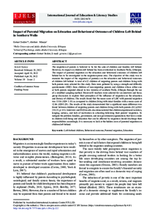
The migration of parents is believed to be for the sake of children and families left behind. However, its impact on children left behind has been overlooked in Southern Wollo, Ethioipia. The impact of parental migration on the education and behavioral outcomes of children left behind has to be investigated in the migration-prone area. The objective of this study was to examine the impact of the migration of parent(s) on the education and behavioral outcomes of children left behind.
This article explores the role resilience processes play in education and well-being outcomes for street-connected children. It draws on research and practice undertaken as part of the Building with Bamboo Programme (BwB) on resilience. BwB investigated the forms a resilience-based approach might usefully take in practice, the effect this has on promoting resilience in children, and how this resilience leads to improved outcomes in their lives.
In the BBC interview below, parent activist Taliah Drayak presents key findings from the report: Children’s Social Care: The Way Forward. She describes her family’s own nightmare when social workers removed her two-year-old from her custody.
This video by the Alliance for for Child Protection in Humanitarian Action details the main reasons for investing in child protection prevention programming in humanitarian crises.
![Watch Why invest in Child Protection Primary Prevention? [English] on YouTube.](http://i.ytimg.com/vi/LZXDVDpsVUk/sddefault.jpg)
![Watch Why invest in Child Protection Primary Prevention? [French] on YouTube.](http://i.ytimg.com/vi/v-M_TTlpdFw/sddefault.jpg)
![Watch Why invest in Child Protection Primary Prevention? [Spanish] on YouTube.](http://i.ytimg.com/vi/TD2HVplvYpQ/sddefault.jpg)
![Watch Why invest in Child Protection Primary Prevention? [Arabic] on YouTube.](http://i.ytimg.com/vi/XrMs51u6thI/sddefault.jpg)
This paper explores perspectives on family reunification and emergent forms of separation among young migrants. These young people lived apart from and later reunited with their migrant parents who moved from the Philippines to Canada for work.
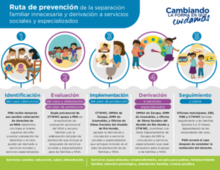
Esta Ruta de Coordinación, fue construida y diseñada de manera participativa y liderada por CTWWC Guatemala, con el objeto de articular de manera eficiente y coordinada los esfuerzos que los profesionales de las instituciones gubernamentales y municipales vinculadas a la prevención y proteccion, deben promover, gestionar y facilitar la derivación a los servicios sociales y especializados que permitan la prevención de la separación familiar innecesaria de los niños, niñas o adolescentes de su entorno familiar, basando las acciones en la metodología de manejo de casos y priorizando ante cualquier desición que se tome, la observacnia del interés superior del niño