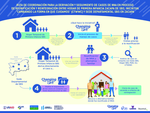
Los Procedimientos de Manejo de Casos para la Reunificación y Reintegración de los Niños, Niñas y Adolescentes al cuidado Familiar y Comunitaria

Changing the Way We Care

Los Procedimientos de Manejo de Casos para la Reunificación y Reintegración de los Niños, Niñas y Adolescentes al cuidado Familiar y Comunitaria se desarrollaron a través de talleres participativos en conjunto con la Secretaría de Bienestar Social (SBS), la Procuraduría de la Niñez y la Adolescencia (PNA) de la Procuraduría General de la Nación (PGN), El Organismo Judicial (OJ), El Consejo Nacional de Adopciones (CNA), la Asociación de Hogares Cristianos de Guatemala (ASOCRIGUA) y Hogar Aldeas de Esperanza. Se basó en el trabajo de Changing the Way We Care de Kenia en la Guía para trabajadores sociales: Manejo de casos para la reintegración de niños y niñas en cuidado familiar o comunitaria, adaptada al contexto guatemalteco.

File

ផលប៉ះពាល់នៃជំងឺកូវីដ១៩ លើមណ្ឌលថែទាំកុមារ ដែល មានដំណើរការ និងទទួលបានមូលនិធិគាំទ្រពីឯកជន

Better Care Network, Law Futures Centre - Griffith Law School, World Childhood Foundation, Eriks Development Partner

This study was a small-scale piece of qualitative research that involved 21 semistructured interviews with founders, funders, and directors of RCIs across 7 countries. It was designed to better understand the impacts of COVID-19 on the operations of residential care institutions including funding, staffing, volunteering, children’s care, education, family connection and reintegration.

File

Population and Response Capacity Study in the INAU 24-Hour Protection System

UNICEF Uruguay & INAU

Study that investigates the situation of children and adolescents who have temporarily or permanently lost the care of their families and reside in INAU institutions: the reasons for admission, the length of stay, their family situation. In turn, this information is analyzed in conjunction with the response capacity of the institution (human resources and infrastructure).

File

Engaging Everyone in the Transformation - Child Rescue Centre and Helping Children Worldwide

Better Care Network and Helping Children WorldWide

The Child Rescue Centre was the first orphanage in Sierra Leone to successfully complete a transition from residential to family-based care. This case study highlights some of the key dynamics that arose throughout the transition of the orphanage and examines how those dynamics both influenced the transition and determined the type of support provided as well as the most appropriate transition strategy.

File

The Effect of COVID-19 on the Wellbeing of Children in Uganda

AfriChild Center

The assessment of COVID-19 effect on the Wellbeing of Children in Uganda was conducted between June and August, 2020 by AfriChild Centre, Makerere University. The study took a retrospective approach with a focus on the three months of the COVID-19 lock down (AprilJune 2020) to counter contradictions that could arise from a longer study period in the face of changing dynamics of COVID-19.

File

Uganda Child Protection National Training Curriculum

Over the past two decades of humanitarian work in northern Uganda, national and international child-focused organisations as well as government departments responsible for children have built a rich body of knowledge that has informed child protection work throughout the country. The development of this Child Protection Curriculum and related training materials is therefore a first step by the Ministry of Gender, the Ministry of Labour and Social Development, the United Nations Children’s Fund (UNICEF), the Child Protection Working Group in Uganda, and selected academic institutions to professionalise the child protection sector within the broader realm of social work in Uganda.

File

Strengthening Uganda’s National Response for Implementation of Services for Orphans and Other Vulnerable Children: Final Evaluation

Coordinating Comprehensive Care for Children (4Children) project

Strengthening Uganda’s National Response for Implementation of Services for Orphans and Other Vulnerable Children (SUNRISE-OVC) is a five-year project, which began June 2010, to deliver and monitor high quality, comprehensive and scaled-up services for OVC in 80 out of 112 districts in Uganda. The project was funded by USAID, working in partnership with the Government of Uganda’s (GoU) Ministry of Gender, Labour and Social Development (MGLSD) for oversight.

File

Multidimensional Child Poverty and Deprivation in Uganda Report: Volume 1

David Gordon, Şebnem Eroğlu, Eldin Fahmy, Viliami Konifelenisi Fifita, Shailen Nandy, Acomo Oloya, Marco Pomati and Helen Anderson

This report represents the successful integration of multidimensional child poverty measures in national statistics. In doing so it provides a better understanding of child poverty in Uganda by augmenting Uganda’s rich tradition of poverty analysis with a more deprivation-centred analytical tool.

File

Basic Requirements and Minimum Standards Indicators for Education Institutions

The Republic of Uganda, Ministry of Education and Sports

In 2001 the Republic of Uganda's Ministry of Education and Sports (MoES) issued the Basic Requirements and Minimum Standards Indicators for Education Institutions (BRMS) to schools and other relevant stakeholders to guide the organization and management of educational institutions. This BRMS has been reviewed by a multi-sectoral team comprising of members from the public and private sectors, development partners, international and national NGOs and other organizations.

File
Inspiring Children’ s Futures - Supporting Children’s Wellbeing During COVID-19: Providers’ and Policymakers’ Successes, Challenges, Lessons Learned and Recommended Actions

The Institute for Inspiring Children’s Futures at the University of Strathclyde

This report presents the findings of the COVID 4P Log Project, which sought to better understand the changing demands on the policies and practices designed to support children's wellbeing in response to the COVID-19 pandemic across different cultures and contexts, in 22 countries and five continents.

File
The impact of COVID-19 on children and families in Scotland: Understanding needs and services through local social work data

Alex McTier and Ruth Sills - CELCIS, e Scottish Government Children and Families Collective Leadership Group

This report was prepared by CELCIS in collaboration with local authorities and stakeholders in Scotland to inform the Scottish Government Children and Families Collective Leadership Group's consideration of the impact of COVID-19 on children and families.

File
Catholic Care for Children in Uganda: A Family for Every Child - Findings from a Midterm Evaluation

GHR Foundation

The goals of Catholic Care for Children in Uganda (CCCU) are to enable children to grow up in safe environments, reduce recourse to institutional care, and encourage family- and community-based care for children. This midterm evaluation examines what has been accomplished in the four years since the program began.

File
Transforming Children's Care Webinar #5 - The Impact of COVID-19 on Privately Run Residential Care Institutions

Transforming Children's Care Global Collaborative Platform

This webinar, the fifth in the Transforming Children's Care Webinar Series focused on a new study ('Impact of COVID-19 on Privately Run Residential Care Institutions: Insights and Implications for Advocacy and Awareness Raising'). The study, comprising 21 semi-structured interviews across seven focus countries, explores the effect of COVID-19 on a small number of privately run and funded residential care institutions.

Impact of COVID-19 on Privately Run and Funded Residential Care Institutions: Briefing Note for Volunteers and Volunteer Sending Organisations

Better Care Network, Law Futures Centre - Griffith Law School, World Childhood Foundation, Eriks Development Partner

This briefing paper draws on data and findings from the report: Impact of COVID-19 on Privately Run Residential Care Institutions: Insights and Implications for Advocacy and Awareness Raising.

Impact of COVID-19 on Privately Run and Funded Residential Care Institutions: Summary Briefing Paper

Better Care Network, Law Futures Centre - Griffith Law School, World Childhood Foundation, Eriks Development Partner

This briefing paper draws on data and findings from the report: Impact of COVID-19 on Privately Run Residential Care Institutions: Insights and Implications for Advocacy and Awareness Raising.

Impact of COVID-19 on Privately Run and Funded Residential Care Institutions: Briefing Paper for In-Country Organisations Engaging with RCIs

Better Care Network, Law Futures Centre - Griffith Law School, World Childhood Foundation, Eriks Development Partner

This briefing paper draws on data and findings from the report: Impact of COVID-19 on Privately Run Residential Care Institutions: Insights and Implications for Advocacy and Awareness Raising.

File
Impact of COVID-19 on Privately Run and Funded Residential Care Institutions: Briefing Note for Donors and Supporters of Overseas RCIs

Better Care Network, Law Futures Centre - Griffith Law School, World Childhood Foundation, Eriks Development Partner

This study was a small-scale piece of qualitative research that involved 21 semistructured interviews with founders, funders, and directors of RCIs across 7 countries. It was designed to better understand the impacts of COVID-19 on the operations of residential care institutions including funding, staffing, volunteering, children’s care, education, family connection and reintegration.
Innovations in care for children separated from parents: Transitioning from residential to family models of service

Nicole Gilbertson Wilke & Amanda Hiles Howard - Children & Society

Research suggests that children develop best in families, but millions currently reside in residential care centers. Using a mixed methods design, the current study examined (1) antecedents to transition, (2) key elements in the process and (3) outcomes of transitioning models of care.

Cadrul Normativ Și Mecanismul De Finanțare A Sistemului De Îngrijire Alternativă În Republica Moldova

Changing the Way We Care (CTWWC)

Cercetarea a vizat o analiză cuprinzătoare a cadrului juridic și de reglementare, conform Orientărilor ONU privind îngrijirea alternativă a copiilor, inclusiv o analiză a mecanismelor de finanțare pentru programarea serviciilor de îngrijire.

File

Dezinstituționalizarea Prin Înțelegerea Particularităților Sistemului Rezidențial De Îngrijire În Republica Moldova

Changing the Way We Care (CTWWC)

A fost efectuată o evaluare cuprinzătoare a copiilor și adolescenților care trăiesc în îngrijire rezidențială identificând că există un mecanism complex de evaluare, axat pe oferirea unei vederi de 360° asupra nevoilor și interesului superior al copilului.

File

Cunoștințe, Atitudini, Practici Privind Reintegrarea Copiilor În Familii Și Prevenirea Separării În Republica Moldova

Changing the Way We Care (CTWWC)

Studiul a evaluat cunoștințele, atitudinile și practicile populației generale în ceea ce privește reintegrarea copiilor în familii, integrarea copiilor cu dizabilități în școala și comunitate și prevenirea separării copiilor care trăiesc în familii vulnerabile.

File

Situația Actuală La Nivel Național În Prestarea Serviciilor Sociale Destinate Copiilor Şi Familiilor Vulnerabile În Republica Moldova

Changing the Way We Care (CTWWC)

Analiza a vizat revizuirea tuturor categoriilor de servicii sociale pentru copiii și familiile vulnerabile, cu accent specific pe  serviciile de prevenire și răspuns.

File

Rezumatul analizei situaționale efectuate în cadrul inițiativei CTWWC Moldova

Changing the Way We Care (CTWWC)

În perioada ianuarie-iunie 2021, Changing the Way We Care în Moldova, împreună partenerii săi cheie P4EC, CCF și Keystone Moldova, a efectuat șapte studii de cercetare privind diferite elemente ale sistemului de îngrijire și protecție a copiilor din Moldova, care, atunci când sunt citite împreună, oferă o imagine cuprinzătoare a sistemului.

File

Unsafe In Foster Care

Deepa Fernandes and Victora Estrada - Latino USA

This two-part investigation looks into Los Angeles County’s Department of Children and Family Services (DCFS), the largest child welfare agency in the U.S., and what happens when the system that is meant to protect these children falls short—and even puts their lives at risk.

Children: The Hidden Pandemic 2021 – A joint report of COVID-19- associated orphanhood and a strategy for action

Global Reference Group on Children Affected by COVID-19: Joint Estimates and Action

This report presents statistical data from 192 countries on children experiencing COVID-19-associated orphanhood and death of grandparent caregivers, a description of the trends in these data, a real-time COVID-19 Calculator for Death of Parents and Caregivers, and strategies and principles for integrating care for children bereaved by the virus into every nation’s COVID-19 response planning.

File

Khmer: Prakas on Procedures to Implement Kinship Care and Foster Care

Ministry of Social Affairs, Veterans and Youth Rehabilitation (MoSVY) - Kingdom of Cambodia

The Goal of the Prakas is to ensure the best interests of the child and protect the basic rights of the child separated from his/her biological parents and receiving kinship or foster care, so that they are safe and thriving in a warm, loving and happy family environment.

File

Khmer: Cambodia Child Protection Monitoring Framework - Care Indicators and Metadata: A working document to guide the establishment of the Child Protection Information Management System (CPIMS) in Cambodia

Ministry of Social Affairs, Veterans and Youth Rehabilitation (MoSVY)

This document (written in Khmer), the Cambodia Child Protection Monitoring Framework, contains 50 core indicators considered important in assessing the child protection system in Cambodia.

File

Khmer: Report on Results of the Implementation of the Action Plan for Improving Child Care with the Target of Safely Returning 30 Percent of Children in Residential Care to their Families by 2019

Ministry of Social Affairs, Veterans and Youth Rehabilitation (MoSVY)

This report (in Khmer) presents the outcomes of the implementation of the Action Plan for improving child care with the target of safely returning 30 per cent of children in residential care to their families, including key achievements, lessons learned, and recommendations going forward.

File

Report on Results of the Implementation of the Action Plan for Improving Child Care with the Target of Safely Returning 30 Percent of Children in Residential Care to their Families by 2019

Ministry of Social Affairs, Veterans and Youth Rehabilitation (MoSVY)

This report presents the outcomes of the implementation of the Cambodian Ministry of Social Affairs, Veterans and Youth Rehabilitation (MoSVY) Action Plan for Improving Child Care and the safe return of 30 per cent of children in residential care to their families, including key achievements, lessons learned, and recommendations going forward.

File

Study Report on Good Practices in Family Preservation and Prevention of Family Separation Programming in Cambodia

Kirsten Anderson - Coram Children’s Legal Centre (CCLC)

This report provides in-depth analysis of programs of 7 different NGOs in Cambodia working on the prevention of family separation and family preservation in order to respond to risks related to physical and mental well-being and domestic violence.

File

Prakas on Procedures to Implement Kinship Care and Foster Care

Ministry of Social Affairs, Veterans and Youth Rehabilitation (MoSVY) - Kingdom of Cambodia

This Prakas was drafted in accordance with Cambodia’s policies, standards and regulations to enable the implementation of kinship care and foster care. The Goal of the Prakas is to ensure the best interests of the child and protect the basic rights of the child separated from his/her biological parents and receiving kinship or foster care, so that they are safe and thriving in a warm, loving and happy family environment.

File