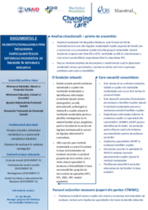
Dezinstituționalizarea Prin Înțelegerea Particularităților Sistemului Rezidențial De Îngrijire În Republica Moldova

Changing the Way We Care (CTWWC)

A fost efectuată o evaluare cuprinzătoare a copiilor și adolescenților care trăiesc în îngrijire rezidențială identificând că există un mecanism complex de evaluare, axat pe oferirea unei vederi de 360° asupra nevoilor și interesului superior al copilului.

File
Cunoștințe, Atitudini, Practici Privind Reintegrarea Copiilor În Familii Și Prevenirea Separării În Republica Moldova

Changing the Way We Care (CTWWC)

Studiul a evaluat cunoștințele, atitudinile și practicile populației generale în ceea ce privește reintegrarea copiilor în familii, integrarea copiilor cu dizabilități în școala și comunitate și prevenirea separării copiilor care trăiesc în familii vulnerabile.

File

Situația Actuală La Nivel Național În Prestarea Serviciilor Sociale Destinate Copiilor Şi Familiilor Vulnerabile În Republica Moldova

Changing the Way We Care (CTWWC)

Analiza a vizat revizuirea tuturor categoriilor de servicii sociale pentru copiii și familiile vulnerabile, cu accent specific pe  serviciile de prevenire și răspuns.

File

Rezumatul analizei situaționale efectuate în cadrul inițiativei CTWWC Moldova

Changing the Way We Care (CTWWC)

În perioada ianuarie-iunie 2021, Changing the Way We Care în Moldova, împreună partenerii săi cheie P4EC, CCF și Keystone Moldova, a efectuat șapte studii de cercetare privind diferite elemente ale sistemului de îngrijire și protecție a copiilor din Moldova, care, atunci când sunt citite împreună, oferă o imagine cuprinzătoare a sistemului.

File
Unsafe In Foster Care

Deepa Fernandes and Victora Estrada - Latino USA

This two-part investigation looks into Los Angeles County’s Department of Children and Family Services (DCFS), the largest child welfare agency in the U.S., and what happens when the system that is meant to protect these children falls short—and even puts their lives at risk.

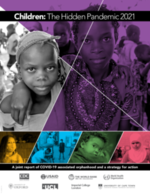
Children: The Hidden Pandemic 2021 – A joint report of COVID-19- associated orphanhood and a strategy for action

Global Reference Group on Children Affected by COVID-19: Joint Estimates and Action

This report presents statistical data from 192 countries on children experiencing COVID-19-associated orphanhood and death of grandparent caregivers, a description of the trends in these data, a real-time COVID-19 Calculator for Death of Parents and Caregivers, and strategies and principles for integrating care for children bereaved by the virus into every nation’s COVID-19 response planning.

File
Khmer: Prakas on Procedures to Implement Kinship Care and Foster Care

Ministry of Social Affairs, Veterans and Youth Rehabilitation (MoSVY) - Kingdom of Cambodia

The Goal of the Prakas is to ensure the best interests of the child and protect the basic rights of the child separated from his/her biological parents and receiving kinship or foster care, so that they are safe and thriving in a warm, loving and happy family environment.

File
Khmer: Cambodia Child Protection Monitoring Framework - Care Indicators and Metadata: A working document to guide the establishment of the Child Protection Information Management System (CPIMS) in Cambodia

Ministry of Social Affairs, Veterans and Youth Rehabilitation (MoSVY)

This document (written in Khmer), the Cambodia Child Protection Monitoring Framework, contains 50 core indicators considered important in assessing the child protection system in Cambodia.

File
Khmer: Report on Results of the Implementation of the Action Plan for Improving Child Care with the Target of Safely Returning 30 Percent of Children in Residential Care to their Families by 2019

Ministry of Social Affairs, Veterans and Youth Rehabilitation (MoSVY)

This report (in Khmer) presents the outcomes of the implementation of the Action Plan for improving child care with the target of safely returning 30 per cent of children in residential care to their families, including key achievements, lessons learned, and recommendations going forward.

File
Report on Results of the Implementation of the Action Plan for Improving Child Care with the Target of Safely Returning 30 Percent of Children in Residential Care to their Families by 2019

Ministry of Social Affairs, Veterans and Youth Rehabilitation (MoSVY)

This report presents the outcomes of the implementation of the Cambodian Ministry of Social Affairs, Veterans and Youth Rehabilitation (MoSVY) Action Plan for Improving Child Care and the safe return of 30 per cent of children in residential care to their families, including key achievements, lessons learned, and recommendations going forward.

File
Study Report on Good Practices in Family Preservation and Prevention of Family Separation Programming in Cambodia

Kirsten Anderson - Coram Children’s Legal Centre (CCLC)
This report provides in-depth analysis of programs of 7 different NGOs in Cambodia working on the prevention of family separation and family preservation in order to respond to risks related to physical and mental well-being and domestic violence.

File

Prakas on Procedures to Implement Kinship Care and Foster Care

Ministry of Social Affairs, Veterans and Youth Rehabilitation (MoSVY) - Kingdom of Cambodia

This Prakas was drafted in accordance with Cambodia’s policies, standards and regulations to enable the implementation of kinship care and foster care. The Goal of the Prakas is to ensure the best interests of the child and protect the basic rights of the child separated from his/her biological parents and receiving kinship or foster care, so that they are safe and thriving in a warm, loving and happy family environment.

File

Global Report on Trafficking in Persons

United Nations Office on Drugs and Crime (UNODC)

This report draws on data from 148 countries and explores issues of particular relevance in the current crisis, including the impact of socio-economic factors, drivers of child trafficking and trafficking for forced labour, and traffickers’ use of the internet.

File

Webinar: Learning Session on Alternative Care in the COVID 19 Pandemic (for the Indian Context)

This webinar featured presentations and discussions from practitioners who have experience of working on alternative care (short term and long term) and prioritising family-based care in emergency settings that could be helpful for practitioners in India as they plan a response for children who have lost parents to COVID-19.

Global minimum estimates of children affected by COVID-19-associated orphanhood and deaths of caregivers: a modelling study

Susan D Hillis, H Juliette T Unwin, Yu Chen, Lucie Cluver, Lorraine Sherr, Philip S Goldman, et al - The Lancet

This study used mortality and fertility data to model minimum estimates and rates of COVID-19-associated deaths of primary or secondary caregivers for children younger than 18 years in 21 countries.

File

70 to 700 to 70,000: Lessons from the Jamaica Experiment

M. Caridad Araujo, Marta Rubio-Codina, Norbert Schady - Inter-American Development Bank, Social Protection and Health Division

This document compares three versions of the same home visiting model, aimed at improving parent-child interactions and child development: the well-known Jamaica model, which was gradually scaled up from an efficacy trial (‘proof of concept’) in Jamaica, to a pilot in Colombia, to an at-scale program in Peru.

File

Mapping U.S. Support for Orphanages Abroad: Key Findings & Strategic Recommendations

Better Care Network and ReThink Orphanages

This report lays out the results of a preliminary mapping exercise to document the ways in which the United States supports and perpetuates overseas orphanages. It is based on: an analysis of existing data; a literature review of U.S government publications and investments; a review of non-profit organizations and foundation activities; an analysis of key supply chains and stakeholders; and the identification of existing data gaps.

File

Transforming Children's Care Webinar #4: Child's Right to Identity in Alternative Care

Transforming Children's Care Global Collaborative Platform, Child Identity

This webinar, the fourth in a series from the Transforming Children's Care Global Collaborative Platform, explored the importance of protecting the child’s right to identity in how it is created, how it may be modified and/or falsified in alternative care as well as the need to preserve information about the child’s identity, notably family relations.

“Forever family is like a manufactured Hallmark idea”: Adoption discontinuity experiences of intercountry adoptees

JaeRan Kim - Child Abuse & Neglect

This study sought to understand how intercountry adoptees with adoption discontinuity histories experience legal, relational, and residential permanency losses through the framework of ambiguous loss and trauma.

Estimates and Projections of COVID-19 and Parental Death in the US

Rachel Kidman, Rachel Margolis, Emily Smith-Greenaway, et al - JAMA Pediatrics

The authors of this study estimated the expected number of affected children for each COVID-19 death (the parental bereavement multiplier) in the U.S., enabling tracking of parental bereavement as the pandemic evolves. This article shares the results of that study.

Independent Child Safeguarding Review Report

Keeping Children Safe

The Independent Child Safeguarding Review (ICSR) was commissioned by the International Senate of SOS Children’s Villages to find ways to address the complex topic of child safeguarding failures. The report sets out consolidated findings and recommendations from four country reviews with the aim of contributing to improvements in safeguarding practice.

File

Report on National Assessment of Centres caring for Children with Disabilities in Rwanda

National Council of Persons with Disabilities, National Commission for Children, UNICEF

The purpose of this assessment was to review service delivery in centres for children with disabilities in Rwanda. This report establishes relevant baseline information on institutional capacity including services offered, staffing levels and other parameters regarding care of children with disabilities.

File

2021 Kids Count Data Book

Annie E. Casey Foundation

The 32nd edition of the Annie E. Casey Foundation's KIDS COUNT® Data Book describes how children across the United States were faring before — and during — the coronavirus pandemic.

File

Caring in the time of COVID-19: Gender, unpaid care work and social protection

Zahrah Nesbitt-Ahmed and Ramya Subrahmanian - UNICEF

This blog post by Zahrah Nesbitt-Ahmed and Ramya Subrahmanian of the UNICEF Office of Research - Innocenti calls attention to the risks faced by women and girls in light of the economic and social fallout of the COVID-19 pandemic and the impacts of the pandemic on women and girls' unpaid care work.

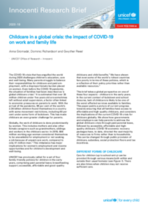
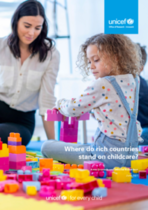
Where do rich countries stand on childcare?

Anna Gromada and Dominic Richardson - UNICEF Office of Research – Innocenti

This report published by UNICEF’s Office of Research – Innocenti, ranks countries across the Organisation for Economic Co-operation and Development (OECD) and the European Union (EU) based on their national childcare and parental leave policies.

File

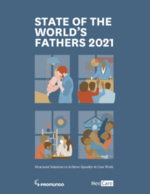
The State of the World’s Fathers 2021

Gary Barker, Aapta Garg, Brian Heilman, Nikki van der Gaag, and Rachel Mehaffey - Promundo-US

The State of the World’s Fathers 2021 report – the fourth in the series – presents research on care work during the COVID-19 pandemic, focusing on structural barriers that prevent equitable distribution of caregiving between women and men.

File

Making the case for monitoring and reporting on EU-wide progress in deinstitutionalisation and reform of child protection systems: Interim findings & recommendations from the DataCare Project

Eurochild

The DataCare Project seeks to map how EU Member States and the UK currently collect data on the situation of children in alternative care. This report presents the interim findings of this project, based on the analysis of 14 countries who participated in the study at the end of 2020.

File

Tubarerere mu Muryango programme (‘Let’s raise children in families’): Inclusive Case Management for Children’s Reintegration - Participants' Handbook

National Child Development Agency, Rwanda and UNICEF Rwanda

This participant’s handbook relates to Module 3 of the Government of Rwanda’s Tubarerere Mu Muryango (TMM) training programme. It is for Child Protection and Welfare Officers who work directly with children and families on reintegration of children, including children with disabilities from residential institutions.

File

Tubarerere mu Muryango programme (‘Let’s raise children in families’): Inclusive Case Management for Children’s Reintegration - Facilitators' Manual

National Child Development Agency, Rwanda and UNICEF Rwanda

This training package is primarily for Government of Rwanda’s Child Protection and Welfare Officers who work directly with children and families on reintegration of children (including children with disabilities) from residential institutions.

File

Tubarerere mu Muryango programme (‘Let’s raise children in families’): Operational Guidance on Inclusive Children’s Reintegration

National Child Development Agency, Rwanda and UNICEF Rwanda

This operational guidance describes how the Government of Rwanda conducts case management for reintegration of children from residential institutions to family-based care, including children with disabilities.

File

Estudio sobre la reforma del cuidado infantil en América Latina y el Caribe dirigido a desarrollar una estrategia regional de incidencia

Changing the Way We Care

El estudio llevó a cabo un ejercicio de recopilar prácticas prometedoras de reforma de cuidado infantil por parte de diversos actores clave en la región de América Latina y el Caribe. 

File

The right to identify one’s ancestors, ‘limping parentage’ and origin deprivation

Alice Diver - Korean Adoptee Adoption Research Network

This seminar was given as part of the Korean Adoptee Adoption Research Network's inaugural seminar series, The Right to Know. Each speaker of the series discussed the concept of the right to origin and examined the broader social, legal and political implications in South Korea as a sending country along with experiences from North America and Europe as receiving countries.

Anonymous donation of sperm and oocytes: balancing the rights of parents, donors and children

Petra de Sutter, Committee on Social Affairs, Health and Sustainable Development - Parliamentary Assembly, Council of Europe

This report from the Parliamentary Assembly of the Council of Europe looks at the right of donor-conceived persons to know their origins in a global context where more than 8 million children worldwide have been born as a result of assisted reproductive technologies.

ICAV Perspective Paper: Illicit Intercountry Adoptions - Lived Experience Views on How Authorities and Bodies Could Respond

Lynelle Long - Inter Country Adoption Voices

This paper from Inter Country Adoptee Voices (ICAV) attempts to bring together not only the voices and experiences of impacted intercountry adoptees who have lived experience with some form of illicit practice in their adoption, but also the voices of a few adoptive parents and first family representation. 

File

Virtual Training Series on Civil Registration, Vital Statistics, Identity Management: Communication for Development targeting CRVS practitioners in LMICs

Centre of Excellence for Civil Registration and Vital Statistics Systems

This series of 3 training sessions is based on the newly developed handbook on “Civil Registration, Vital Statistics, Identity Management: Communication for Development targeting CRVS practitioners in LMICs,” which provides guidance on the use of different tools to research, design, implement strategies and measure Social and Behavior Change/ Communication for Development.

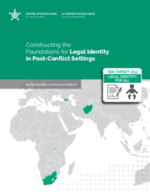
Constructing the Foundations for Legal Identity in Post-Conflict Settings

Centre of Excellence for Civil Registration and Vital Statistics Systems - International Development Research Centre (IDRC)

This paper aims to contribute to the achievement of Target 16.9 under Sustainable Development Goal 16 by analyzing the role of the civil register and the legal underpinnings for identity in four countries: Afghanistan, Georgia, Rwanda, and South Africa. It describes institutional and operational models in each country that support universal registration of births, deaths, and other vital events.

File

Webinar Recording: Constructing the foundations for legal identity in post conflict situations

Global Partnership for Sustainable Development Data & Center of Excellence for Civil Registration and Vital Statistics Systems at the International Development Research Centre (IDRC)

This is a video recording from the webinar: Constructing the foundations for legal identity in post conflict situations. This webinar shared findings from research that documents how Afghanistan, Georgia, Rwanda and South Africa have made registration of vital events more accessible by adjusting or removing legal and institutional obstacles in post-conflict settings.

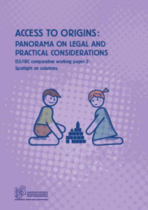
Access to Origins: Panorama on Legal and Practical Considerations - ISS/IRC comparative working paper 2: Spotlight on solutions

International Social Service (ISS)

This paper is aimed at supporting the professionals who accompany adoptees and their families in the process of searching for one's origins, and the various authorities with the competency to make decisions on this matter.

File

Solutions for Children Previously Affiliated With Extremist Groups: An Evidence Base to Inform Repatriation, Rehabilitation and Reintegration

UN Office of the SRSG on Violence against Children

This report from the UN Office of the SRSG on Violence against Children explores repatriation, rehabilitation, and reintegration of foreign, Iraqi and Syrian children who are being held in detention on suspected ISIS association or terror-related offenses, or in camps.

File

Children forever: The search for origins among Chilean adults who were adopted

Irene Salvo Agoglia, Diana Marre - Child & Family Social Work

In this article, the authors present some results from the first qualitative study that explores the experiences of some Chilean adults who were adopted and searched for their origins in Chile through the National Service of Minor's Search for Origins Program.

Committee on the Rights of the Child General comment No. 25 (2021) on children’s rights in relation to the digital environment

UN Committee on the Rights of the Child

In the present general comment, the Committee on the Rights of the Child explains how States parties should implement the Convention on the Rights of the Child in relation to the digital environment and provides guidance on relevant legislative, policy and other measures to ensure full compliance with their obligations under the Convention and the Optional Protocols thereto in the light of the opportunities, risks and challenges in promoting, respecting, protecting and fulfilling all children’s rights in the digital environment.

File

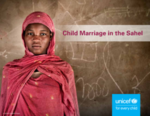
Child Marriage in the Sahel

UNICEF Division of Data, Analytics, Planning and Monitoring

This brochure from UNICEF provides an overview of child marriage in the Sahel, a region spanning the northern portion of sub-Saharan Africa.

File

Shifting the Field: Philanthropy’s role in strengthening child- and youth-led community rooted groups

Marcela Rueda Gomez - Elevate Children Funders Group

This report maps current practice in philanthropic support for child- and youth-led work at the community level and offers strategic advice to donors on how to strengthen their funding modalities to achieve greater impact.

File

COVID-19 Future Trends: Impacts on Children and the Search for Opportunities

Sol Pradelli - Elevate Children Funders Group

In attempts to delineate the future impacts on today's children, this paper analyses the COVID-19 crisis as a dynamic phenomenon that shapes children's lives well into adulthood, with age and gender considered key influencing factors. It examines the impacts from previous crises and the available data to build prudent assumptions about the present situation and outlines four scenarios which provide opportunities to identify potential levers for positive change.

File

The role of risk in child welfare decision-making: A prospective cohort examination of families transferred to ongoing child protection services after an investigation

Bryn King, Tara Black, Barbara Fallon, Yu Lung - Children and Youth Services Review

This study uses longitudinal administrative data to assess the decision to transfer a family to ongoing child welfare services within twelve months of an initial investigation.

A collective impact approach to supporting youth transitioning out of government care

Annie Smith, Maya Peled, Stephanie Martin - Child Abuse & Neglect

In Vancouver, Western Canada, 60 agencies and 20 youth from government care are working in partnership using a collective impact approach to address the systemic issues and barriers to healthy development that youth from care experience. This mixed-method evaluation included quantitative and qualitative data, collected through outcomes, diaries, surveys, and focus groups, to measure process and outcomes.

Experiences of Becoming Emotionally Dysregulated. A Qualitative Study of Staff in Youth Residential Care

Heine Steinkopf, Dag Nordanger, Brynjulf Stige & Anne Marita Milde - Child & Youth Services

Trauma informed care (TIC) emphasizes the importance of professionals maintaining an emotionally regulated state. For this article, the authors interviewed eight staff members in a residential care unit for children and adolescents where TIC had been implemented, about situations wherein they experienced difficulty regulating their own emotions.

The quality and developmental pathways in sibling relationships: A qualitative study of Norwegian children admitted to child welfare service care

Wenche Hovland, Sarah Hean - Child & Family Social Work

This paper explores young people's perceptions of changes in the quality of sibling relationships and the pathways relationships follow during the transition from the biological family into care.

File

Reconstructing Children’s Rights Conversation #3: Confronting Colonialism, Racism and Patriarchy in Funding

CPC Learning Network

This session’s speakers discussed the funding ecosystem’s challenges and barriers and highlighted examples of how innovative funding mechanisms are reinventing donor giving by shifting resources and power closer to the children, young people, families, and communities they are meant to support.

File

Reconstructing Children’s Rights Conversation #2: Confronting Colonialism, Racism and Patriarchy in Child Welfare and Child Rights Programming

CPC Learning Network

The goal of the Reconstructing Children’s Rights Institute is to raise awareness and recognition of how racism, patriarchy, and power permeate the international child rights and child protection field. Building on Conversation #1, this session expands our political imagination by delving deeper into the international children’s rights and child protection space.

File

Reconstructing Children’s Rights Conversation #1: Confronting Colonialism, Racism and Patriarchy in International Relations, Development and the Humanitarian Aid Industries

Ghazal Keshavarzian and Mark Canavera - CPC Learning Network

The goal of the Reconstructing Children’s Rights Institute is to raise awareness and recognition of how racism, patriarchy, and power permeate the international child rights and child protection field. This first conversation examines the larger ecosystems of international development, humanitarian aid, international relations, and peace and security, and unpacks the colonial vestiges and power imbalances intrinsic to these larger contexts.

File

The best intentions: an examination of current practices in short-term international service trips intended to benefit vulnerable children and youth

Amanda R. Hiles Howard, Megan Roberts, Jacqueline N. Gustafson & Nicole Gilbertson Wilke - Journal of Human Behavior in the Social Environment

The goal of the present study was to provide data on pre-trip preparation, in-country activities, and how these impacted volunteer perceptions of preparation and trip satisfaction for volunteers working with vulnerable children, including those in residential care (ex. orphanages).

Socio-economic supports available for the education of adolescent girls in child-headed families in the Kingdom of Eswatini: Policy Implication for Educational Evaluators

S’lungile K.Thwala, Christian S. Ugwuanyi, Chinedu I.O. Okeke, Ngwenya Ncamsile - International Journal of Psychosocial Rehabilitation

The study sought the socio-economic supports available for the high school adolescent girl learners from child-headed families (CHFs).

File

‘They became my second family’: Children's relational lives and relationship-based practice in residential care in the Philippines

Steven Roche, Catherine Flynn, Philip Mendes - Child & Family Social Work

Drawing on 50 qualitative interviews with children and young people currently or previously living in residential care, as well as a range of social workers and programme staff, this study identifies the highly relational lives of children and young people who cite extensive and close relationships with residential care staff, peers and family.

Parental monitoring by foster parents, youth behaviours and the youth–foster parent relationship

Morgan E. Cooley, Heather M. Thompson, Armeda Stevenson Wojciak, Brittany P. Mihalec-Adkins - Child & Family Social Work

This study utilized secondary data from National Survey of Child and Adolescent Well-being (NSCAW II) to examine the experiences of 298 youth and their caregivers.

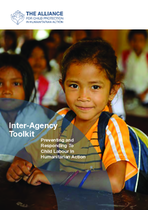
Inter-Agency Toolkit: Preventing and Responding to Child Labour in Humanitarian Action

The Alliance for Child Protection in Humanitarian Action

This toolkit complements the 2019 Edition of the Minimum Standards for Child Protection in Humanitarian Action and seeks to form an evidence base for child labour programming in humanitarian settings, reflecting the great progress made over the past years.

File

Mental health, adverse life events and health service use among Norwegian youth in the child welfare system: Results from a population-based study

Sondre Aasen Nilsen, Kristin Gärtner Askeland, Dora Poni Joseph Loro, Anette Christine Iversen, Karen J. Skaale Havnen, Tormod Bøe, Ove Heradstveit - Child & Family Social Work

This study aimed to compare mental health problems and health service use among adolescents receiving in-home services (IHS), living in foster care (FC) and general population youth (GP).

Institutional variety rather than the end of residential care: Regional responses to deinstitutionalisation reforms in Russia

Anna Tarasenko - Reforming Child Welfare in the Post-Soviet Space

This chapter traces and explains responses to deinstitutionalisation reforms in the Russian regions. Three parallel policy shifts are taken into account: deinstitutionalisation (DI), public sector reform, and social provision reform.

Position Paper: Collaboration Across Child Protection in Humanitarian Action and Education in Emergencies [v.2]

Mark Chapple- The Alliance for Child Protection in Humanitarian Action and the Inter-Agency Network for Education in Emergencies (INEE)

In this paper, the the Alliance and INEE set out the evidence supporting collaboration and integration between the sectors, providing a rationale for cross-sector work grounded in child well-being and holistic development.

File

Disclosure and identity experiences of adults abandoned as babies: A qualitative study

Lorraine Sherr, Kathryn J. Roberts & Natasha Croome - Cogent Psychology

This qualitative study examined disclosure for adult survivors of abandonment. Findings are centred around the experience of disclosure, the process of disclosure specifically exploring the role of half-truths and finally the impact of disclosure on the search for identity and self.

Impact of COVID-19 on Privately Run Residential Care Institutions: Insights and Implications for Advocacy and Awareness Raising

Rebecca Nhep, Better Care Network; Dr Kate van Doore, Law Futures Centre & Griffith Law School

This study explores the effect of COVID-19 on a small number of privately run and funded residential care institutions by conducting a qualitative research study comprising 21 semi-structured interviews across seven focus countries.