Care System Assessments Learning Brief

Changing the Way We Care

This brief was developed from key informant interviews in the countries that participated in the care system assessment: Armenia, Guatemala, Kenya, and Uganda. The aim is to share learning with others interested in assessing a country’s care system, to think about if a care system assessment is right for them, and if so, how to do it.

File

Learning Brief: The Importance of Integrating Family Strengthening, Reunification, Case Management and Workforce Strengthening

Changing the Way We Care

This learning brief was developed as part of the CTWWC 2021 annual report and shares learning from several contexts and is intended to share learning on how family strengthening, reunification, case management and workforce strengthening can be integrated in care reform.

File

Learning Brief: Participation of People with Lived Experience

Changing the Way We Care

This learning brief was developed as part of the CTWWC 2022 annual report and shares learning from Kenya, Guatemala and Moldova. It is intended to help other practitioners understand how to bring meaningful participation of people with lived experience into care reform. By people with lived experience CTWWC considers children and youth, care leavers, parents and other care givers who are experiencing the care system in their context.

File

A Call for Catholics’ Support

Changing the Way We Care

In this video, Changing the Way We Care (CTWWC) speaks to Catholic audiences in the U.S. and around the world who have supported children in residential care facilities – sometimes referred to as “orphanages” - about the importance of supporting children to stay with their families or be reintegrated from residential care into family care. 

Climate Change and Care Reform

ESARO Regional Learning Platform

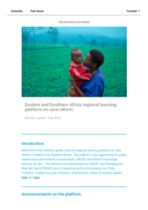
This UNICEF ESARO webinar examines the impacts of climate change on children's care and explains how care reform strategies and programmes need to adapt to address these new realities. The webinar explored how climate change affects communities in Eastern and Southern Africa.

Web Annex: WHO Guidelines on Parenting Interventions to Prevent Maltreatment and Enhance Parent–Child Relationships With Children Aged 0–17 Years (GRADE Evidence Profiles and Evidence to Decision Tables)

World Health Organization (WHO)

This web annex forms part of the WHO guidelines on parenting interventions to prevent maltreatment and enhance parent–child relationships with children aged 0–17 years. As such, it should only ever be read in conjunction with the main guideline document that sets out in detail how the methodology in the WHO handbook for guideline development was applied here, along with the development process and the recommendations themselves.

File

WHO Guidelines on Parenting Interventions to Prevent Maltreatment and Enhance Parent–Child Relationships with Children Aged 0–17 Years

World Health Organization (WHO)

These WHO guidelines provides evidence-based recommendations on parenting interventions for parents and caregivers of children aged 0–17 years that are designed to reduce child maltreatment and harsh parenting, enhance the parent–child relationship, and prevent poor mental health among parents and emotional and behavioural problems among children.

File

Report of the Independent International Commission of Inquiry on Ukraine

Human Rights Council

In this report the Independent International Commission of Inquiry on Ukraine outlines the main findings since the outset of its mandate. The body of evidence collected shows that Russian authorities have committed a wide range of violations of international human rights law and international humanitarian law in many regions of Ukraine and in the Russian Federation.

File

Совместное заявление о принудительном перемещении, депортации и усыновления украинских детей Россией

Interagency Statement

Принудительное перемещение, депортация и усыновление детей из Украины, призводящее к окончательному разлучению детей с их семьями, сообществами  и культурой, является явным нарушением их прав человека и международного гуманитарного права и представляет существенную угрозу их безопасности и б

File

Temporary Protection for Those Fleeing Russia's War of Aggression Against Ukraine: One Year On

European Commission

This Communication takes stock of the Temporary Protection Directive implemented on 4 March 2022 over the course of one year. It provides insight into how the EU managed to enable and coordinate a response to the largest displacement on European soil since the Second World War.

File

Спільна заява щодо примусового переміщення, депортації та усиновлення українських дітей Росією

Interagency Statement

Примусове переміщення, депортація та усиновлення дітей з України, що призвело до остаточного розлучення дітей із їхніми сім’ями, громадами та культурою, є явним поруше

File

COVID-19's Devastating Impact on Young People

World Bank Group

This webinar gives a comprehensive overview of the World Bank’s Human Development Flagship report, Collapse & Recovery: How COVID-19 Eroded Human Capital and What to Do About It, which reviews global data showing that the COVID-19 pandemic destroyed human capital at critical moments in the life cycle, scarring millions of children and young people in low- and middle-income countries.

Collapse & Recovery: How COVID-19 Eroded Human Capital and What to Do About It

Norbert Schady, Alaka Holla, Shwetlena Sabarwal, Joana Silva, Andres Yi Chang - World Bank Group

This World Bank report provides a first comprehensive review of global data for young people who were under the age of 25 during the pandemic. It shows that the COVID-19 pandemic disrupted human capital accumulation at critical moments in the life cycle, derailing development for millions of children and young people in low- and middle-income countries. 

File

Russia’s Systematic Program for the Re-education and Adoption of Ukraine's Children

Yale School of Public Health’s Humanitarian Research Lab

This report published by the Yale School of Public Health’s Humanitarian Research Lab (HRL) documents the relocation by Russia of at least 6,000 children from Ukraine to a network of re-education and adoption facilities in Russia-occupied Crimea and mainland Russia.

File

WHO Guidelines on Parenting Interventions to Prevent Maltreatment and Enhance Parent–Child Relationships with Children Aged 0–17 Years

World Health Organization (WHO)

This guideline provides evidence-based recommendations on parenting interventions for parents and caregivers of children aged 0–17 years that are designed to reduce child maltreatment and harsh parenting, enhance the parent–child relationship, and prevent poor mental health among parents and emotional and behavioural problems among children.

Image
WHO Guidelines on Parenting Interventions to Prevent Maltreatment and Enhance Parent-Child Relationships with Children Aged 0-17 Years

Angolan Children’s Experiences in Residential Centers: Displacement, Liminality, and Belonging

Kristina João Nazimova

This article examines how language, liminality, and social marginalization converge in the institutional lives of two displaced children in Angola. A displaced child is very likely to be placed into institutionalized care, which in Angola exists in the form of centros de acolhimento, residential centers that house minors affected by orphanhood, poverty, displacement, or abandonment. Drawing on one year of ethnographic research in two residential centers, the article argues that despite being sites of care and protection, some children come to desire living on the street as a byproduct of persistent marginalization and forms of liminality in the institutions.

Image
International Journal of the Sociology of Language

Implementation and Effectiveness of the Indian Child Welfare Act: A Systematic Review

This paper is a systematic review of studies that examined the implementation and/or effectiveness of the Indian Child Welfare Act (ICWA). ICWA was enacted in 1978 in response to the disproportionate number of American Indian children in non-American Indian out-of-home placements and to enhance the stability of American Indian families and tribes.

Image
Children and Youth Services Review

What do Childcare Professionals Agree on When they Propose Non-Kin Foster Care? // ¿Con Qué Están de Acuerdo los Profesionales Para Proponer un Acogimiento en Familia Ajena?

Rosa Sitjes-Figueras, Joan Llosada-Gistau, Carme Montserrat

The aim of this article is to analyse the factors that intervene in decision-making by childcare professionals regarding non-kin foster care in the north-east of Spain.

Image
European Journal of Social Work

Étude historique sur les pratiques illicites dans l’adoption internationale en France // Historical study on illicit practices in international adoption in France

Yves Denéchère, Fábio Macedo

This study examines international adoptions by French people in more than twenty countries from 1979 to 2021. Researchers analyzed thousands of diplomatic files from the French Ministry of Foreign Affairs on the subject and found reports of various illicit practices in the process of adopting children. ​​​​​​​

File

Supervised Independent Living for Care Leavers in Rwanda

UNICEF, Changing the Way We Care

This case study examines the transition of Patrick from residential care to being supported to live independently through a programme of supervised independent living for young people. This programme aims to ease the transition from residential care to living independently in the community and is part of the broader Tubarerere Mu Muryango Programme (Let’s Raise Children in Family) care reform programme in Rwanda.

Reintegration from Residential to Kinship Care in Uganda

UNICEF, Changing the Way We Care

This case study details the experience of Attim, a 54-year-old grandmother from Eastern Uganda who provides care for her grandchildren after they left residential care. Social workers in Uganda often find that placement with extended family members is the most appropriate option for children leaving residential care. 

Integrating Social Protection and Child Protection Services for Better Outcomes for Children in the Middle East and North Africa

Karen Codazzi Pereira, Fernando Araújo, International Policy Centre for Inclusive Growth (IPC-IG)

This research report, developed by the IPC-IG and the UNICEF MENA Regional Office for Middle East and North Africa, presents five case studies that demonstrate how integrated social protection and child protection systems enhance efficiency, especially of the social service workforce, and improve socio-economic and child outcomes: Tunisia, Morocco, Iraq, Egypt, and Brazil.

Image
Integrating social protection and child protection services for better outcomes for children in the Middle East and North Africa

Foster Caring as ‘Professional Parenting’: A Grounded Theory of the Relationships Between Parent and Professional in Long-Term Foster Care

Megan Hollett, Alex Hassett, Virginia Lumsden

This UK-based study aimed to develop an explanatory theory and model of the processes involved in fostering looked after children and the relationship between the roles of parent and professional.

Image
Foster caring as ‘professional parenting’: A grounded theory of the relationships between parent and professional in long-term foster care

Understanding Catalysts for Transition: Dynamics Leading to the Uptake of Transition Amongst Charitable Children’s Institutions in Kenya

Better Care Network, Changing the Way We Care (CTWWC)

This study was designed to be a small insights-based qualitative learning and reflection study to explore catalysts for transition. It was based on interviews conducted with Charitable Children’s Institutions’ (CCI) directors that sought to identify and explore the range of factors that influenced each director’s decision to transition their residential care services, and the interplay between those factors.

Image
Understanding Catalysts for Transition

National Care Service - Stage 1 Report from the Scottish Parliament's Education, Children and Young People Committee

Scottish Parliament's Education, Children and Young People Committee

In their Stage 1 Report published on 19 December, the Scottish Parliament's Education, Children and Young People Committee warned that plans to integrate children's services into the National Care Service lack vital information; it is not currently possible to have a clear view on whether children’s services should be included under a National Care Service; and urged the government to provide more details on the financial implications.

Image
National Care Service

Strengthening Alternative Care Practices for Children in Need of Care and Protection Under Juvenile Justice (Care and Protection of Children) Act, 2015

Judith Harwin, Lily Golding

This UK Department for Education report charts the experiences and views of parents in the UK whose children were made subject to a supervision order or a care order at home at the end of care proceedings.

Image
Supporting families after care proceedings: supervision orders and beyond

Indigenous Services Leading the Way for Aboriginal and Torres Strait Islander Children in Out-of-Home Care

Sandra Creamera, Suzi Blairb, Maree Toombs, Claire E Brolan

This study aims to provide evidence and instruction to social work educators, policymakers and practitioners
in Australia’s child protection, wellbeing, and justice systems about why and how Aboriginal and Torres Strait Islander controlled organizations are best placed to lead out-of-home care service delivery for Indigenous children, their family and community.

Image
Indigenous services leading the way for Aboriginal and Torres Strait Islander children in out-of-home care

Impact of the COVID-19 Pandemic on Children Living in Shelters and Children in the Community (Review)

Elisavet Damaskopoulou, Eleni Papakonstantinou, Flora Bacopoulou, Elias Eliopoulos, George P. Chrousos, Dimitrios Vlachakis

This article in the World Academy of Science Journal reviews some of the latest global studies on the impact of the COVID-19 pandemic on children in residential care and children living with their families.

Image
Impact of the COVID-19 pandemic on children living in shelters and children in the community (Review)

It’s Complicated: A Longitudinal Exploration of Young People’s Perceptions of Out-of-Home Care and Their Reflections on How to Change the Child Welfare System

Heather Taussig, Michelle R. Munson

In this U.S.-based study, over 200 pre-adolescent children recently placed into out-of-home care were asked about the difficulty and helpfulness of placement and how their lives might be different had they not been removed. The same participants were interviewed 10 years later.

What is Prevention?

The Alliance for Child Protection in Humanitarian Action

This video by the Alliance for for Child Protection in Humanitarian Action details the three levels of prevention in child protection in humanitarian action.

Navigating Violent Spaces: Violence Against Children in Alternative Care

Scott L. Moeschberger, BreeAnna White

This chapter in the book, "Psychological Perspectives on Understanding and Addressing Violence Against Children: Towards Building Cultures of Peace", explores how violence impacts children in various types of alternative care from larger scale institutions such as orphanages to family-based care models like foster care. The book explores the topic from a global perspective.

Image
Psychological Perspectives on Understanding and Addressing Violence Against Children: Towards Building Cultures of Peace

Transformation of Out-of-Home Services for Children in North Macedonia: Towards Individualized and Child Tailored Care

Natasha Bogoevska, Suzana Bornarova, Sofija Georgievska

This article reviews the key reform processes in the domain of social protection in the the Republic of North Macedonia, with a focus on social services for children without parents and parental care.

File
A/HRC/52/52: Support Systems to Ensure Community Inclusion of Persons With Disabilities, Including as a Means of Building Forward Better After the Coronavirus Disease (COVID-19) Pandemic

Office of the United Nations High Commissioner for Human Rights

The Office of the High Commissioner for Human Rights has published a new report following a request by the Human Rights Council on Support systems to ensure community inclusion of persons with disabilities, including as a means of building forward better after the coronavirus disease (COVID-19) pandemic.

Image
Support systems to ensure community inclusion of persons with disabilities, including as a means of building forward better after the coronavirus disease (COVID-19) pandemic - Report of the Office of the United Nations High Commissioner for Human Rights

Cost Utility of Supporting Family-Based Care to Prevent HIV and Deaths Among Orphaned and Separated Children in East Africa: A Markov Model–Based Simulation

Marta Wilson-Barthes, Paula Braitstein, Allison DeLong, David Ayuku, Omar Galárraga, Lukoye Atwoli, Edwin Sang,

Strengthening family-based care is a key policy response to the more than 15 million orphaned and separated children who have lost 1 or both parents in sub-Saharan Africa. This analysis estimated the cost-effectiveness of family-based care environments for preventing HIV and death in this population.

Image
Cost Utility of Supporting Family-Based Care to Prevent HIV and Deaths among Orphaned and Separated Children in East Africa: A Markov Model–Based Simulation

El futuro de los sistemas de protección infantil en América Latina y Europa: Revisión de países seleccionados. Lecciones e impactos

Mónica López López, Hilda Paredes Dávila, Beatriz Vizcarra Larrañaga

El objetivo fundamental del presente libro es el análisis comparativo de las políticas, prácticas e investigaciones en relación a los sistemas de protección infantil en diversos países de América Latina y Europa. Las distintas experiencias recogidas en el texto esperamos contribuyan a aportar a la escasa literatura existente sobre el tema en Iberoamérica, pese a su enorme relevancia para los distintos intervinientes, investigadores, comunidad profesional y tomadores de decisiones.

Image
El futuro de los sistemas de protección infantil en América Latina y Europa: Revisión de países seleccionados. Lecciones e impactos

Abordar el suicidio en contextos humanitarios: Directrices

Inter-Agency Standing Committee Reference Group on Mental Health and Psychosocial Support (IASC MHPSS RG)

Esta nota de orientación tiene como objetivo ayudar a los implementadores de programas, coordinadores y otros actores humanitarios a abordar el suicidio y las autolesiones en entornos humanitarios. Reúne una amplia gama de enfoques, herramientas, materiales de referencia y ejemplos de casos. Es un recurso práctico y conciso aplicable a todo tipo de emergencias, organizaciones y sectores.

File
Changing The Way We Care, Maestral FY22 Engagement and Outcomes

Changing the Way We Care, Maestral

With a focus on 2022-23 themes of transition of care services, development of family-based alternative care, participation of people with lived experience and disability inclusion, this report details several of the significant outcomes and program activities achieved by the work of the CTWWC Maestral team over the last year.

File
Families. Not Institutions

Hope and Homes for Children

This Hope and Homes for Children publication provides critical lessons learned, practical evidence and recommendations to support global, regional and national decision makers to build political will, strategies, policies, and target funding to transform care systems.

File
El futuro de los sistemas de protección infantil en América Latina y Europa: Revisión de países seleccionados. Lecciones e impactos

Mónica López López, Hilda Paredes Dávila, Beatriz Vizcarra Larrañaga

El objetivo fundamental del presente libro es el análisis comparativo de las políticas, prácticas e investigaciones en relación a los sistemas de protección infantil en diversos países de América Latina y Europa. Las distintas experiencias recogidas en el texto esperamos contribuyan a aportar a la escasa literatura existente sobre el tema en Iberoamérica, pese a su enorme relevancia para los distintos intervinientes, investigadores, comunidad profesional y tomadores de decisiones.

Cost Utility of Supporting Family-Based Care to Prevent HIV and Deaths Among Orphaned and Separated Children in East Africa: A Markov Model–Based Simulation

Marta Wilson-Barthes, Paula Braitstein, Allison DeLong, David Ayuku, Edwin Sang, Lukoye Atwoli, Omar Galárraga

This analysis estimated the cost-effectiveness of family-based care environments for preventing HIV and death among orphaned and separated children in sub-Saharan Africa.

File
Transitioning Residential Care Learning Event: Workshop Report

Better Care Network

This report captures the key insights, trends, learnings, and participant inputs from the Transitioning Residential Care Services Learning Event held in October 2022 which was organized and hosted by the Transitioning Residential Care Working Group as part of the Transforming Children’s Care Global Collaborative Platform.

Image
Transitioning Residential Care Learning Event - Workshop Report

SYMPOSIUM: Child's Right to Identity in Emergency Settings

Institute on Statelessness and Inclusion (ISI), Child Identity Protection (CHIP)

The Institute on Statelessness and Inclusion (ISI), Child Identity Protection (CHIP) and supporting organizations convened a symposium focusing on “The Child’s Right to Identity in Emergency Settings”. The symposium delved deeper into the challenges of protecting and preserving identity rights, including nationality rights, for children on the move and children affected by armed conflict. It examined how children’s identity rights are undermined in emergency settings, the increased risk of statelessness and the need for urgent action on repatriation, reintegration and reunification of children affected by armed conflict. 

Children's Lives and Rights Under Lockdown: A Northern Irish Perspective by Autistic Young People
Gillian O'Hagan, Bronagh Byrne
Autistic children's experiences of COVID-19 have been largely absent from current crisis and recovery discourse. This is the first published study to directly and specifically involve autistic children both as research advisors and as research participants in a rights-based participatory study relating to the pandemic. 

File

“If I Wasn’t Poor, I Wouldn’t Be Unfit”: The Family Separation Crisis in the US Child Welfare System

Human Rights Watch, American Civil Liberties Union (ACLU)

This Human Rights Watch report examines removals of children and termination of parental rights by state child welfare systems in the U.S., focusing primarily on four states: California, New York, Oklahoma, and West Virginia.

File

Operationalising the New UN Guidelines on Deinstitutionalisation, Including in Emergencies – the Case of Sweden, Slovenia and Scotland

European Coalition for Community Living (ECCL), in cooperation with the Disability Rights Defenders Network

Organised jointly by ENIL-ECCL and Disability Rights Defenders, this webinar on November 22, 2022, featured speakers from Sweden, Slovenia and Scotland on the UN Guidelines on Deinstitutionalisation, including in Emergencies. 

Existential Well-Being Among Young People Leaving Care: Self-Feeling, Self-Realisation, and Belonging

Maritta Törrönen, Carol Munn-Giddings, Riitta Vornanen

This study explores young people’s perceptions of their existential well-being during the transition after leaving care. The study involves peer research with young people leaving care in Finland and England.

Image
Ethics and Social Welfare