Image
Displaying 121 - 130 of 220
The objective of the present research study is to increase knowledge about kinship care in DRC and provide recommendations for programming to increase the care and protection of children.
This report assesses the practice of kinship care within four research countries in the West and Central African region (Sierra Leone, Nigeria, the Democratic Republic of Congo, and Niger), reflecting upon the widespread use of kinship care.
A report by Save the Children examining the role and extent of kinship care in West Central Africa, as well as looking into program and policy implications and gaps in advocacy.
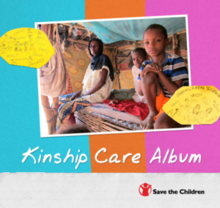
This Kinship Care Album was produced as part of a regional participatory research initiative undertaken by Save the Children to build knowledge on endogenous care practices within families and communities, especially informal kinship care. The Album is a compilation of documentation by children who participated in the research, including resource maps, body maps, photos of focus group discussions and observations by child researchers, pictures and letters from children highlighting their experiences of living in kinship care, their views and recommendations about life in kinship care.
Comprendre et renforcer les mécanismes informels de prise en charge alternative pour améliorer les soins et la protection des enfants, avec un accent sur la prise en charge par la famille elargie en Afrique Centrale et Occidentale.
PAN has translated its materials into Portuguese, French, and Kiswahili.
This research looked at the factors affecting the family reintegration of girls in the Tshangu district of Kinshasa (DRC), an operational zone of the local NGO OSEPER, a partner of War Child for a 3-year project, seeking to address the needs of street-connected girls, including family reintegration.
Representatives from International Social Service, Save the Children, and SOS Children’s Villages met with the African Committee on Experts on the Rights and Welfare of the Child during its 21st session on 15 April, 2013 to present on the international Guidelines for the Alternative Care of Children (UNGA resolution A/RES/64/142) and its new implementation Handbook “Moving Forward.”
Cette déclaration conjointe inter-agences a pour but de (i) de présenter une vision commune des systèmes de protection de l’enfance en Afrique subsaharienne et d’expliquer pourquoi ils sont importants et méritent des investissements et (ii) lancer un appel à l’action auprès des gouvernements, à l’Union africaine, aux communautés économiques régionales, aux institutions multilatérales, aux bailleurs de fonds, au secteur privé, aux institutions académiques, aux organisations de la société civile, aux communautés et aux groupes d’enfants et de jeunes organisés.
Thirteen agencies working in Africa have issued a Joint Statement calling on African governments to strengthen their child protection systems to secure the right of children to a life free from violence, abuse, exploitation and neglect in both emergency and non-emergency settings.