Image
Displaying 421 - 430 of 665
The State of the Ugandan Child: An Analytical Overview focuses on four thematic areas, namely: health and nutrition, education, child protection and child participation; with emphasis placed on the girl child.
This study is a snapshot of a multi-country study involving Italy, Peru, Viet Nam, and Zimbabwe of how individual characteristics, interpersonal relationships, and the communities in which people live interact with institutional drivers to increase or reduce a child’s risk of violence.

This qualitative study explored how volunteers delivering social welfare to orphans and vulnerable children through a community initiative supported by donors made sense of volunteering during a period of hyperinflation in Zimbabwe.
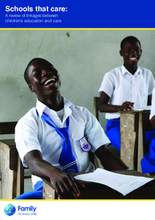
This report presents the key findings of a scoping study on the links between education and children’s care. The study involved a literature review in English, French and Spanish; key informant interviews; and consultations with 170 children, carers, teachers and other stakeholders in Guyana, India, Russia and Rwanda.
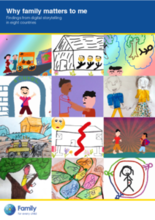
This report examines what family means to children and adults in the following countries: Brazil, India, Guyana, South Africa, Egypt, Mexico, Russia, Kenya. The storytellers use evidence from 59 short films made using digital storytelling technique.
In this chapter of Global Perspectives, Stephen Ucembe uses his personal experiences and his experiences as a social work professional to discuss institutional care in Kenya. This chapter covers the factors that influence institutional care of children in Kenya, international aid, volunteerism, and the negatives of institutional care.
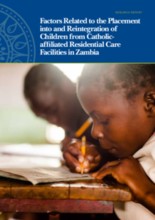
This is a study from Catholic Relief Services that investigates the factors related to children’s placement in Catholic-affiliated residential care facilities in Zambia. According to this study, the government estimates that there are approximately 190 residential-care facilities located in Zambia, and of those 40 are Catholic-affiliated. At the time of this study, there were 1674 residents living in residential care.
The overall objective of this study was to deepen understanding on the experiences and support systems of grandparent-headed households with children of prisoners (CoP) in Uganda.
This chapter first traces the etymology of the definition of “orphan” and its attendant “crises.” Then, using examples from Guatemala and Uganda, the authors consider how the idea of an “orphan crisis” has traveled from development to charitable responses and what effects this has on local child protection systems.
This paper uses two approaches to understand the phenomenon of proliferation of children's institutions in Kenya.