Image
This page contains documents and other resources related to children's care in Africa. Browse resources by region, country, or category. Resources related particularly to North Africa can also be found on the Middle East and North Africa page.
Displaying 141 - 150 of 597
This programme brief is part of a package of materials documenting successes and lessons learnt from implementation of the Tubarerere Mu Muryango (TMM) child care reform programme between 2012 and 2018.
This paper documents the care reform process and presents key lessons learnt. It is based on a review of Rwandan policy and programme documents and on interviews and focus group discussions with 65 stakeholders.
In collaboration with UNICEF, the government of Rwanda has established the Tubarerere Mu Muryango (TMM - Let’s Raise Children in Families) programme to ensure that all children living in institutional care in Rwanda are reunited with their families or placed in suitable forms of family-based alternative care. This report presents a summary of the findings of an evaluation of Phase 1 of this programme.
This package of materials documents successes and lessons learnt from implementation of the programme of care reform and family strengthening - called Tubarerere Mu Muryango (TMM), translated to Let’s Raise Children in Families - in Rwanda between 2012 and 2018.
The purpose of this study was to investigate factors influencing performance of orphans and vulnerable children Programmes in Kenya focusing on unbound project in TharakaNithi County, Kenya.
The aim of this study was to assess the feasibility and acceptability of a home‐based intervention—Amagugu Asakhula—to promote nurturing interactions and healthy behaviours with the caregivers of preschool children.
The sole purpose of the study was to determine the factors influencing utilization of cash transferred to orphans and vulnerable children in Runyenjes Subcounty, Embu County. The study concluded that demographic characteristics had the greatest effect on the utilization of cash transferred to orphans and vulnerable children, followed by frequency of cash transferred then attitude of beneficiaries while home factors had the least effect to the utilization of cash transferred to orphans and vulnerable children.
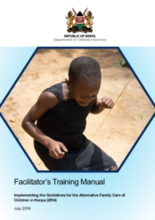
Kenya's Department of Children’s Services (DCS), and its care reform partners within government and civil society, developed this Facilitator’s Training Manual for training on implementing the Guidelines for the Alternative Family Care of Children with the intent to streamline and standardize alternative family care services in Kenya through standardized training. This comprehensive training package includes the training facilitator’s manual, PowerPoint presentations, handouts, case studies, and video clips.
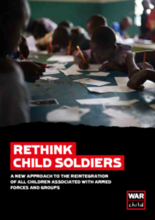
This report by War Child aims to bring global attention to the challenges related to the reintegration of children associated with armed forces and groups, and promote better policy, practice and funding in the future.
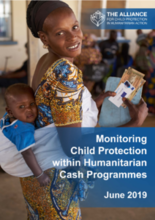
This paper from the Alliance for Child Protection in Humanitarian Action summarises findings from an initial scoping study, which seeks to review how child protection outcomes are captured when monitoring multi-purpose humanitarian cash programmes. The paper proposes a theory of change of the possible links between cash and child protection to inform the development of a monitoring strategy, including hypotheses that humanitarian cash might contribute to prevention of family separation, reduction of family violence, and supporting foster and temporary caregivers to care for separated and unaccompanied children.