Image
This page contains documents and other resources related to children's care in the Americas. Browse resources by region, country, or category.
Displaying 131 - 140 of 1438
Este informe documenta las primeras etapas de un proceso de aprendizaje entre Cambiando la forma en que Cuidamos y la Congregación de las Hermanas de Nuestra Señora de la Caridad del Buen Pastor en México a medida que ellas avanzan en su proceso de transición. Este documento está dirigido a los profesionales, las organizaciones y los actores católicos interesados en apoyar o participar en un proceso de transición con las organizaciones católicas y también proporciona información útil para aquellos que participan en la transición con actores no religiosos. Esto incluye un importante aprendizaje relacionado con la forma de acompañar a las religiosas en el proceso de transición, comprendiendo los matices relacionados con el tiempo, el contenido y el enfoque. Y lo más importante es que explora el componente emocional que conlleva el hecho de que las religiosas, adapten el enfoque de su carisma a medida que se transforman, pasando de proporcionar atención residencial a una atención basada en la familia y la comunidad.
This brief documents the first stages of a learning process between Changing the Way We CareSM and the Mexican Province of the Congregation of the Sisters of Our Lady of Charity of the Good Shepherd as the Sisters moved forward in their transition process. It is written for practitioners and organizations, including Catholic actors interested in supporting or engaging in a transition process with women religious and also provides useful information for those engaging in transition with non-faith actors.
Informed by a case review of 36 Guatemalan children supported to reintegrate into families, and interviews with social workers and psychologists engaged in the process, this article explores the role of the “community connectedness” wellbeing domain. The authors explore how community connectedness or lack thereof, can contribute to child and parent/caregiver wellbeing and successful reintegration—the different types of community connectedness and who/what was involved in establishing and fostering these connections.
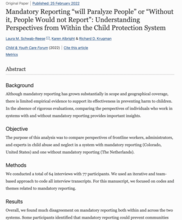
The purpose of this analysis was to compare perspectives of frontline workers, administrators, and experts in child abuse and neglect in a system with mandatory reporting (Colorado, United States) and one without mandatory reporting (The Netherlands).
Este gráfico está destinado a los profesionales que trabajan en los organismos gubernamentales y las organizaciones no gubernamentales que participan en diferentes aspectos del sistema de protección y atención, pero específicamente en el apoyo a la reunificación, y detalla las funciones y responsabilidades específicas de quienes participan en este proceso en Guatemala y cómo deben coordinarse.
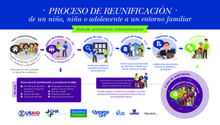
This graphic is intended for use by professionals working within government agencies and non-governmental organizations in Guatemala engaged in different aspects of the protection and care system but specifically in support of reunification. It details specific roles and responsibilities of those engaged in this process in Guatemala and how they should coordinate.

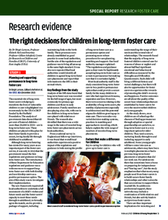
Although long-term fostering has existed for many years as an important part of the foster care service, it was only in 2015 that the government issued the first regulations and guidance on longterm foster care. The introduction of these Department for Education regulations and guidance supports long-term foster care with both kinship and non-kinship carers as a positive permanence option. The aim of this study was to investigate their implementation.
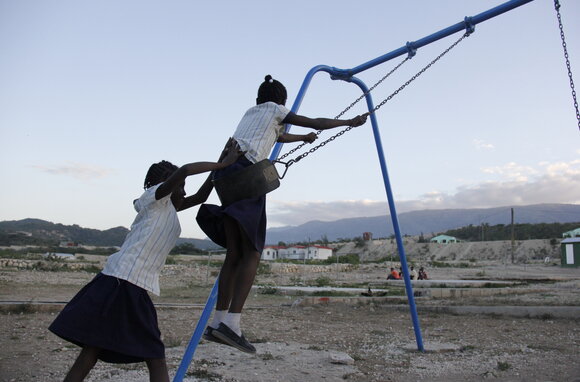
This paper explores perspectives on family reunification and emergent forms of separation among young migrants. These young people lived apart from and later reunited with their migrant parents who moved from the Philippines to Canada for work.
Child Maltreatment 2022 (the report) is the latest edition of the annual Child Maltreatment report series. The report is used by researchers, practitioners, and advocates throughout the world as a source for national child welfare data. Jurisdictions provide the data for this report via the National Child Abuse and Neglect Data System (NCANDS). NCANDS was established as a voluntary, national data collection and analysis program to make available state child abuse and neglect information. Since 1991, child welfare agencies in the 50 states, the Commonwealth of Puerto Rico, and the District of Columbia have collected and submitted data for NCANDS.

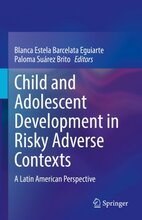
The causes of institutionalization are multiple and the impact it causes is reflected in different areas such as the development of the child in general, such as mental, psychic structuring, health, and nutrition. Psychologically, children present alterations in their cognitive, emotional, sexual, and social domains with a high probability of developing several pathological conditions. This chapter presents an overview of this phenomenon based on several research investigations carried out in Spain, Latin America, and Mexico.