Image
This page contains documents and other resources related to children's care in Europe. Browse resources by region, country, or category.
Displaying 1261 - 1270 of 1752
For many social workers, participatory practice may seem an unachievable goal, particularly in the field of child protection. This paper discusses a significant programme of change in one London local authority, as part of which the authors undertook 110 observations of practice and provided more than eighty follow-up coaching sessions for workers.
During the summer of 2016, in the midst of one of the biggest refugee crises in centuries, the author of this article joined the team from a shelter for unaccompanied refugee minors on Samos, Greece, in an effort to provide young boys seeking asylum in Europe with an opportunity to engage in speaking about the difficulties they have encountered in life.
This report continues a predecessor Committee’s inquiry into fostering in the UK. It emphasizes the importance of valuing the young people in foster care, foster carers, and the foster care system itself.

This study examines and compares the extent of child maltreatment (physical, emotional, and sexual abuse; physical and emotional neglect) and lifetime traumatization with regard to current adult mental health in a group of survivors of institutional abuse and a comparison group from the community.
In this introduction to a special issue on unaccompanied migrant minors from the Global South to Europe and the U.S., the authors seek to shed light on what resources and experiences unaccompanied migrants arrive with, stressing these young migrants’ challenges at each stage prior to arrival and the challenges they face navigating the receiving context.
This paper provides an overview of the post 2015 immigration crisis in key European countries with a special focus on current demographics, refugee children, mental health studies, policies and practical support available for refugees.
This research aims to contribute to a deeper visibility of the care phenomena, giving specific attention to the foster families themselves.
This article examines whether migrant children are viewed differently than native children, employing an experiment on a representative sample of the populations of Austria, Norway and Spain.
This study aimed to (1) evaluate the indicated prevention program Teaching Recovery Techniques (TRT) in a community setting and describe the program’s effects on symptoms of PTSD and depression in unaccompanied refugee minors; and (2) examine participants’ experiences of the program.
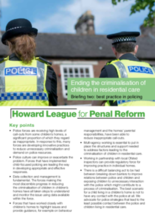
This is the second briefing paper published as part of the Howard League’s two-year programme to end the criminalisation of children in residential care. It explores how good practice in the policing of children’s homes can significantly reduce the unnecessary criminalisation of vulnerable children and demand on police resources.