Image
This page contains documents and other resources related to children's care in Europe. Browse resources by region, country, or category.
Displaying 1691 - 1700 of 1752
This study aims to use media reports as a resource to collate existing information on abandoned babies and to draw conclusions to inform future response.
Outlines the project aims, critical areas of child care reform, and expected results of the Serbian initiative: “Transforming Residential Institutions for Children and Developing Sustainable Alternatives”
The purpose of this study is to inform stakeholders about the current status of social work in the region, describe the practice environment, identify gaps between what is expected of social workers and the reality, provide examples of best practices, and make recommendations for furthering the development of social work in the region.
This report provides an assessment of the current situation with regards to rights of children in institutions in 42 Council of Europe member states.
In this meta-analysis of 75 studies on more than 3,888 children in 19 different countries, the intellectual development of children living in children's homes (orphanages) was compared with that of children living with their (foster) families.
This paper seeks to highlight the resilience‐enhancing potential for vulnerable young people of roles and relationships in the domains of recreation and work. The paper explores its theme through a specific focus on the needs of young people in long‐term care.
A great change is coming over childhood in the world’s richest countries. Today’s rising generation is the first in which a majority is spending a large part of early childhood in some form of out-of-home child care. This Report Card discusses the opportunities and risks involved in the child care transition, and proposes internationally applicable benchmarks for early childhood care and education.
Explores causal relationship between increased international adoption and increase in institutional care of children in Europe.
The study reported by Shihning Chou and Kevin Browne explored the link between institutional care for young children and international adoption, using a survey of 33 European countries. The evidence suggests that, rather than reduce the number of children in institutions, international adoption may contribute to the continuation of this harmful practice. A child rights-based approach to providing alternative care for children separated from their parents is proposed.
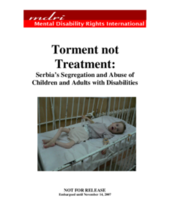
This report is the product of an investigation spanning four years by Mental Disability Rights International (MDRI) into the human rights abuses perpetrated against institutionalized children and adults in Serbia. From July 2003 to August 2007, MDRI documented a broad array of human rights violations against people with disabilities, segregated from society and forced to live out their lives in institutions.