Image
This page contains documents and other resources related to children's care in Africa. Browse resources by region, country, or category. Resources related particularly to North Africa can also be found on the Middle East and North Africa page.
Displaying 21 - 30 of 597
The Kafaalah Community Engagement Facilitator's Flipbook is a practical guide designed to support trained facilitators—such as Children Officers, Imams, Ustadh, Ustadhas, and other Muslim community leaders—in delivering community sessions on the Kafaalah. It offers structured guidance for engaging male caregivers, female caregivers, and children through interactive sessions.
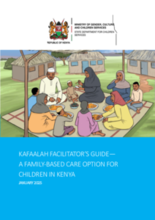
The Kafaalah Facilitator’s Guide is part of a training package to strengthen understanding and implementation of Kafaalah, a family-based alternative care option for children in Kenya. Developed by the Government of Kenya with support from Changing the Way We Care, it provides structured session plans, tools, and activities to help child protection professionals and community members effectively promote and practice Kafaalah.
This package of materials on Kafaalah - was developed by the Government of Kenya in collaboration with Changing the Way We Care, UNICEF, and other key development partners and civil society actors.
The report is a meta-evaluation of Save the Children Finland’s Global Child Protection programme, implemented from 2022 to 2025 in four countries in Africa – Burkina Faso, Côte d´Ivoire, Somaliland and Zambia – spanning development, humanitarian and peace-building contexts.
This news article, from the Guardian Tanzania, notes how the government of Tanzania has initiated a nationwide programme to support children living and working on the streets, marking a significant step towards protecting vulnerable groups and fostering inclusive development.
This case study showcases Kar Geno’s transition from institutional care to community-based support for children with disabilities in Siaya County, Kenya, guided by CTWWC and Catholic Relief Services. Through family reintegration, disability-inclusive services, and strong collaboration with government and civil society, Kar Geno has become a model for sustainable care reform, reintegrating nearly all resident children while continuing to provide accessible medical and psychosocial support through a community drop-in center.

This study examined how disability status affects the well-being of children in Kenya who were reunified with families after living in residential care. It found that children with disabilities reported lower well-being and life satisfaction compared to their peers without disabilities, highlighting the need for targeted support during reunification.
In this video, practitioners, faith leaders, and a Kafaalah caregiver share experiences in promoting and strengthening Kafaalah as an important part of family-based alternative care in Kenya.
Street-connected children in Ghana face systemic marginalization, requiring comprehensive interventions at the family, community, and policy levels. Based on insights from 12 social workers, this study highlights micro-, mezzo-, and macro-level strategies to reduce the number of street-connected children and support their reintegration into society.
This video explores efforts to enable children with disabilities in Rwanda to grow up in safe and caring families using an integrated approach which saw collaboration between the child protection, health, education and social protection sectors.