Image
This page contains documents and other resources related to children's care in Africa. Browse resources by region, country, or category. Resources related particularly to North Africa can also be found on the Middle East and North Africa page.
Displaying 1391 - 1400 of 2666
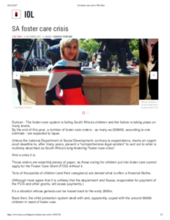
High numbers of children in kinship care in South Africa are putting a strain on the foster care system due to the intensive supervision required in order for families to receive the Foster Care Grant.
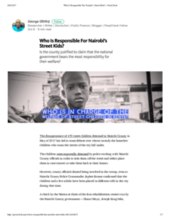
Following the disappearance of 470 street-connected children after being detained in Nairobi County, county officials claim that it is the responsibility of the federal government to house and rehabilitate the children.
The fifteen member states of the Economic Community of West African States(ECOWAS) have adopted the Strategic Framework for Strengthening National Child Protection Systems to Prevent and Respond to Violence.
Faith leaders in Rwanda are being urged to contribute to child protection efforts by engaging families to prevent violence and family separation.
Implementation of comprehensive care reform strategy in Rwanda has led to a successful transition from a system dependent on insitutionalization to one that embraces family-based care.
This video series from Better Care Network, in partnership with Child's i Foundation, highlights promising practices in children's care in Uganda.

High prevalence of sex tourism in Zanzibar has spurred a five year National Action Plan to end violence against children and women on the island.
International actors and representatives from Armenia, Ghana, Moldova, and Uganda convened in London September 11-15 2017 to learn and share experiences to inform the alternative care reform process in the four countries.
At convening of the Global First Ladies Alliance in New York, Rwanda's First Lady Jeannette Kagame shared the successes of Rwanda's care reform.
This qualitative study explores 49 orphaned children who were observed in a non-governmental organization group setting in a small, rural village located in Eastern Cape, South Africa.