Image
This page contains documents and other resources related to children's care in the Americas. Browse resources by region, country, or category.
Displaying 1411 - 1420 of 1438
This one-page document identifies some difficulties that youth face in leaving institutional care. Offers recommendations to assist financial, emotional, and educational preparation for emancipation.
Economist article which argues for changes in US federal welfare funding to maintain family unity and reduce the numbers of children entering into foster care.
A series of papers examining kinship care options and programs in the US which address low socio-economic status, culturally appropriate care, exemplary models of kinship care, and public policy.
In assessing the practice of foster care in the US and its current limitations, this series of articles advocates for the implementation of health assessments for all children in care, support to preserve permanency and assist birth families, comprehensive supports for foster families, specialized services for children in need, increased cultural competency in social work practice, coordinated services across sectors for families in need and comprehensive well being assessments for children in care.
This working paper from the National Scientific Council on the Developing Child explains how adult-child relationships shape child development, and identifies ways to strengthen policies that affect those relationships in the early childhood years.
This article discusses the importance of safety and stability to healthy child development and reviews the research on the risks associated with maltreatment and the foster care experience in the United States.
Rapid assessment of the social impact of HIV/AIDS on children in Belize. Although many typical vulnerabilities are not as prevalent in the Belize as in other developing countries, HIV-related stigma remains a significant threat to children living with and affected by HIV/AIDS.
A list of US programs and program approaches that influence family reunification outcomes. Relevant for social workers, policy-makers, and others involved in foster care, after care, and family reunification.
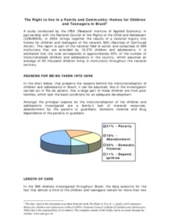
This research study provides statistical information on institutional care of children under the age of 12 in Brazil. Interviews with institutions and children are conducted, and reasons for separation from family, length of time in care, status of family relationship, religious orientation and financial support of the institutions are highlighted.
Analyzing rich data from in-depth ethnographic interviews conducted in Cleveland, Milwaukee, and Philadelphia, Next Generation researchers documented the challenges that low-income families face as they patch together a variety of arrangements to meet their child care needs.