Image
This page contains documents and other resources related to children's care in Europe. Browse resources by region, country, or category.
Displaying 141 - 150 of 1752
This is the Executive Summary of the briefing ‘Building resilience in social services by managing demand’ published as an output of the 2023 annual meeting of the European Social Network ‘Social Services Transformation and Resilience’ Working Grou
The demand for social care, support, and protection is rapidly increasing across Europe, driven by a variety of factors, such as demographic changes and increasing inequalities. This briefing from the European Social Network (ESN) examines this critical issue and identifies solutions to manage demand for social services, to plan and allocate their resources, both human and financial, to deliver high-quality outcomes that are tailored to the actual needs of persons seeking support.
The article explores the notion of deinstitutionalization, emphasising its importance in post-conflict areas and emphasising the value of a personalised social work approach in promoting the welfare of children and young people impacted by the Russia-Ukraine war conflict.
9 серпня 2023 року Міністерство соціальної політики України, Міністерство реінтеграції України та Міністерство внутрішніх справ України підписали спільний наказ №274-Н/215/651, яким затвердили Типовий план повернення українських дітей, евакуйовани
On 9 August 2023 the Ministry of Social Policy of Ukraine, the Ministry of Reintegration of Ukraine and the Ministry of Internal Affairs of Ukraine signed a joint Order No274-H/215/651 adopting a Model Plan for the return of Ukrainian children evacuated from 22 baby homes and placed in boarding institutions in safer places in Ukraine and abroad.
This qualitative study explores the prevalence and role of natural mentors in the lives of unaccompanied immigrant youth residing in the Barcelona Metropolitan Area. The authors' findings suggest that natural mentors provide various types of social support and social capital, which fulfil the emotional or educational needs of young people.
In this article, the authors discuss residential staff in Sweden where residential care is part of the municipal child welfare system, which covers services targeting juvenile delinquency as well as other residential care services. Children and young people placed in Swedish residential care have diverse needs, from mainly supportive needs to advanced behavioral problems, and the field consists of open and secure residential care units.
Mapping integration and outcomes in Scotland: A statistical analysis investigated if the most recent major structural reform of health and social care services to take place in Scotland has had an impact on outcomes for children, young people and families.
Case studies of transformational reform programmes examined a range of approaches to the delivery of children’s services to better understand the evidence regarding systems-level integration between children’s social work/social care with health services and/or adult social care.
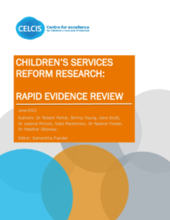
Strand 1: Rapid Evidence Review reviewed existing published national and international research evidence focused on better understanding the evidence associated with different models of integration of children’s services with health and/or adult social care services in high income countries, as defined by the World Bank.