Image
This page contains documents and other resources related to children's care in Europe. Browse resources by region, country, or category.
Displaying 141 - 150 of 3593
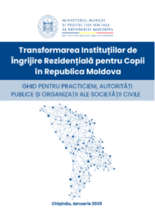
The Moldova Transformation Guidance aims to support the transformation process of residential care facilities (RCF) to models that promote family support and community-based services, or to safely close them and redirect their resources. National and local authorities can use this guidance to design, plan, budget, communicate, and coordinate transformation at both individual and system levels.
The publication summarizes lessons and good practices from the Community Engagement for Better Care pilot project implemented in four communities by Diaconia of the Bessarabian Orthodox Church in Moldova in 2024-2025. The project explored how faith communities - especially the Orthodox Church - can support children and families in need.
This booklet of sermons, developed by Diaconia of the Bessarabian Orthodox Church in Moldova promotes solidarity-based communities where children and families thrive in safe and nurturing environments. It provides sermons for priests to emphasize child protection, family values, and community engagement.

This article reports that, according to Save the Children, recent migration policies and border-management agreements by the European Union are endangering migrant children — especially unaccompanied minors and children fleeing conflict — by pushi
This article reports how an investigation reveals that in 2024, over 2,000 children, including 864 trafficked children (37%) and 1,501 unaccompanied asylum-seeking children (13%), disappeared from care under UK local authorities, exposing alarming
This article reports that in 2024, over 2,000 children identified as trafficked or unaccompanied asylum seekers went missing while under the care of local authorities in the UK — 37% of 2,335 trafficked children, and 13% of 11,999 lone‑child asyl
This study explores how children living in children’s homes in Luxembourg experience their daily lives, revealing that while many feel sad or worried, they also demonstrate resilience and the ability to find joy. The findings highlight that children feel better when adults listen and take them seriously, and that additional support with school and caring relationships can improve their well-being.
This article highlights the experiences of Greenlandic families in Denmark whose children were taken into care following parental competency tests (FKUs), which critics say are culturally biased, conducted in Danish rather than Kalaallisut, and fa
This study examines how children in Swiss residential care perceive safety, revealing that while institutions aim to protect them, many still experience both safety and unsafety shaped by physical spaces, institutional rules, and relationships with staff. By centering children’s voices, the article highlights gaps between residential care’s protective mandate and children’s lived experiences, calling for a more nuanced, justice-oriented understanding of safety in child welfare.