Image
This page contains documents and other resources related to children's care in Europe. Browse resources by region, country, or category.
Displaying 2381 - 2390 of 3592
The Bucharest Early Intervention Project sought to examine the effects of foster care as an alternative to institutional care for abandoned infants in Romanian institutions.
The aim of this study was to investigate 60 foster parents' acceptance, commitment and awareness of influence to their early placed foster children at 2 years, as well as to investigate the association between these three concepts and the foster children's social-emotional functioning (externalizing, internalizing, dysregulation and competence) at 2 and 3 years of age.
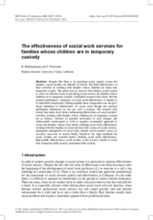
The article aims to uncover what hinders social workers to carry out effective work in providing social services for families whose children are in temporary custody.
This study explored whether trust in caregiver support and communication about experiences with primary caregivers, are associated with Child Welfare System (CWS) youngsters’ depressive symptoms and/or self-harm.
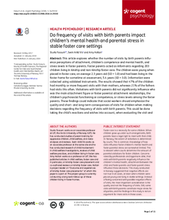
This article explores whether the number of visits by birth parents influence perceptions of attachment, children’s competence and mental health, and stress levels in foster parents.
This study evaluates the ‘Nurturing Attachment’ program in the UK, a Dyadic Developmental Psychotherapy intervention for adoptive families.
The Netherlands' health minister Hugo de Jonge has proposed a plan to allow foster youth to stay in care until the age of 21, extending it from the current maximum age of 18, according to this article from DutchNews.nl.
This article, in Dutch, features an interview with Patricia Nieuwenhuizen of Better Care Network Netherlands on the campaign to stop orphanage tourism.
In this piece, Robert Halfon, the Chair of the UK Parliament's Education Select Committee, writes that England's foster care system is failing vulnerable children.
This article, based on a unique mixed‐methods study of social work interventions in the UK and the influence of poverty, highlights a narrative from practitioners that argues that, as many poor families do not harm their children, it is stigmatizing to discuss a link between poverty and child abuse and neglect.