File
Displaying 3961 - 3970 of 4505
In June 2010, the Committee on the Rights of the Child issued its Concluding Observations to countries reviewed during the Committee's 54th session. This brief summarizes the UNCRC observations regarding alternative care.
This child friendly report was produced to provide feedback to children who took part in the consultations for for developing EveryChild's conceptual framework -Every child deserves a family. Aimed at children 11 years and older, it can be used to initiate discussions about a loss of parental care and care and protection issues for youth.
This briefing paper draws on ODI’s research on social protection and gender in eight countries and three regions funded by DFID and AusAID and discusses how social protection interventions can promote an inter¬linked gender-sensitive approach to the MDGs.
The evidence presented in this paper shows that insufficient attention paid to equity across and within generations has devastating impacts for the achievement of the MDGs and for the wellbeing of children now and in the future.
This report argues that a failure to provide proper care and protection for children is hindering progress in the achievement of many of the MDGs.
The handbook provides operational guidance and tools to support effective protection responses in situations of internal displacement.
The special issue brings together the rationale for family-centred services for children affected by HIV and AIDS and some of the available evidence for the effectiveness of integrating treatment and care into the broader context of family-support schemes
The Interagency Panel on Juvenile Justice seeks a part time Secretariat Coordinator to be based in Geneva, Switzerland
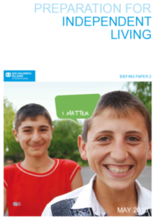
The "I Matter Campaign" advocates for support for young people ageing out of care. The second edition of the "I Matter" briefing paper, published by SOS Children's Villages, focuses on young people's involvement in the campaign.
This document contains the minimum standards for placing children in foster care in Bosnia and Herzegovina. The Minimum Standards includes service specifications, instruments for monitoring compliance with standards, and guidelines for use of the minimum standards for day centers for children with developmental disabilities.