Image
Displaying 231 - 240 of 665
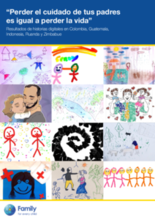
This report explores what family means to children and adults in five countries using the digital storytelling technique.
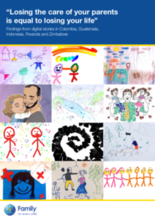
Pese a que hay un consenso sobre la importancia del cuidado efectivo en las familias para los niños, existe una falta de discusión y acuerdo sobre los componentes precisos de este cuidado. Este informe contribuye a debatir sobre este importante tema al proporcionar perspectivas de los grupos focales con 198 niños y 81 adultos de Brasil, Colombia, Egipto, México, Rusia, Ruanda y Zimbabue.

There is extensive research demonstrating clearly the importance of a safe and caring family for child wellbeing and development. While there is consensus on the importance of effective care in families for children, there is a lack of discussion and agreement about the precise components of this care. This report contributes to debates on the components of family care by providing perspectives from nearly 200 children and over 80 adults from Brazil, Colombia, Egypt, Mexico, Russia, Rwanda and Zimbabwe. The report demonstrates that there are many commonalities in perspectives on and experiences of care across contexts.

In order to address the need for evidence-based research about the care leaver experience, a study was facilitated by the Uganda Care Leavers project - sponsored by Alternative Care Initiatives (ACI), a Ugandan NGO, and BULA, a U.S. 501(c)(3) non-profit organization - to conduct peer-led participatory workshops throughout the country. These care leavers, identified by local community leaders and networks, were invited to participate in workshops where they completed surveys about their experiences, the results of which are presented in this report. Survey results are the basis of this study’s recommendations and suggestions for future care reform.
The purpose of this study was to establish the relationship between technology as a capacity building strategy and performance of the orphans and vulnerable children cash transfer program in Nairobi County, Kenya.
The goal of this study was to examine whether and how alternative kinship structures were reproduced in Charitable Children’s Institutions (CCIs) in Kenya.
This book largely focuses on unaccompanied minors who arrived in a European country in 2015, with special attention paid to the top-three nationalities of unaccompanied minors, namely Syrian, Afghan and Eritrean minors.
This article investigates whether individuals who were orphaned as a child suffer long‐term consequences on their pro‐sociality.
The authors of this study examined the collective effects of childhood sexual, physical, and emotional violence on selected self-reported health outcomes among young Kenyan females and males using the Violence Against Children Survey (VACS).