Image
Displaying 131 - 140 of 431
The Case Management Task Force (CMTF) of the Alliance for Child Protection in Humanitarian Action commissioned this project to gather and draft key lessons learned on the Case Management Supervision and Coaching initiative. Key questions that the Task Force wanted to address included feedback on the interagency country collaboration, the effectiveness of the localization approach, the successes and challenges of roll-outs in the eight participating countries, and the impact on case management teams’ supervision practices.
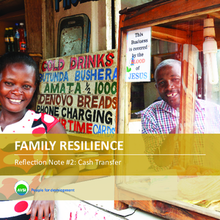
This Reflection Note is intended as a means for AVSI staff and implementing partners on the FARE project to capture emerging learning as relates to the theory of change elaborated during project design.
This Reflection Note is intended as a means for AVSI staff and implementing partners on the FARE project to capture emerging learning as relates to the theory of change elaborated during project design. Particularly, the Reflection Note seeks to answer how necessary and effective cash transfers are as a component of the economic strengthening pathway, hypothesized as crucial for the project goals of building family resilience as a means of preventing child-family separation or ensuring successful reintegration of children into family care.
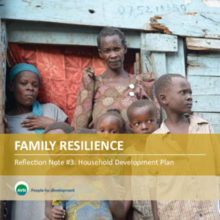
This Reflection Note from the Family Resilience (FARE) project asked how, in practice, Household Development Plans were used, and what was their value in improving the relationship environment and capacities of families to reintegrate previously separated children and youth back at home and to prevent separation.
The primary goal of the ASPIRES project is to support gender-sensitive programming, research and learning to improve the economic security of highly vulnerable individuals, families and children.
This Practitioner Brief presents key learning and recommendations from the Keeping Children in Healthy and Protective Families (KCHPF) project, an operational research project which supported the reintegration of children living in residential care back into family care in Uganda.
This program brief provides an overview of, and key findings from, an evaluation of a community-based child protection intervention in post-conflict Uganda by Makerere University.
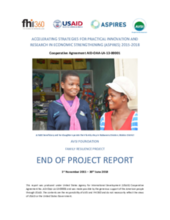
This report describes the FARE project - a subproject of ASPIRES that sought to develop evidence and programming guidance for matching contextually appropriate economic interventions with specifically targeted households to reintegrate separated children into families and prevent unnecessary separation of children from their families - and summarizes achievements, challenges, and learning.
This chapter from Social Work Practice in Africa: Indigenous and Innovative Approaches showcases examples of home-grown indigenous and innovative models of social work practice in Uganda, including local models for addressing the HIV/AIDS orphan crisis in Rakai district.
This chapter from Social Work Practice in Africa: Indigenous and Innovative Approaches presents a traditional fostering model adopted by a group of women in Northern Uganda, analysing its potential for building resilience and for contributing to social capital and social development within the broad context of post-conflict situations.