Image

Displaying 541 - 550 of 1665
In this video for BBC News, Southern Africa reporter Pumza Fihlani went to visit Antalaha Prison in Sava, one of Madagascar's biggest vanilla-producing regions, to expose the "worrying" conditions of the prison where children accused of stealing vanilla beans are being held (some for up to nearly three years without trial).
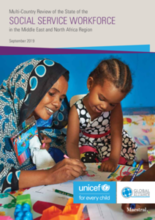
This report is a review of the social service workforce in eight countries: Djibouti, Iran, Jordan, Lebanon, Morocco, Palestine, Sudan and Tunisia.
In this article for the Conversation, Julia Sloth-Nielsen provides an overview of recent efforts in Kenya to shift from institutional care of children to family-based care and family strengthening to prevent separation.
This video from CGTN's Talk Africa explores Kenya's recent decision to ban the adoption of children by foreign nationals.
The purpose of this commentary is to reflect on the utility and possible application of the suggestions and study designs in this special issue to real‐life intervention studies in dynamic context settings.

This video from BBC News tells the stories of mixed-race children in Africa who were separated from their mothers, taken from their countries of origin, and brought to live with "host families" in Belgium during the Belgian colonial period.
This video segment from The Lead exposes corruption and abuse within some of Kenya's children's homes.
The Accelerating Strategies for Practical Innovation and Research in Economic Strengthening (ASPIRES) Family Care Project focused on how economic strengthening (ES) interventions can help prevent unnecessary separation of children from families as well as support the reintegration into family care of children who were already separated. This mixed methods evaluation was implemented alongside programming that included longitudinal quantitative data collection with all participating FARE and ESFAM households at three time points to assess a range of indicators related to household economic and family well-being, as well as in-depth, longitudinal qualitative research to help understand how (well), from participants’ perspectives, the FARE and ESFAM interventions aligned with perceived drivers of separation and families’ experienced child-level effects of programming.
The Economic Strengthening to Keep and Reintegrate Children in Family Care (ESFAM) project was developed to help build the evidence base on how to appropriately match economic strengthening (ES) activities with families at risk of family-child separation and with families in the process of reintegrating a previously separated child. In addition to supporting families, ESFAM offered an opportunity for learning about how to provide these services and how well they worked. This report focuses on the latter and summarizes changes in key indicators related to family-child separation over the course of the project.
The Family Resilience (FARE) project was developed to help build the evidence base on how to appropriately match economic strengthening (ES) activities with families at risk of family-child separation and with families in the process of reintegrating a previously separated child. The project offered an opportunity for learning about how to provide ES and other family strengthening services and how well they worked. This report focuses on the latter and summarizes changes in key indicators related to family-child separation over the course of the project.