Image
This page contains documents and other resources related to children's care in Africa. Browse resources by region, country, or category. Resources related particularly to North Africa can also be found on the Middle East and North Africa page.
Displaying 171 - 180 of 597
This Practitioner Brief presents key learning and recommendations from the Keeping Children in Healthy and Protective Families (KCHPF) project, an operational research project which supported the reintegration of children living in residential care back into family care in Uganda.
This program brief provides an overview of, and key findings from, an evaluation of a community-based child protection intervention in post-conflict Uganda by Makerere University.
This briefing paper reports on the lessons learnt from a process evaluation of the child protection component of the Global Fund’s Young Women and Girls (YWG) programme, a multi-pronged HIV prevention programme targeting young women and girls implemented in 10 districts in South Africa.
This report describes the FARE project - a subproject of ASPIRES that sought to develop evidence and programming guidance for matching contextually appropriate economic interventions with specifically targeted households to reintegrate separated children into families and prevent unnecessary separation of children from their families - and summarizes achievements, challenges, and learning.
This chapter from Social Work Practice in Africa: Indigenous and Innovative Approaches showcases examples of home-grown indigenous and innovative models of social work practice in Uganda, including local models for addressing the HIV/AIDS orphan crisis in Rakai district.
This chapter from Social Work Practice in Africa: Indigenous and Innovative Approaches presents a traditional fostering model adopted by a group of women in Northern Uganda, analysing its potential for building resilience and for contributing to social capital and social development within the broad context of post-conflict situations.
This study sought to examine social protection mechanisms for children living on the streets of Uganda, a case study of Kampala.

This qualitative study sought to explore the perspectives of a group of South African caregivers, all of whom were in receipt of a Child Support Grant (CSG), in relation to their own caregiving and family functioning.
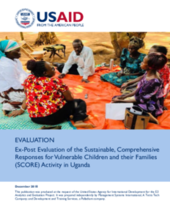
This ex-post evaluation examines the sustainability of outcomes from USAID’s Sustainable, Comprehensive Responses for Vulnerable Children and their Families (SCORE) activity.
The All Babies Count (ABC) initiative was a comprehensive health systems strengthening intervention designed to improve neonatal care in rural public facilities. This article describes ABC implementation outcomes, including development of a quality improvement (QI) change package.