
Image

Displaying 171 - 180 of 213
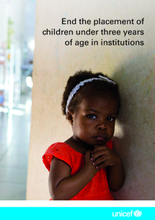
On the 22nd October 2013, a new regional campaign in the Latin American and Caribbean region was launched to end the placement of children under three years of age in institutions.
Le phénomène des restavek (enfants qui « restent avec » une famille qui n’est pas la leur) a longtemps ete méconnu du public. Pourtant, entre 150 000 et 500 000 enfants haïtiens vivent ce calvaire.
Charts that accompany the article Orphan Fever: The Evangelical Movement’s Adoption Obsession, illustrating the trends in international adoptions from Liberia, Kyrgyzstan, Ethiopia, Uganda, and Haiti to families in the United States.
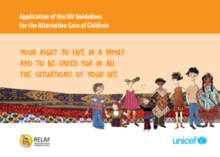
This RELAF booklet, Application of the UN Guidelines for the Alternative Care of Children, is a child-friendly guide to the Guidelines of for the Alternative Care of Children meant for children and adolescents to inform them of their right to live with their families and make that right a reality.
Selon l'UNICEF et l'Institut du bien-être social et de recherche environ 80% des enfants qui se trouvent dans les orphelinats en Haiti ont un parent proche. Ces enfants sont le plus souvent abandonnés par leur famille parce que celles-ci manquent de moyens pour subvenir à leurs besoins, selon l'UNICEF qui attribue ce problème à l'extrême vulnérabilité de ces enfants en Haïti.
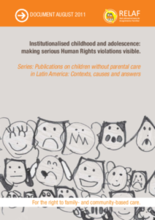
This paper, produced by RELAF, is part of a series of publications on children without parental care in Latin America: Contexts, causes and answers. This document, and others in the series, pertains to the broad topic of children without parental care and examines the particular situation of institutionalised children.
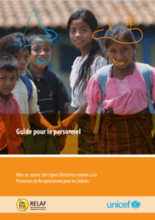
Ce Guide est un outil pour la mise en œuvre des Lignes Directrices relatives à la Protection de Remplacement pour les Enfants. Ses orientations en matière de droits de l’homme s’adressent aux opérateurs professionnels et aux personnes qui travaillent dans les institutions gouvernementales et non gouvernementales, mais aussi aux preneurs de décisions aux différents niveaux des Etats, aux autorités judiciaires, aux législateurs, etc.
Findings of a study aimed to determine the effectiveness and the efficiency of the Foster Care Programme, assess the treatment of children in Foster Care, assess the adherence to child rights in the provision of Foster Care, provide policy direction for the enhancement of the Programme.
Des milliers d’enfants vivent dans des centres résidentiels (orphelinats et crèches) en Haïti. a plupart d’entre eux ne sont pas orphelins mais ont été placés dans ces centres car leurs familles vivent en grandes difficultés matérielles, sociales ou économiques ou sont installées dans des localités où le manque d’accès aux services de base (santé et éducation) est un vrai défi. Leur protection est un réel enjeu pour les organismes de protection de l’enfance.
This paper aims to show different organisations, institutions, governments and civil society the reality facing thousands of children in Latin America. This information can be used as a tool for debating and prioritising the issue as well as promoting constructing good practices and public policies that will improve the wellbeing and chances to develop of children without parental care and/or who are at risk of losing
