Image
This page contains documents and other resources related to children's care in the Americas. Browse resources by region, country, or category.
Displaying 51 - 60 of 1438
The survey results presented in this report highlight increasing efforts by states, the District of Columbia and Puerto Rico to promote kinship care and support the caregivers of children who are known to the child welfare system. At the same time, the report calls on states to do more to help willing kin caregivers access and benefit from foster care licensing.

In this article, the authors present considerations related to the global mandate for child protection and the challenges that persist amongst marginalized communities. Subsequently, they focus on Canada and, in particular, the Ontario example: the trends from the Ontario Incidence Study of Reported Child Abuse and Neglect (OIS). This child welfare epidemiological project has highlighted the need for greater intersectional adjustments to best protect children, where the iterative research-policy cycle has most effectively been seen with a formal system for the inclusion of lived experience, as in the case of Indigenous peoples.

The goal of this study is to examine the relationship between caregiver characteristics, caregiver attachment and placement type on two dimensions of mental health and substance use among a sample of older youth living in care in Ontario, Canada.
The purpose of this U.S.-based study was to examine two intervening variables, self-care and formal support that affect the relationship between children with behavioural issues and caregiver depression.
This study based in Canada explored views on the changes in child safety reporting and interventions with newcomer families during the COVID-19 pandemic.
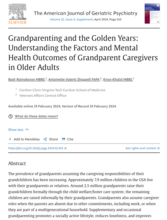
This report outlines the various trends and reasons for the rise of grandparents involved in caring for grandchildren in the U.S. It also describes the different types of households involving grandparents and grandchildren, including grandfamilies, skipped-generation, and three-generation families, and summarize various theories of grandparent stress including role strain theory and social exchange theory.
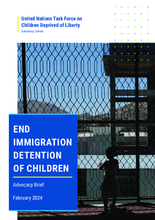
This advocacy brief provides an overview of promising practices and lessons learned to end child immigration detention in the U.S. and sets out a range of policy actions needed to scale up efforts to end this form of violence.
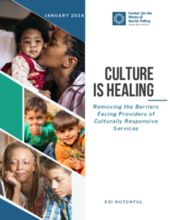
Ensuring child and family well-being requires a radically different, anti-racist response of supports that center the voices of diverse children and families of color, are dignified and strengths-based, and that are offered in spaces they trust. As this brief highlights, community-based organizations across the U.S. are striving to answer that call despite numerous barriers. This brief lifts up the voices of those community providers, with the goal of highlighting and addressing the barriers that stand in the way of all families having the support they need.
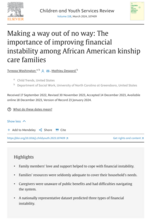
This study examined African American families who are providing informal kinship care in the U.S. with the aim of developing a nuanced understanding of the financial characteristics, challenges, and coping strategies of these families.
The authors explore approaches, challenges, solutions, and recommendations offered by child welfare workers in Canada on remote communication with children/youth regarding safety and on managing parent–child access during the COVID-19 pandemic.