Image
This page contains documents and other resources related to children's care in Asia. Browse resources by region, country, or category.
Displaying 31 - 40 of 2061
The UNICEF Caring for the Caregiver package is a counselling approach and behaviour change intervention that can be integrated into routine home-visiting by frontline workers, in a demand-responsive way, at a population level. This study aimed to evaluate caregiver outcomes and explore intervention experiences from the package in six low-income and middle-income countries.
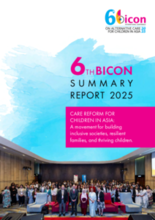
The 2025 BICON Conference Summary Report captures the outcomes of the 6th Biennial International Conference, held in Kuala Lumpur, Malaysia on 15–16 October 2025. It brings together key discussions, insights, and recommendations from across the conference, providing a clear direction for strengthening care reform and advancing inclusive, family-based systems for children.
This study explores the challenges faced by young people with disabilities in Japan after leaving residential care, finding they often struggle with adapting to new environments, managing their health, and accessing consistent support. It highlights the need for more structured, long-term support systems to help them successfully transition to independent living.
The Vanam Vasapadum initiative evaluated an arts-based, trauma-informed social-emotional learning program for children in institutional care in Tamil Nadu, finding significant improvements in self-esteem and psychological well-being over three years. Both quantitative and qualitative results highlight that creative, holistic interventions can enhance emotional regulation, resilience, and social skills among vulnerable adolescents, suggesting strong potential for broader mental health promotion.
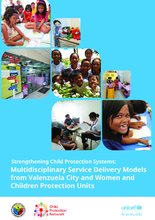
Developed to support efforts to strengthen the child protection system in the Philippines, this report documents two complementary approaches to delivering child protection services. Drawing on fieldwork, stakeholder consultations, and system analysis, the paper presents how local government-led Child Protection Centers and hospital-based Women and Children Protection Units provide integrated, child-focused, survivor-centered responses to violence against children.
This article from UNICEF describes how Turkmenistan has initiated the development of its first National Programme on Child Protection and Justice for Children, marking a significant step toward strengthening its systems to safeguard children’s rights and well-being. The article highlights how the programme aims to establish a more coordinated and comprehensive framework for preventing violence, improving access to justice, and ensuring child-friendly services across sectors such as social welfare, education, and law enforcement.
This phenomenological study explores the lived experiences of five houseparents in a residential care facility in Bukidnon, Philippines, highlighting their critical role in providing emotional support and stability while navigating significant emotional labor and institutional challenges. The findings reveal themes of adaptation, caregiving rewards, coping strategies, and personal transformation, underscoring the need for stronger institutional support, training, and culturally responsive interventions to improve both caregiver well-being and quality of care for children.
This article examines how, years after the Covid-19 crisis, many children in India who lost one or both parents continue to struggle due to gaps in government support systems.
This article examines South Korea’s decades-long international adoption system as a major human rights scandal, arguing that the country’s past role as a leading “baby exporter” was driven by state policy rather than purely humanitarian motives. It explains how, from the post-Korean War era onward, the government promoted overseas adoption as a cost-saving alternative to building domestic social welfare systems, enabling widespread abuses such as falsified records, coerced or fabricated parental consent, and the misclassification of children as orphans.
This study finds that young people in China experience leaving state care as a gradual, emotionally and materially complex transition shaped by readiness, relationships, and access to housing and income, while staff tend to frame it as a fixed administrative cutoff with limited follow-up support. It highlights systemic gaps—such as fragmented responsibilities, hukou-related transitions, and abrupt loss of support—and calls for more gradual, coordinated, and well-supported pathways to independence.