
Image

Displaying 241 - 250 of 1115
The purpose of this study was to establish the prevalence of adverse childhood experiences (ACEs) in child residential care and to explore predictors of accumulation and clustering patterns.
UN human rights experts today expressed concern about the situation of children with disabilities in Ukraine placed in institutions and being displaced to other institutional settings either within Ukraine or further afield.
Disabled children are being abused and neglected in institutions across Ukraine, UN experts have warned. The human rights officials said the war had made their situation even worse and called on the Ukrainian government to right its "historic wrongs".
Fourteen-year-old Serhii Sorokopud is still haunted by what happened when Russian tanks rolled into his village five months ago. He lifts his T-shirt to show the deep scars across his back -- a reminder of a trauma both hidden and visible.
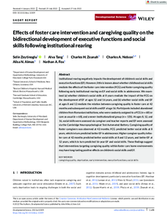
Institutional rearing negatively impacts the development of children's social skills and executive functions (EF). However, little is known about whether childhood social skills mediate the effects of the foster care intervention (FCG) and foster caregiving quality following early institutional rearing on EF and social skills in adolescence. Participants included abandoned children from Romanian institutions
Luiza Baloh left her home in Dnipro, central Ukraine, in March. Fleeing the constant sound of explosions, she and her five children came to the Czech Republic hoping to find refuge. Instead, they found themselves behind a barbed wire fence in a repurposed immigration detention center that was, she says, dirty and full of strangers, some of whom were aggressive towards her and her children.
Coverage of the conflict in Ukraine has been a stark reminder of the pace and extent to which war turns lives upside down. The terrifying experience of conflict sees people turning to loved ones and places that are familiar and comforting. Children are no different. And yet, even before the war in Ukraine started on 24 February, for over 100,000 Ukrainian children the familiar wasn’t a family environment, but an institution.
In July, Russian mortars rained down on a psychiatric home in northern Ukraine, while dozens of elderly and disabled residents were sleeping.
Flames soon swept through the facility’s dining room, and its dormitory and administration buildings were wrecked. Miraculously, only three people were injured. But it marks the latest in a series of deadly attacks in which some of Ukraine’s most vulnerable have been caught up in a savage conflict far beyond their control.
There was nothing obviously untoward about the woman who approached the Palanca border crossing between Ukraine and Moldova with a 15-year-old boy she said was her nephew. But something about the pair just seemed odd. The boy, in particular, appeared embarrassed and uncomfortable.
There was nothing obviously untoward about the woman who approached the Palanca border crossing between Ukraine and Moldova with a 15-year-old boy she said was her nephew. But something about the pair just seemed odd. The boy, in particular, appeared embarrassed and uncomfortable.