
Image

Displaying 1591 - 1600 of 1660
A report on orphans and vulnerable children in Malawi. It examines how orphanhood increases vulnerability though decreased access to formal schooling and increased exposure to child labor. Includes detailed statistical tables.
This paper outlines a program (SIMBA) established to work with local AIDS Service Organizations (ASOs) in Zimbabwe to promote economic development in HIV/AIDS affected communities. Efforts to promote capacitiy building of organizations, self-managed and savings-based microfinance services, and basic business management training are described.
A review of interventions for orphaned and vulnerable children that focuses on community-supported, home-based care examples. Highlights several models and programs, such as the COPE approach and Village AIDS Committees. Advocates the need for more research-based interventions and evaluation.
An informal evaluation of an NGO residential institution in Zimbabwe, based on the opinions of the child residents. Includes recommendations for the improvement of residential care.
The NSPPI provides overall guidance to implementers to mitigate the impact of orphan hood and other vulnerabilities among children in Uganda.
This document is the official policy governing National Orphans and OVC of the Ministry of Gender, Labour and Social Development (MGLSD) of the Republic of Uganda. The policy interprets a vision of a society where all orphans and other vulnerable children live to their full potential, where their rights and aspirations are fulfilled.
Research on the incidence, living arrangements, and causes of lower school enrollment of orphans in Sub-Saharan Africa.
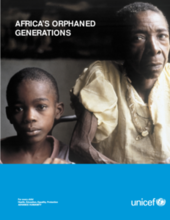
This paper reports on the life circumstances of today’s orphaned children in Africa with new data and fresh analyses. The report presents a strategy for ensuring that all of Africa’s orphaned children have a safe, healthy and well-educated childhood, establishing the foundation for a productive adult life and for their countries’ overall development. Therefore, this paper encourages hope in the face of an epic disaster as it offers the possibility of change for those already orphaned and for the generation to come.
This paper hopes to contribute to a sorely under-documented field of how to reintegrate institutionalized children back into the community in a post-conflict environment. It provides a brief description of IRC Rwanda’s Reunification and Reintegration Program for Unaccompanied Children, emphasizing its innovative nature and promising field methodologies. It includes a review of core principles and a programmatic overview of center and community-based work, outlining key steps in the process. It also provides a brief review of good practices and offer some points of reflection for future work with children in post-conflict situations.
This paper hopes to contribute to a sorely under-documented field of how to reintegrate institutionalized children back into the community in a post-conflict environment.
