
Image
Displaying 851 - 860 of 1146
This study sought to identify factors that contribute to the relational well-being of youth in substitute care.
Following up on a 2014 report of the same name, this report (Race for Results) describes the disproportionate barriers facing children of immigrant families in the US, and it recommends strategies that policy, community and civic leaders can use to guide their decisions so that all our children have a fair chance to thrive.

This study employed Concept Mapping (CM) with a convenience sample of 51 foster youth/alumni in one southeastern state in the US to explicate a conceptual framework for the development of campus supports for collegiate foster youth/alumni, and examine priority areas (e.g., importance and feasibility).
This study investigated social capital, risk factors, and protective factors associated with the likelihood that youth in foster care will enroll in college.
This study contributes to the literature by examining risk and protective factors of chronic neglect.
The authors of this article performed a multiple case study to gather information about barriers and facilitators in building a working alliance between social workers and families.
The authors used a mixed-methods, cross-sectional design, focused on qualitative results to explore how foster parents in the US utilize daily routines in foster care.
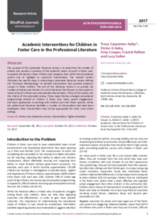
The purpose of this systematic literature review is to determine the number of articles and provide a summary of the academic needs of youth in foster care, to explore the barriers those children and caregivers face within the educational system and to highlight to successful interventions.
This article examines whether and how felt caregiver burden influences the reported propensity of caregivers to want to adopt the children in their care.
This study investigated whether mothers experience changes to their health and social situation after having a child taken into care by child protection services, then compared these outcomes with those found in mothers whose children were not taken into care.