Image
This page contains documents and other resources related to children's care in Asia. Browse resources by region, country, or category.
Displaying 111 - 120 of 2061
This study examined the link between child neglect and family protective factors among 936 parents in Hatay, Türkiye, a region marked by migration, cultural diversity, and economic hardship. Results showed that stronger family protective factors were associated with less neglectful behavior, emphasizing the need for family-centered prevention efforts in disadvantaged, multicultural contexts.
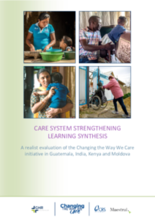
This report presents findings from an evaluation by Changing the Way We Care (CTWWC) that used a realist approach to examine how care reform progressed in Guatemala, India, Kenya, and Moldova across five key system components. It identifies advocacy, government ownership, collaboration, and capacity-building as major drivers of change and offers recommendations for governments and partners to embed family care in national systems, strengthen coordination and workforce capacity, and sustain reforms through evidence, shared learning, and long-term commitment.
This review examined 39 studies on parenting interventions for Southeast Asian families in low- and middle-income countries and diaspora communities, identifying 31 distinct programs that generally improved parenting practices and child behavior. Findings support the effectiveness of these interventions while emphasizing the need for more rigorous research, clearer documentation of adaptations, and stronger evaluation methods to maximize public health impact.
The 6th BICON Conference on Alternative Care for Children in Asia will be held on 15 and 16 October 2025 in Kuala Lumpur, Malaysia. Since 2014, BICON has been a significant event focusing on the rights of children and young people without par
This paper outlines the development of a community-led child protection approach (Seeds), created through a multi-stage process involving a systematic literature review, formative research in Uganda and Lebanon, a field test in Sri Lanka, a feasibility study in Colombia, and expert review, resulting in a six-phase model designed to strengthen children’s protection and their sense of safety.
This news article discusses how high-level representatives – including ministers, senior decision-makers, professionals, and children – from across the European Union and the wider Europe and Central Asia region met on October 13, 2025 in Buchares
This study explores the experiences of nine young Thai adults who grew up in a Christian orphanage supported by foreign volunteer tourists, highlighting the impact of these visits on the children. Findings reveal that while orphanages often used children to attract financial support, most volunteers provided fleeting attention, leaving children disappointed and vulnerable, emphasizing the need for orphanage models that prioritize the children’s needs over tourist interests.
This Wall Street Journal article recounts the unraveling of Sovann Komar (“Golden Children”), a Cambodian orphanage founded in 2003 by Elizabeth Ross Johnson, heir to the Johnson & Johnson fortune, and her local collaborator Sothea Arun.
Changing the Way We Care (CTWWC) is a global initiative which promotes safe, nurturing family care for children.
This article analyzes the gap between Pakistan’s progressive child protection laws and the harsh realities faced by the country’s 1.5 million destitute and neglected children, highlighting how weak implementation, custodial care models, and social stigma undermine their rights and well-being. It argues that meaningful rehabilitation requires shifting from welfare-based responses to empowerment-focused, holistic support systems that integrate legal protection, trauma-informed care, and market-relevant education.