Image

Displaying 181 - 190 of 863
This briefing is the fifth in a series of evidence summaries on the impact of COVID-19 on the wellbeing of children and families in Scotland, drawing on wider UK and international research where appropriate.
This paper explores the research from a collaborative between Tusla, the Child and Family Agency and University College Cork (UCC) that had an overarching aim to reduce fostering instability, in relation to its contribution to supporting fostering stability.
This study consists of interviews with 22 children’s spokespersons in Norway. Study findings question whether children in care proceedings understand the invitation to voice their wishes as confined to matters relating to the proceedings.
This report sets out the findings from the most comprehensive study of attitudes towards bringing up children from conception to 5 years ever undertaken in the United Kingdom.

Informed by developmental perspectives that consider young people's development through participation across contexts in everyday life and by research into how parents in ‘ordinary’ families organize care, the authors of this article developed a study based on interviews with 15 unaccompanied refugee minors and their professional caregivers at residential care institutions.
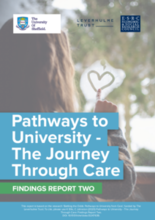
The authors of this study conducted research with 234 care experienced university students in England and Wales to explore their experiences of the journey through care.
The purpose of this study was to assess trends in inequalities in Children Looked After (CLA) in England between 2004 and 2019, after controlling for unemployment, a marker of recession and risk factor for child maltreatment.
This article presents data from the first large-scale study of fathers involved in repeat (or recurrent) care proceedings in England. The study consisted of three elements: an analysis of population-level administrative data from the Child and Family Court Advisory and Support Service (CAFCASS), a survey of fathers in pre-proceedings and care proceedings, and a qualitative longitudinal (QL) study of recurrent fathers.
This report reflects on the effects of the coronavirus pandemic on children. It compiles information gathered from 25 countries across Europe, and provides recommendations for improving public policies in the short and long-term to support better outcomes for children and families, including children in alternative care or at risk of separation.
This article examines the case for greater recognition of the children’s workforce in out-of-home care (OHC), and situates the concept of ‘expertise’ in the rise of recognition of children’s status as competent social actors, as well as in professionalisation debates.