Image
This page contains documents and other resources related to children's care in Europe. Browse resources by region, country, or category.
Displaying 11 - 20 of 483
This report from the Coram Institute for Children marks the 50th anniversary of Coram Voice and highlights the Bright Spots programme, which captures the perspectives of children and young people in care and care leavers to inform local and national policy. Drawing on 27,000 responses collected between 2015 and 2024, the study focuses on what matters most to children and young people in their lives, emphasizing their voices rather than care system outcomes or reasons for entering care.
War negatively affects adults’ mental and physical health, which in turn impacts their parenting, exposing children to both direct and indirect stressors. This book examines these consequences, using evidence-based research and case studies from the Russian-Ukrainian war to highlight the importance of attachment, trauma-informed support, and interventions for families during and after conflict.
Governments across Europe and Central Asia have advanced child care reforms, yet many children—especially those with disabilities or from marginalized communities—still face risks of separation without strong statutory family support systems in place. This White Paper outlines the essential policies, services, workforce standards, and rights-based approaches countries need to prevent unnecessary separation, strengthen families, and ensure every child can grow up safely in a supportive family environment.
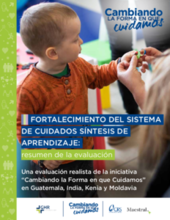
Cambiar la Forma en que Cuidamos (CTWWC, por sus siglas en inglés) es una iniciativa global que promueve un cuidado familiar seguro y afectuoso para los niños.
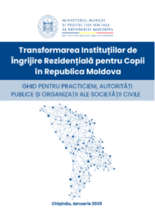
The Moldova Transformation Guidance aims to support the transformation process of residential care facilities (RCF) to models that promote family support and community-based services, or to safely close them and redirect their resources. National and local authorities can use this guidance to design, plan, budget, communicate, and coordinate transformation at both individual and system levels.
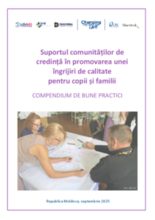
The publication summarizes lessons and good practices from the Community Engagement for Better Care pilot project implemented in four communities by Diaconia of the Bessarabian Orthodox Church in Moldova in 2024-2025. The project explored how faith communities - especially the Orthodox Church - can support children and families in need.
This study examines how children in Swiss residential care perceive safety, revealing that while institutions aim to protect them, many still experience both safety and unsafety shaped by physical spaces, institutional rules, and relationships with staff. By centering children’s voices, the article highlights gaps between residential care’s protective mandate and children’s lived experiences, calling for a more nuanced, justice-oriented understanding of safety in child welfare.

The Family Network Pilot (FNP) aims to help UK children stay safely within their extended families and prevent entry into care by providing Family Group Conferences and Family Network Support Packages. This report evaluates the pilot’s implementation, processes, and impacts across seven local authorities, using qualitative research and monitoring data analysis.

Changing the Way We Care’s “Care System Strengthening Learning Synthesis: Evaluation Summary” distills lessons from care reform efforts in four countries, examining how change happened across laws, workforce, financing, monitoring, and services. It finds that evidence-based advocacy, strong government ownership, collaboration, and capacity-building were central to driving and sustaining reform across diverse contexts.