
File
Displaying 11 - 20 of 4505
The 19th Session of the Conference of States Parties to the Convention on the Rights of Persons with Disabilities (COSP) will be held at the United Nations Headquarters, New York
Available information on the numbers and conditions of people excluded from society in closed institutions is often wrong or missing. For this reason, Disability Rights International is launching a global survey to collect better information.
This report is an overview of Childlight’s Into the Light Index on Global Technology-Facilitated Child Sexual Exploitation and Abuse 2026 Data Update. The update focuses on new emerging data as well as updating existing global and regional prevalence and scale data on Technology-Facilitated Child Sexual Exploitation and Abuse.
The Second Global Ministerial Conference to End Violence Against Children will be hosted by the Government of the Philippines, in partnership with WHO and UNICEF, in November 2026.
Family-oriented policies can accelerate social progress with family and child benefit policies stabilizing households when most vulnerable. This year's observance of the International Day of Families commemoration at the UN aims to demonstrate that engagement at international level is essential to elevate early family investment as a core social development priority.
Families, inequality, and child well-being are deeply connected. This report, commissioned by UN DESA for the International Day of Families, examines how global and regional patterns of inequality shape family formation, early childhood and child outcomes in the context of the 2030 Agenda. It analyses trends in income inequality, poverty, fertility, under-five mortality, education and broader family well-being, showing how disadvantage can be transmitted across generations when families are not adequately supported.
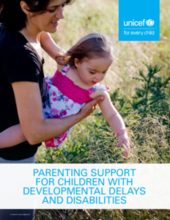
This technical brief highlights parenting support strategies and interventions that can benefit parents and help them create better spaces for children with developmental delays and disabilities to thrive. The brief includes data on children with developmental delays and disabilities and features country examples from around the world.
With an estimated 37-42 million children on the move globally, this publication underscores the urgent need to place children’s rights at the center of migration governance. Drawing on promising practices from countries including Thailand, Jordan, Mexico and Uganda, the report highlights practical, rights-based solutions that address children’s specific vulnerabilities while promoting their protection, development and inclusion.

This narrative review analyzes 161 recent studies across 67 countries on the shift from institutional to family-based care, finding that while most research supports de-institutionalization, it is often limited by small samples, qualitative methods, and weak study designs. It highlights significant evidence gaps and calls for more rigorous, transparent, and replicable research to better inform policy and practice.
The Alliance for Child Protection in Humanitarian Action, Better Care Network, Early Childhood Development Action Network, INSPIRE Implementation Working Group, Moving Minds Alliance and Georgetown University’s Collaborative on Global Children’s Issues are co-convening a webinar for child protection, care, and development stakeholders to share and discuss recommendations to address the impact of U.S. foreign aid cuts on children and their families and sustain progress in the changing landscape.