Image
Displaying 1 - 10 of 431
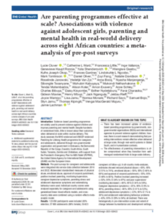
This large-scale study across eight African countries finds that the Parenting for Lifelong Health programme is associated with significant reductions in physical and emotional abuse, improved parenting practices, and better mental health outcomes for both caregivers and adolescents. It demonstrates that evidence-based parenting interventions can be effectively delivered at scale—even in humanitarian contexts—while maintaining strong positive impacts.
This webinar, co-hosted by the Transforming Children's Care collaborative and Hope and Homes for Children, dove into the ground-level realities of system strengthening across three diverse national contexts: South Africa, Rwanda, and Bulgaria. Country experts shared the critical bottlenecks they encountered, the strategies that worked, the course corrections required, and the evidence of impact for children and families.
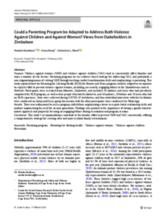
This study explored adapting the Parenting for Lifelong Health (PLH) program in Zimbabwe to explicitly address both violence against children and violence against women by incorporating gender-transformative approaches and actively engaging fathers. Findings showed strong interest in the program, highlighting the need for relationship skill-building, economic support, and intentional father involvement to create safer, more resilient family environments.
This paper introduces an Advocacy Reach Calculator developed by ChildFund International to estimate how many children and families benefit from child protection policy changes. It outlines the tool’s development and pilot testing in four countries, showing how it can support better monitoring, planning, and advocacy efforts.
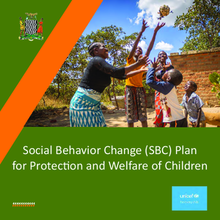
This Social and Behaviour Change (SBC) Plan outlines Zambia’s strategic approach to strengthening child protection through behaviourally informed programming and community engagement. Developed by the Ministry of Community Development and Social Services with support from UNICEF and partners, the plan focuses on reducing violence against children, preventing child marriage, increasing birth registration, and promoting family-based care.
This report presents findings from the SEEDs community-led child protection pilot implemented in Manica Province, Mozambique (2023–2024). The approach aimed to strengthen community ownership, enhance local capacity, and generate evidence for scalable child protection programming.
This video highlights the rise of a locally led movement in Ethiopia, where Christian leaders and organizations are transforming child welfare practices following the end of intercountry adoption. It showcases the impact of the CAFO-supported DEBO Alliance as churches and advocates embrace domestic adoption and best practices to bring hope and lasting care to vulnerable children and families.
This evaluation of Save the Children Finland’s Child-Sensitive Social Protection (CSSP) programme (2022–2025) found that it improved access to social protection, strengthened government systems, and supported better parenting practices across six countries in Africa and Asia. The programme showed strong results—especially through its parenting component, which improved caregiver engagement and child development outcomes—while highlighting the need for greater government ownership to sustain long-term impact.
A strong social service workforce (SSW) is the backbone of effective child protection systems. Across Eastern and Southern Africa, social service workers play a critical role in preventing and responding to violence, abuse, neglect, and exploitation of children. Yet, the workforce remains underfunded and understaffed, limiting its ability to deliver essential services. To address this gap, UNICEF Eastern and Southern Africa Regional Office (ESARO) has developed this Synthesis Report , providing a detailed guide to developing an investment case, drawing on lessons from Kenya and Zambia.
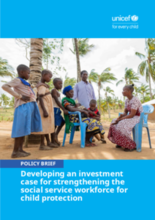
A strong social service workforce (SSW) is the backbone of effective child protection systems. Across Eastern and Southern Africa, social service workers play a critical role in preventing and responding to violence, abuse, neglect, and exploitation of children. Yet, the workforce remains underfunded and understaffed, limiting its ability to deliver essential services. To address this gap, UNICEF Eastern and Southern Africa Regional Office (ESARO) has developed this Policy Brief summarizing the rationale and approach for building an investment case for strengthening the SSW.