Image
Displaying 171 - 180 of 431
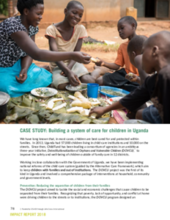
This case study from ChildFund's 2018 Impact Report describes the Deinstitutionalization of Orphans and Vulnerable Children (DOVCU) initiative in Uganda, which aims to to improve the safety and well-being of children outside of family care.
Catalyzing Business Skills is a suite of three financial literacy and business skills curricula developed by Making Cents International and Child Fund's Economic Strengthening to Keep and Reintegrate Children into Families (ESFAM) project in Uganda.
These Standard Operating Procedures (SOPs) have been developed based on current, evidence-based practices to facilitate joint action by all health actors to effectively respond to child sexual violence in Kenya.

Reframing Early Childhood Development and Learning is a communications toolkit for building public support in Kenya for better child development policies and programmes.
This learning brief analyzes quantitative data from the second of the “Deinstitutionalization of Orphans and Vulnerable Children in Uganda” (DOVCU) project’s stated objectives: examining the extent to which DOVCU project interventions decrease vulnerabilities for reintegrating children and their families.
This learning brief analyzes quantitative data from the first of the project’s stated objectives: examining the extent to which “Deinstitutionalization of Orphans and Vulnerable Children in Uganda” (DOVCU) project interventions decrease vulnerabilities for households and children at risk of separation.
This learning brief analyzes quantitative data from both households at risk of separation and reintegrating households to understand how the “Deinstitutionalization of Orphans and Vulnerable Children Project in Uganda” (DOVCU) package of integrated social and economic interventions affects children and households differently depending on the sex of the child, caregiver, and/or household head.
This report presents the preliminary findings from an ongoing project undertaken by 4Children that seeks to identify key opportunities to incorporate violence prevention and response interventions within priority PEPFAR Program Areas at clinical and community levels.
This paper reports on findings from an evaluation study of two institutions providing transition programmes to adolescent girls transitioning from institutional care in Zimbabwe.

This study sought to examine the feasibility of rejuvenating and strategically repositioning the Zunde raMambo (King’s granary) as a traditional orphans and vulnerable children (OVC) coping mechanism in Zimbabwe with a special reference to Gutu District.