Image
This page contains documents and other resources related to children's care in Africa. Browse resources by region, country, or category. Resources related particularly to North Africa can also be found on the Middle East and North Africa page.
Displaying 71 - 80 of 2616
At the close of the Changing the Way We Care (CTWWC) The Changing the Way We Care (CTWWC) initiative launched in 2018 with the aim to reform child care systems by promoting safe, nurturing family-based care over institutional ca
Alarmingly high numbers of Ugandan children experience or are at risk of experiencing abuse and neglect. This article analyzes the state of priority for and quality of governance of Uganda’s formal system for the care of orphans and vulnerable children (OVC).
This study assessed the mental health of children in 12 Nigerian residential institutions and found that many had abnormal scores on the Strengths and Difficulties Questionnaire, with risks linked to orphan status, type of institution, and length of stay. The findings highlight the urgent need for routine mental health assessments and better care for children in residential settings.
The Kafaalah Community Engagement Facilitator's Flipbook is a practical guide designed to support trained facilitators—such as Children Officers, Imams, Ustadh, Ustadhas, and other Muslim community leaders—in delivering community sessions on the Kafaalah. It offers structured guidance for engaging male caregivers, female caregivers, and children through interactive sessions.
The Kafaalah Facilitator’s Guide is part of a training package to strengthen understanding and implementation of Kafaalah, a family-based alternative care option for children in Kenya. Developed by the Government of Kenya with support from Changing the Way We Care, it provides structured session plans, tools, and activities to help child protection professionals and community members effectively promote and practice Kafaalah.
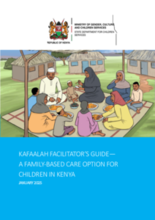
This package of materials on Kafaalah - was developed by the Government of Kenya in collaboration with Changing the Way We Care, UNICEF, and other key development partners and civil society actors.
The report is a meta-evaluation of Save the Children Finland’s Global Child Protection programme, implemented from 2022 to 2025 in four countries in Africa – Burkina Faso, Côte d´Ivoire, Somaliland and Zambia – spanning development, humanitarian and peace-building contexts.
This review explores South Africa’s foster care grant system, highlighting how rising numbers of children in foster care have strained social workers and overwhelmed the system. It examines challenges such as lapsing foster care orders, dependency concerns, and unsustainable practices, while offering recommendations to strengthen the system and better support children and families.
L’Observation générale n°10 de l’ACERWC fournit des orientations faisant autorité sur la mise en œuvre de l’article 25 de la Charte africaine, en clarifiant les obligations des États de protéger et de soutenir les enfants privés de soins parentaux grâce à la prévention, au renforcement des familles, à des solutions de prise en charge alternatives de qualité et à une réforme globale des systèmes de prise en charge. Elle appelle à une transition de la prise en charge institutionnelle vers des approches familiales et communautaires, à de meilleures données et à un renforcement de la supervision, ainsi qu’à une action coordonnée des gouvernements et de leurs partenaires afin de garantir que chaque enfant grandisse dans un environnement sûr et bienveillant.
The ACERWC General Comment No. 10 provides authoritative guidance on implementing Article 25 of the African Charter, clarifying States’ obligations to protect and support children without parental care through prevention, family strengthening, quality alternative care, and comprehensive care-system reform.