Image
This page contains documents and other resources related to children's care in Africa. Browse resources by region, country, or category. Resources related particularly to North Africa can also be found on the Middle East and North Africa page.
Displaying 61 - 70 of 597
In this webinar, UNICEF’s Lauren Rumble and Alessandra Guedes describe how violence in childhood is gendered, introduce the links between violence against women and children, and share effective gender-transformative strategies.
The authors of this study conducted a quasi-experimental feasibility trial in South Africa to adapt and evaluate an established year-long semi-structured, manualized video-feedback caregiver intervention (the Mediational Intervention for Sensitizing Caregivers; MISC) for community-based organizations (CBOs) to equip community-based careworkers with the skills to address the mental health needs of orphans and vulnerable children (OVC).
This report explores how gender-restrictive groups are using child protection rhetoric to manufacture moral panic and mobilize against human rights, and how this strengthens the illiberal politics currently undermining democracies.
In this video, Grace Mwangi discusses the specific support needs of mothers of pre-term babies or those with a congenital condition.
In this video on the Do’s and Don’ts of Care Leaver Engagement, Ruth Wacuka discusses what makes engagement meaningful for Care Leavers and what makes it tokenistic, and in the worst cases, exploitative.
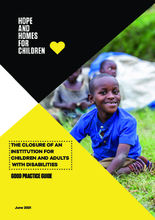
This document outlines 5 key steps that serve as an effective blueprint for a successful reintegration process of children and disabilities. These include ‘engagement’, ‘Assessment’, ‘Design & Development’, ‘Transition’, and ‘Monitoring & Evaluation’.
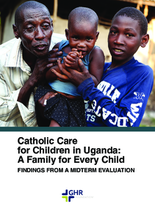
The goals of Catholic Care for Children in Uganda (CCCU) are to enable children to grow up in safe environments, reduce recourse to institutional care, and encourage family- and community-based care for children. This midterm evaluation examines what has been accomplished in the four years since the program began.
This paper draws on two case studies – South Africa and Kerala, India – to discuss the gender implications of social protection responses to Covid-19 in 2020.
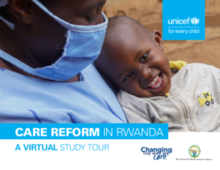
This virtual study tour aims to provide you with a strong understanding of care reform in Rwanda
from the comfort of your own home.
This participant’s handbook relates to Module 3 of the Government of Rwanda’s Tubarerere Mu Muryango (TMM) training programme. It is for Child Protection and Welfare Officers who work directly with children and families on reintegration of children, including children with disabilities from residential institutions.